Full article about Albufera’s secret springs & rust-red cliffs
Moorish lanes, hidden lagoon eyes and ochre-crayon bluffs between Albufeira and Olhos de Água
Hide article Read full article
Albufeira & Olhos de Água: Where the Sand Still Sneezes Freshwater
The first sound is never the Atlantic. It is the yellow-legged gull that patrols Rua Cândido dos Reis at rooftop height, its call ricocheting off the azulejo shopfronts like a thrown coin. Only after that metallic cry fades do you notice the lower register: surf sighing up the funnelled lanes of the Moorish quarter, a slow exhalation that climbs past the 18th-century parish church and arrives at the miradouro tasting of salt and espresso grounds. By nine the light is already liquid; it pools on white lime render and turns every balcony into a mirror of beaten gold. Somewhere below, between the yacht pontoon and Praia dos Pescadores, the morning’s catch—white seabream, gilthead, a last handful of sardines—is being iced in plastic crates. The air smells of scalded milk and low-tide iodine.
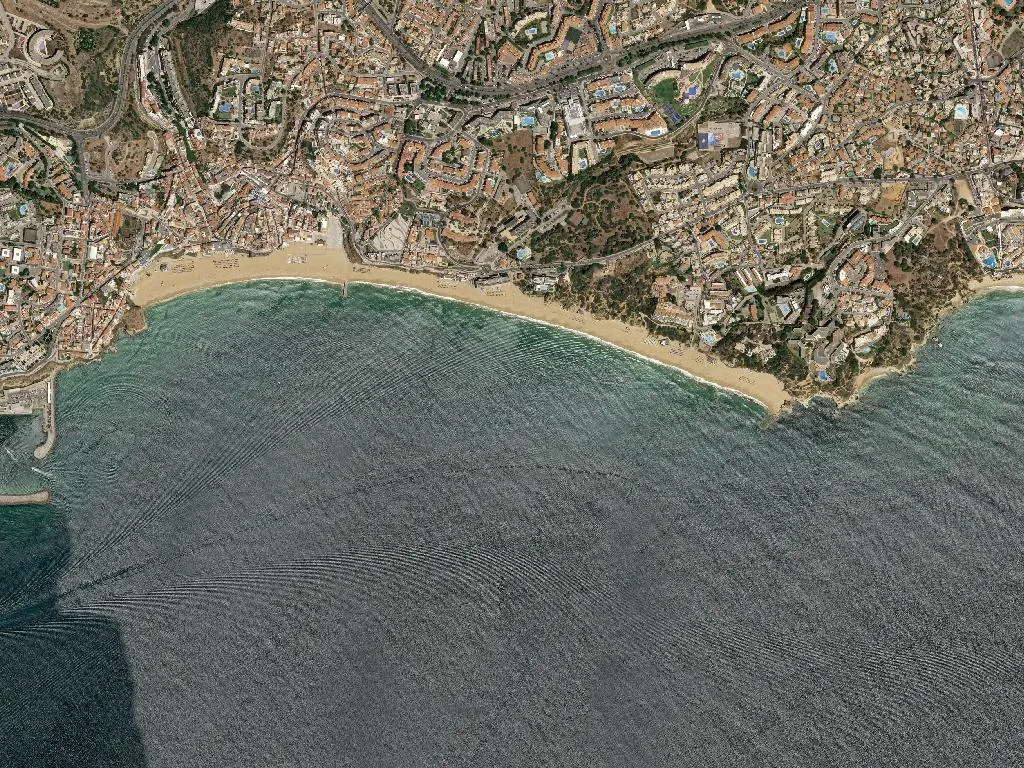
The name Al-Buħayra, “little sea”, survives only in municipal logos, yet the geography it describes is still legible if you know where to look. Where the marina’s floating pontoons now rock with gin-palace hulls, a coastal lagoon once diluted the incoming tide with freshwater springs. Romans beached their liburnians here; the water they baled out was brackish, almost drinkable. That mingling still dictates the town’s metabolism: salt water pushes in through the sandstone, meets a lens of fresh groundwater, and escapes again via hidden eyes in the sand.
Thirty kilometres of ochre and rust
The concelho stretches for roughly thirty kilometres and lists more than twenty beaches, each a slightly different mineral palette. At Praia da Falésia the cliff is a stack of oxidised pages: ochre, cadmium, hematite-red, veined with white calcite that looks like dried candlewax. Kayak east and the rock becomes more theatrical—natural arches at São Rafael drilled by centuries of grit in suspension, the sea thudding through them like a heart in an adjoining room. Olhos de Água itself is subtler. Wait for the ebb and tiny freshwater spouts rise between your toes, cold enough to make you glance down. Locals used them as drinking fountains within living memory; the circles they leave in the sand are the “eyes” that baptised the village. Boatmen at the marina will sell you a two-and-a-half-hour grotto tour for €20–25; if you prefer terra firma, the PR1 footpath climbs 150 m over five kilometres to the cliff-top “Three Castles” lookout—carry water, allow two hours.
A town that traded nets for neon
Dom Paio Peres Correia expelled the last Moorish garrison in 1249. For the next seven centuries Albufeira survived on tuna and shark, protected by the squat Forte de São João de Ferreira. Inside the rebuilt Matriz church the gilded baroque retable still glitters with sea-motifs—scallop-shells, anchors, a tiny caravel crowning the tabernacle. Yet the decisive siege arrived in 1965, the year the first package charter landed at Faro. Within a decade the fishing fleet had been replaced by flotillas of sunloungers; today 28,641 permanent residents co-exist with 45,000 summer beds and a foreign population larger than Lisbon’s. English is the unofficial second language, followed by German and Dutch. After midnight the decibel count on Avenida Sá Carneiro—nicknamed “The Strip”—rivals that of a small airport; entry is free, a pint of Super Bock €3.
Cataplana, Dom Rodrigo and the scent of almond
The municipal market opens at 7 a.m.: ice melts under scarlet arrays of European lobster, sea bass still twitching their opercula, sardine eyes bright as newly-minted coins. Order caldeirada in the old quarter and you will be brought a copper cauldron of layered potatoes, tomatoes and rockfish—€12–15 a head. A seafood cataplana for two costs €35–40 and arrives hissing like a punctured steam valve. For pudding, Dom Rodrigo—threads of egg-yolk and sugar—cost €1 at Ali Super on Rua 5 de Outubro; morgados, dense almond cakes, are €6 for a half-dozen. Finish with a thimble of medronho or almond liqueur (€2), the burn slow and maritime.
On 23–24 June the feast of São João sends processions down to Praia dos Pescadores with basil branches and bottles of bagaceira; bonfires are lit at dusk and boys leap the flames for luck. At Easter the Sobranha procession—Our Lady of Sovereignty—threads the streets in scented silence, candles cupped against the Atlantic wind.
The last eye
Walk eastwards at low tide and the beach empties beyond the last pastel-painted fishing hut. You feel it before you see it: a sudden coolness underfoot, a ribbon of freshwater sliding seaward, so transparent it is almost hallucination. Kneel and the current is cold enough to make your wrist ache—an underground river that has pushed through Jurassic sandstone simply to surface here, indifferent to sunscreen and selfie sticks. Behind you the sun drops behind the Falésia ramparts; the sky turns the colour of diluted Sauternes, suspended dust from the Sahara refracted through Atlantic moisture. The eye keeps pulsing, a quiet metronome marking time long before travel hashtags, before phosphorescent wristbands, before the first Moorish lookout lit a beacon on this coast.