Full article about Ferreiras: Albufeira’s quiet citrus-scented hinterland
Limestone fields, Valencia-late orchards and slow village life seven kilometres inland
Hide article Read full article
The scent of warm iron-rich earth lifts off the fields at dawn. At barely 80 m above sea-level the Atlantic breeze has already shed its salt by the time it reaches the village, arriving instead with the resinous tug of rockrose and a faint citrus sweetness from back-garden trees. A sprinkler ticks somewhere behind whitewashed walls; a single dog barks, then thinks better of it. You are seven kilometres from the nearest beach, but the cadence is inland-Algarve: slow, soil-based, dictated by harvests not high-season.
Where the coast exhales
Spread over 22 km² of rolling limestone, Ferreiras occupies more territory than Albufeira’s entire coastline yet houses only 7,200 people. That gives it a density (325 residents per km²) low enough for neighbours to recognise one another but high enough for the main road to support a bakery that sells out before nine, a pharmacy that still compounds ointments, and a post office whose queue moves at conversational speed. Demography is almost perfectly symmetrical: 1,192 children under fourteen and 1,190 residents over sixty-five, proof that families move here for space rather than retirees for solitude.
The 3,330 dwellings are mostly single-storey, built between 1990 and 2010, the decade when Lisbon architects discovered barrel-tiled roofs and almond-coloured render. You will not find gated condo clusters or infinity-pool blocs; instead, low walls of local sandstone enclose jacarandas and the occasional VW Transporter with surfboards on the roof rack.
Oranges you can weigh in your palm
Ferreiras sits inside the Algarve Citrus PGI, a protected zone created in 1996 that blankets 1,800 ha of orchards. The soil—calcareous clay with a pH that hovers just above neutral—delivers 3,000 hours of sun a year and winter lows that rarely touch freezing. The result is a Valencia Late whose sugar-acid ratio exceeds 10.5, double that of supermarket fruit flown in from Seville or Morocco.
Walk the rows in February and branches bow so low you have to duck; the skins glow so vividly they seem back-lit. Snap one open and the juice runs over your wrist before you can raise it to your mouth. The Ferreiras Agricultural Co-op, housed in a low 1960s warehouse opposite the football ground, handles 25,000 tonnes a season, employing 150 locals from January to May to grade, wax and crate the crop for Harrods, Carrefour and a Stockholm-based subscription box that markets them as “sun capsules”.
Everyday monuments
There is no castle, no miradouro selfie deck, no gift shop. Ferreiras trades in the minor rituals of Portuguese daily life: the metallic rasp of a shutter lifting on a metal-work shop (eighteen still operate), the cardboard-citrus smell inside the morning market, the way men in flat caps greet one another with a half-nod that has not changed since their grandfathers worked the same corner.
The parish church, São José, is barely twenty-five years old—an octagonal concrete shell with a copper roof that turns turquoise in the rain. Its predecessor, São Lourenço, rebuilt after 1755, survives as a side-chapel whose gilded altarpiece now serves as backdrop to Thursday-night choir practice. Opposite, the 1952 market hall keeps 23 stalls: black-pork hock, cactus figs, eggs still freckled with feather down. The café inside opens at 05:45 so train drivers on the 06:03 to Lagos can down an espresso and a pastel de nata before the first whistle.
Where to stay (and why you might)
Albufeira’s hotel belt ends abruptly at the roundabout signed “Ferreiras 4 km”. Beyond it, the only accommodation is 43 locally-licensed guesthouses—most are three-bedroom villas whose owners moved to Lisbon and left the keys with a neighbour. Expect terracotta floors, mosquito-net canopies and kitchens equipped with citrus presses that have never seen a lemon. Swallows nest under the eaves from April to September; mornings begin with their chatter rather than the thud of bass from a pool-party sound system.
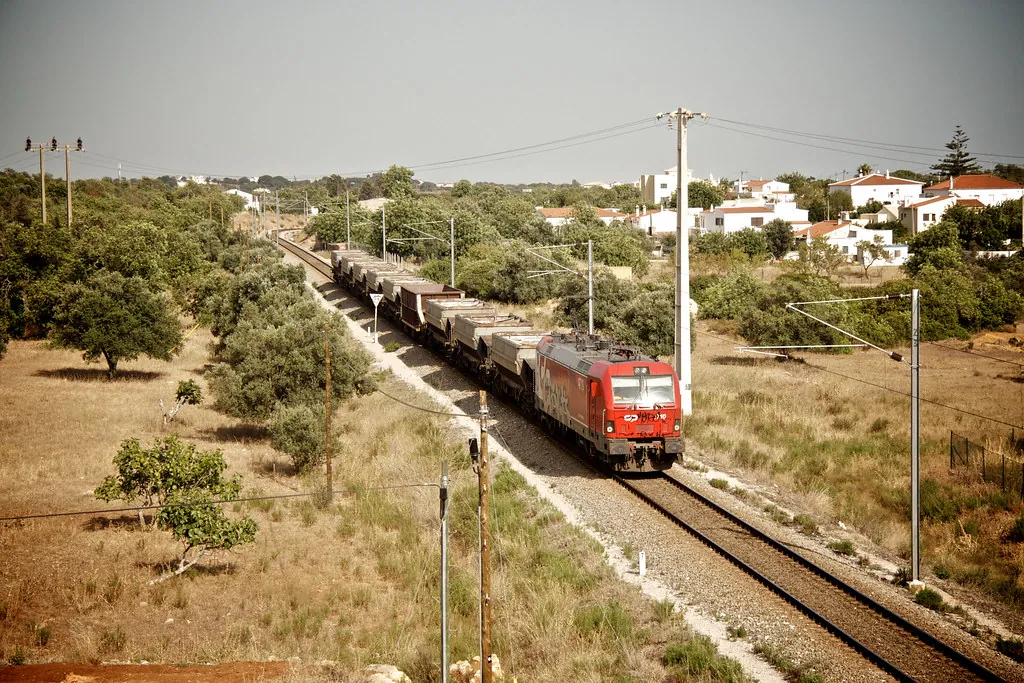
The railway station (Albufeira-Ferreiras, not “Albufeira” – the naming confusion has stranded more than one suitcase) is a five-minute taxi ride away. From there, regional trains reach Faro in 22 minutes and Lagos in 35; if you hire a car, the old road—once the steam-engine route—delivers you to Praia dos Pescadores in twelve minutes without a single roundabout.
The taste that lingers
Leave by the back lane behind the health centre and you will meet the village’s unofficial monument: a Valencia Late planted in 1958 in the yard of the community centre. Every March its petals carpet the ground like wind-blown confetti; by May marble-sized fruit blush into the colour that named a hemisphere. The co-op still sends a picker to harvest the 600 oranges it produces—proof that some things in the Algarve refuse to hurry.
Board the train with sticky fingers and the scent will accompany you all the way to Lisbon. No filter, no Instagram preset, can replicate the particular pigment of Ferreiras earth on a bright winter morning when the citrus is ripe and the coast feels like someone else’s rumour.