Full article about Paderne: citrus-scented Algarve hinterland
Morning mist lifts over orange groves, revealing Moorish castle walls and honey-stone cottages
Hide article Read full article
Morning light among the citrus
January sunlight slices through the orange groves at a low angle, throwing long shadows between the trunks. The air carries a citrus perfume that sharpens as the sun warms the peel — harvest time for the Algarve’s IGP-protected fruit. Paderne wakes slowly, unhurriedly, its population density of just 66 souls per square kilometre allowing fields to breathe between whitewashed houses.
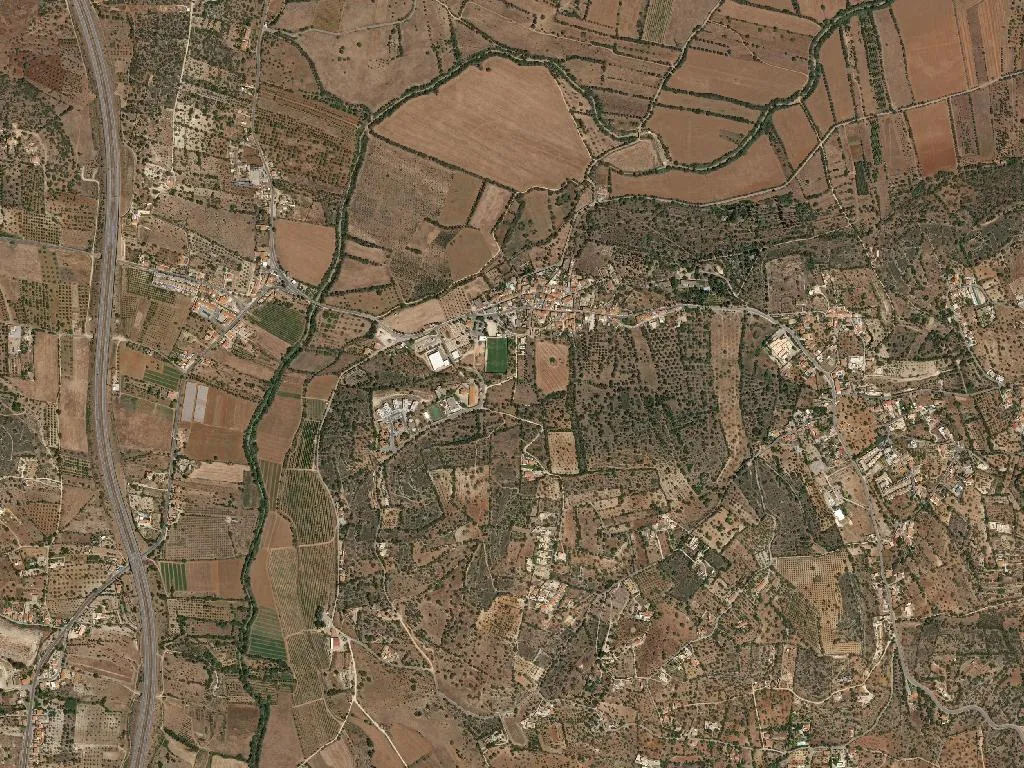
The parish spreads across 5,300 hectares at 72 metres above sea level, far enough inland to escape the coastal scrum that defines Albufeira’s shoreline. Here, the Algarve shows its other face: an agricultural interior where orchards punctuate the landscape and time is measured by growing seasons, not tides.
Stone that endures
Two monuments classified as Properties of Public Interest anchor local memory in limestone: the 18th-century Igreja de Paderne, rebuilt after the 1755 earthquake on medieval foundations, and the 12th-century Castelo de Paderne, a Moorish fortress that forms part of the Algarve’s chain of hilltop castles. The local stone, porous and pale, absorbs Mediterranean light in peculiar ways — at midday it appears to burn, at dusk it takes on the colour of aged honey. Thick walls keep interiors cool in summer and retain warmth in winter, a building logic that predates any energy-efficiency certification.
Walking through Paderne reveals a balanced demographic: 424 residents under fourteen, 920 over sixty-five. This is neither a village frozen in aspic nor a rootless new development. It's a place where grandmothers still walk grandchildren home from school, where 3,498 residents exist on a human scale that allows faces to be recognised, not merely counted.
Accommodation that dissolves into landscape
The 715 registered properties — apartments, houses, hostels, rooms — scatter without aggressive concentration. No resorts devour the horizon. Tourism here is diffused, almost domestic: a restored house, a rented room, a villa with a pool among the citrus. Visitors don't come seeking nightlife within stumbling distance of bed. They come for dawn chorus, eucalyptus wind, the dense silence that only the Algarve's interior offers.
The Algarve wine region has included these lands since 2010, when the EU recognised the Algarve Denominação de Origem. Vines coexist with orange, carob and almond trees. The cuisine, without Michelin stars or pretension, anchors itself to local produce: citrus appears in orange sponge cake, bergamot marmalade, seasoning, chilled infused water. Dishes follow what the land provides: lamb stew with wild herbs, asparagus migas, tomato açorda with poached egg.
The sound of inland
What lingers from Paderne isn't a specific monument or unforgettable dish. It's the texture of daily life: the wooden door of grocery shop "O Padrinho" creaking at noon, the smell of earth after autumn's first rain, the thick silence of August afternoons when even dogs seek shade. It's the contrast between the coast's frenzy — visible in the distance, audible only as distant murmur — and the slowness of fields where agricultural work still sets the rhythm. Here, light simply shifts angle across the orange groves, and somehow, that is enough.