Full article about Odeleite: Jade Water, Bone-Dry Schist
Bronze-Age shards, baroque church, dam-swallowed fields—Odeleite’s quiet drama.
Hide article Read full article
River-green and reservoir light
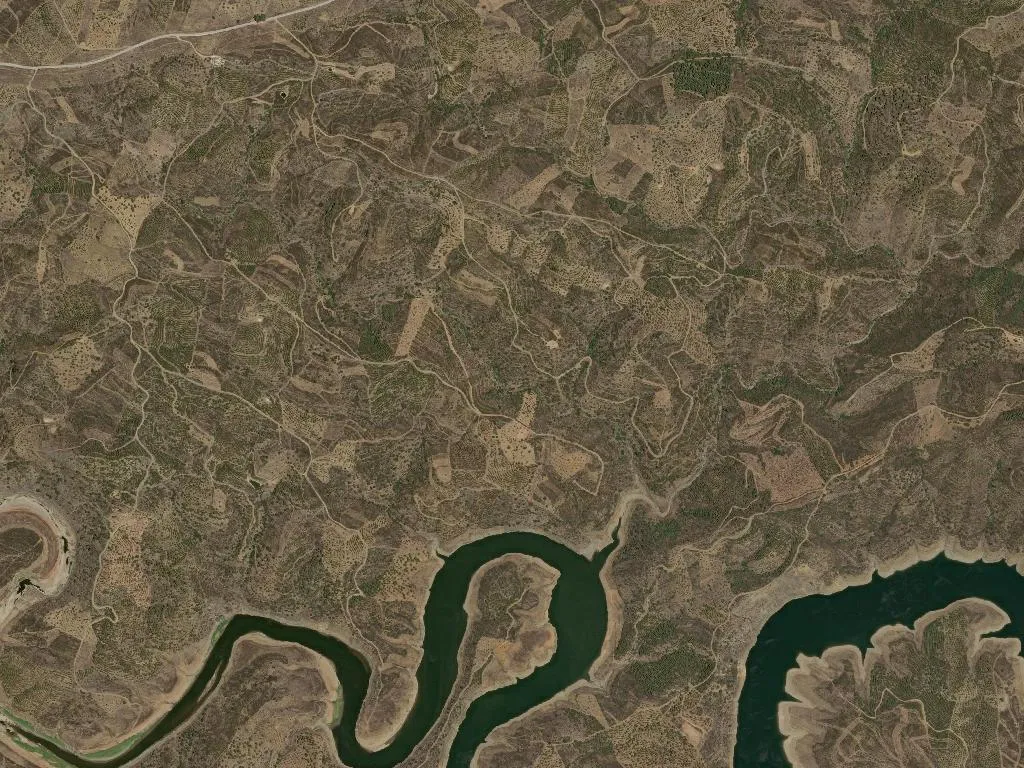
The Odeleite’s jade surface mirrors the late sky as a fishing boat noses against the concrete slip, spilling a slick of diesel that vanishes almost before you notice it. Beyond, the Caldeirão ridge cuts the same jagged line I memorised at seven, perched on the bench seat of my grandfather’s pickup. At 92 m above sea level, with 576 residents whose surnames are interchangeable, silence collects like dew; even the wind seems to ask permission before stirring. The contrast between the penned water and the bone-dry schist is what defines this place. The Arabic name Wādī al-Layṭ still holds: goats graze between orange groves that Uncle Zé irrigates by hand every dawn, hauling buckets from the well before the sun scalds the leaves.
From Bronze-Age shards to submerged lettuce
Pottery fragments I once hoarded in shoeboxes place human thumbs here since the Bronze Age, but the village took Christian shape in 1282 when Dinis parcelled land out to the Order of Santiago. The parish church rose three centuries later; Father Artur still celebrates Sunday mass for twenty-odd faithful beneath a gilded baroque altarpiece restored in 1998 with raffle money — I shifted the tickets door-to-door. Beside the church, the stone calvary doubles as a bench for sueca players who argue, between tricks, whether the drone they saw really resembled an old man’s head (no one here owns one; speculation is free).
Between 1984 and 1995 the dam swallowed my father’s lettuce plots. Rod-and-line subsistence became €30-an-hour kayak hire: strangers paddle across our loss. The reservoir feeds the whole eastern Algarve — Queen Sofia’s 1996 visit closed the roads for six hours — yet what matters to locals is the low light that ignites the water when the fishing hold comes up empty again.
Eels, lamprey and the taste of short wages
Cooking still follows the ledger of the land. My mother’s eel stew is scented with garden mint and yesterday’s stale bread; it appears only when the river yields, usually Fridays. From January to April, lamprey à la bordelaise lands on tables if Zé Manel’s wicker traps are lucky. Wild asparagus migas with streaky bacon is what’s left when the month outruns the wage. Grandmother’s pumpkin jam is spiced with Madeira cinnamon that once arrived in Uncle’s lorry; now a granddaughter posts it through CTT. Medronho firewater burns the throat the same way it scorched my father’s when they announced the cannery was shutting for good.
Trails between ridge and marsh
The PR1-Footpath starts where Manel sells petrol in five-litre water bottles. Five kilometres I used to run barefoot are now way-marked in acrylic for German hikers to photograph. The Algarviana Grande Rota threads yellow ribbons through the parish — my grandchildren collect them like Scouts badges. Southwards, the Castro Marim salt marsh blushes pink with flamingos that remind me of the rose-tinted stick-children I once scratched into sand. From Senhora da Saúde lookout the Guadiana unspools like dropped ribbon; beyond it, Spain grazes the almond terraces we still call ours.
On the first Sunday of August the Assumption procession retraces the route I crawled on knees when my daughter lay fevered. July’s Fishermen’s Fiesta serves smoked eel my youngest refuses; he prefers supermarket burgers. December brings the living nativity: today’s grandchildren wear wire wings my husband still stores among the roof beams.
When the last outboard cuts and the water settles, the dam’s low hum remains — the soundtrack since I was seventeen, losing my virginity behind the hunters’ club. My mother heard it before me; my granddaughters will hear it when I’m no longer here to tell them how the valley tasted before the water rose, when milk came straight from the goat, not a Tetrapak.