Full article about Montenegro: Faro’s Salt-Kissed Hamlet Beneath Black Hill
Ochre lanes, citrus groves and ria breezes circle a limestone rise where Moorish stones glint.
Hide article Read full article
Montenegro: Where the Black Hill Meets the Ria Light
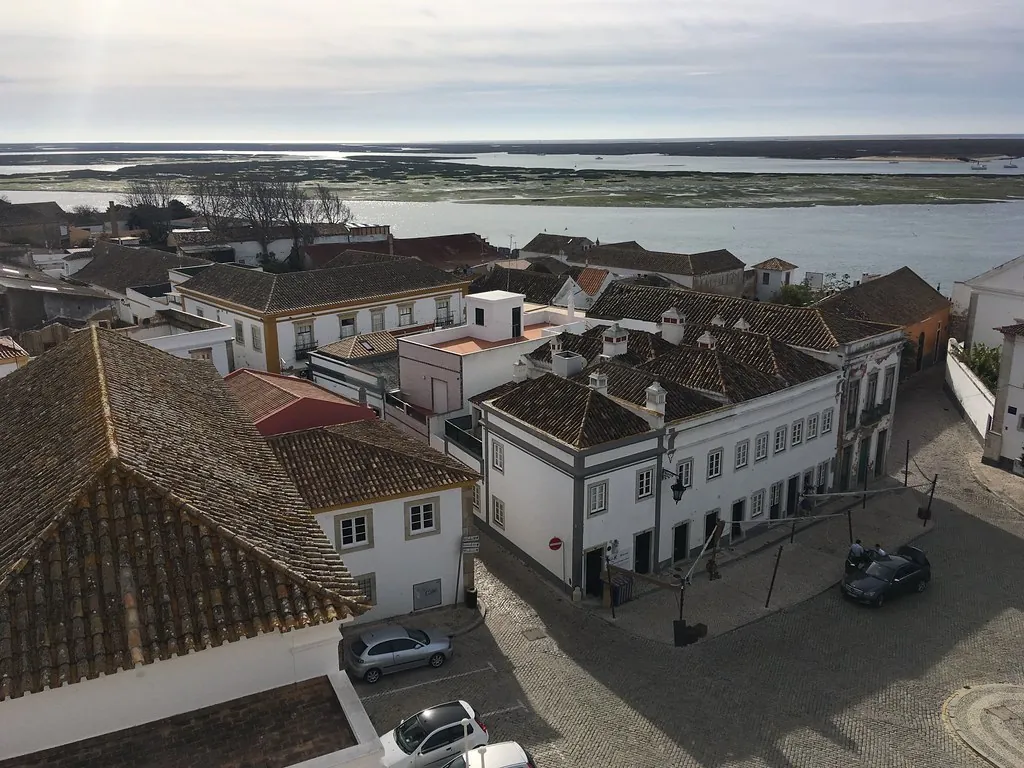
The scent arrives before the sight. Salt and warm mud, the dense perfume the Ria Formosa exhales when the tide peels back to expose the salt-marshes and the mid-morning sun begins to heat the dark silt between the salt pans. Five metres above sea level—barely the height of a cottage—Montenegro stretches across a flatness where the breeze never quite dies, where a filament of briny air threads through groves of orange and tangerine and settles on the skin like a second summer layer. We are minutes from Faro’s marina and office blocks, yet asphalt quickly surrenders to ochre lanes, rammed-earth walls, holm oaks that refuse to quit on a land that almost kisses the sea.
The Hill That Named—and Shaded—the Place
The name is a straight Latin inheritance: mons niger, black hill. Climb the Outeiro de São Miguel and you’ll see why. At 54 m—high enough to survey the coastal plain—the knuckle of limestone still carries closed-canopy Mediterranean scrub, centenarian holm oaks so thick that at noon the ground hardly sees daylight. The vegetal darkness that baptised the hamlet persists; under the boughs the air changes to something cool, resinous, laced with dried-leaf tannin. Look down and you’re stepping on fragments of other centuries: medieval grain silos chiselled into bedrock, Moorish dwelling walls emerging between roots, a snatch of Roman paving exposed by winter rains. Long before Faro existed, this bump was a way-station for south-bound travellers. The 1249 Christian reconquest turned the surrounding land into royal hunting grounds; dry-farming settlers followed, and for the next seven hundred years Montenegro was simply ploughed fields, wind, silence.
Lime, Carving and Cobalt at Half-Light
The parish church, Nossa Senhora do Pilar, built 1758, single-naved and whitewashed, is Montenegro’s cultural engine room. Push the heavy door and the thermometer drops ten degrees. Inside, the gilded baroque retable gleams a muted, almost ochre gold, flaring only when a side-window ray slices the nave. Eighteenth-century tin-glazed tiles—deep cobalt that time refuses to bleach—wrap the walls. Three kilometres away, the Chapel of São Luís keeps the modest proportions of country faith: thick lime-wash, a timber altar, every footstep amplified on the terracotta floor. The driving force behind both buildings was parish priest José Manuel Mendonça (1901-83), who not only commissioned the present church but wired the village for electricity, dragging his neighbours out of olive-lamp dimness.
Sweet Corn, Coriander and the Slow Fire of the Cataplana
Local cooking is Ria Formosa on an oil-clothed table. The cataplana snaps open with a metallic pop, releasing a cloud in which you can pick out razor-clams, small cuttlefish and clams, all swimming in olive oil and garlic. Signature dish, though, is xerém—coarse-ground cornmeal porridge, sunflower-yellow, studded with cockles that yawn open in the heat—served in deep bowls, seasoned with nothing but salt and the shellfish’s own iodine punch. Pudding arrives as Dom Rodrigo, threads of egg yolk and almond wrapped in silver paper like a miniature sculpture. On Saturday mornings the covered market fills with IGP-certified Algarve citrus—sweet orange, tangerine—stacked in slatted wooden crates; the first nick of a thumbnail releases oil that perfumes the entire hall.
Lagoon, Flamingos and a Bike Lane That Skims the Water
The Ria Formosa Natural Park starts where Montenegro ends—or perhaps the other way round. Temporary coastal lagoon Lagoa de São Lourenço floods each winter, turning into a flamingo canteen at dusk when low raking light copper-plates the water. Beside the seasonal São Miguel stream a four-kilometre cycle-track hums only with bike-creak and the stutter of wading birds. The five-kilometre Moinhos Trail links a restored nineteenth-century rammed-earth windmill to the agricultural showground, a walk that ferries you between two eras: the subsistence past and the trade-fair present.
A Campus among Holm Oaks
Montenegro holds a trump card no other Algarve parish can claim: an entire university campus inside its borders. Gambelas campus, floated by agronomist-rector Joaquim Pinto Correia in the 1980-90s, imported a critical mass of youth. Census figures now balance toddlers and pensioners almost one-to-one—an age equilibrium rare in inland Algarve. On Friday evenings the campus observatory opens to the public; in the botanical garden grow endemics that have vanished from the surrounding hills. On the Wednesday of Lent the hilltop lights up again for Noite dos Fachos (Torch Night): bonfires crackle on São Miguel’s summit in a re-enactment of medieval fire signals, turning the outcrop briefly back into the original black hill silhouetted against flame.
Where Orange Meets Salt
Maria da Graça Silva, founder of folk group “Os Montenegrinos” and custodian of the Algarve’s improvised singing duels, hosts living-room sessions where two voices spar line by line, no safety net. That tension—between spontaneous and rooted, between lecture hall and wayside chapel, between orchard sweetness and estuary brine—defines these two thousand hectares. At the end of the afternoon, when flamingos lift off the lagoon and the water blushes pink and ochre, a hush settles that feels almost tactile, smelling at once of orange blossom and sea-spray. It is the precise scent of Montenegro, unreproducible a mile away.