Full article about São Gonçalo de Lagos
São Gonçalo de Lagos mixes pre-dawn fish auctions, 16th-century walls and honey-gold sea arches you can kayak through.
Hide article Read full article
São Gonçalo de Lagos: where salt breathes through the whitewash
The first sound is not the sea – it is the plastic fish crates skidding across the quay, ice crackling over gilthead bream, a hoarse voice auctioning the dawn catch. Only afterwards does the Atlantic arrive: a briny draught that settles on the whitewashed façades and cools them before the sun re-ignites their glare. Lagos wakes at water level, among the nets and stainless-steel tables, then climbs slowly to the walled centre where the lanes are still scaled to a city that once launched caravels and crowned kings.
The town that stared down Cape Bojador
Inside the 16th-century walls of Santa Maria you walk the kernel of the original settlement. It was from the stepped quay below that Gil Eanes sailed in 1434 to round Cape Bojador, the psychological frontier of medieval Europe. His success punched a hole through the horizon and paid for the Manueline pillars inside Santa Maria church, rebuilt after the 1755 earthquake erased its predecessor. Step from the white glare of Rua da Barroca into the nave and the darkness is sudden enough to make pupils dilate like camera shutters; slowly the stone and lime reveal a palimpsest of collapse and restoration.
Outside the walls, the squat Igreja de São Sebastião was vowed to the saint during the plague of 1463. On the night of 5 January its porch still floods with candle-light for the Cantar dos Reis – a parish Epiphany vigil resurrected after the pandemic hiatus. Two hundred locals pack the nave while the Amigos do Chinicato, Rancho de Odiáxere and the First-of-May brass band trade seasonal villancicos under the vaults, and wedges of still-warm bolo-rei are passed hand to hand.
Cliffs that bleed ochre
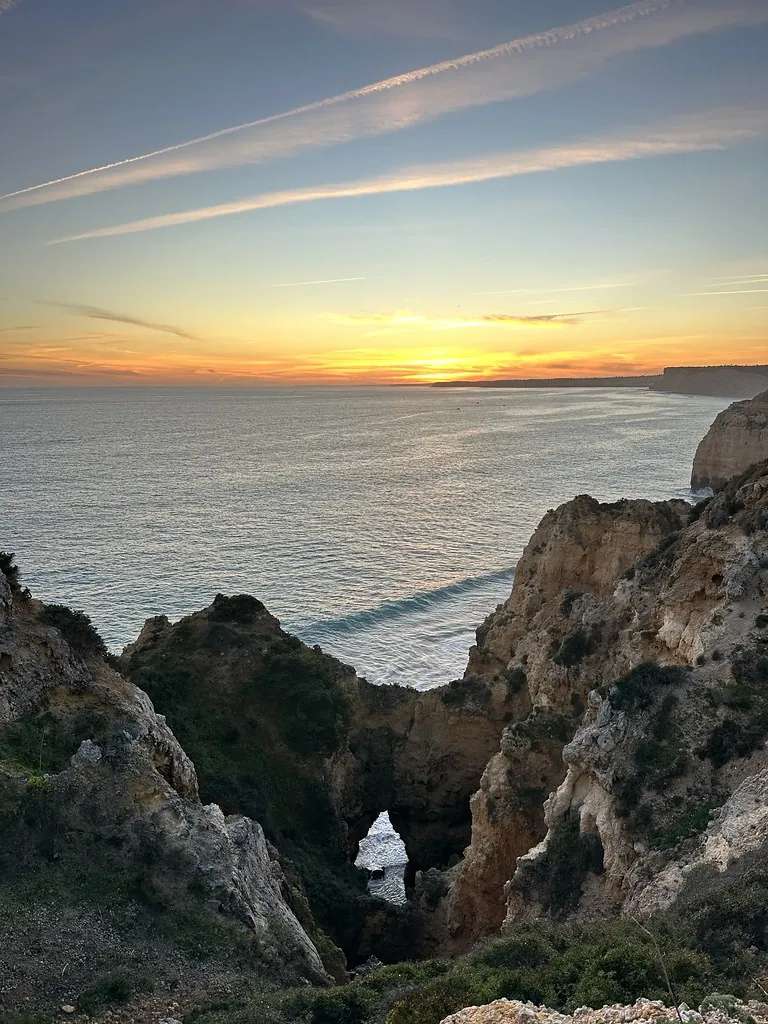
São Gonçalo’s coastline is a tectonic wound: fifty-metre blades of golden limestone, vertically fluted, undercut by swells into arches, blow-holes and subterranean cathedrals. From the deck of a fishing skiff at Ponta da Piedade the rock looks molten, frozen mid-drip. Eastward the beaches slot between these ramparts like hidden courtyards – Meia Praia’s four kilometres of compact, squeaking sand; São Roque pocketed under slanted strata; Estudantes and Pinhão reachable only by timber stairs wedged into fissures. The Seven Hanging Valleys trail threads them on a dirt track that smells of pine resin and crushed fennel, each bend delivering a private balcony over an Atlantic the colour of bottle-glass. Dusk finds the battlements of Ponta da Bandeira Fort turned into an open-air belvedere: the sun slips into the ocean like a broken yolk, and the limestone absorbs the light until it glows like embers.
Cataplana, conquilhas and a confection named after a nobleman
Lagos tastes of tide and terrain. A copper cataplana arrives clamped shut; when the lid is lifted coriander-scented steam rolls over clams, monkfish and prawns. Fish caldeirada, thick with tomato and saffron, is ladled over country bread while conquilhas – thumbnail-sized local clams – are prised open and eaten raw with a glass of lemony Arinto. Octopus stewed until purple is paired with the Algarve’s other staple, roasted sweet potato, the tuber’s sugar balanced by peppery olive oil. In May the Fishermen’s Day procession threads from the harbour to Meia Praia, where sardines blacken over cane-grills and parish priests splash holy water on the bows of brightly painted trawlers. Dessert is Dom Rodrigo – saffron-yellow threads of egg yolk cocooned in coloured foil – chased by segments of sharp Algarve orange whose juice runs over the wrist. Almond cakes called morgadinhos and tiny queijadas are still baked in back-street workshops and sold from hessian-lined trays at Saturday market.
The match-making friar and his 23,000 parishioners
São Gonçalo – 14th-century Dominican, Lagos-born, keeper of the celibate rule – is curiously venerated as the patron of courtship. His parish is now the most populous in the municipality: 23,648 residents spread between the harbour grid and the hamlets of Portelas, Chinicato and Sargaçal. Their 4,331 dwellings range from fishermen’s cottages to glass-walled villas, evidence of a city that learned to host strangers yet still clocks its own rhythms: the 5 a.m. auction, winter choir rehearsals in the cultural centre, the enduring popularity of local writer-diplomat Júlio Dantas whose bust surveys the municipal garden.
The final sound
Night peels Lagos in layers – first the British pub crawlers, then the hire cars, finally the espresso machines. What remains is the Atlantic’s basso continuo: breakers detonating against the foot of the cliffs, a low pulse that climbs the lime-washed lanes and slips through shutters left ajar. It is the city’s true timepiece, more reliable than the church bell or the fortress clock, and it perfumes laundry, skin and memory with the taste of salt on hot stone.