Full article about Almancil’s Terra-Cotta Hush Between Fairway & Lagoon
Cobalt azulejos, pistol-cracking carob & salt-mist views above the N125
Hide article Read full article
The Red Earth Interval
Heat shimmers up from terra-cotta soil at 61 m above sea level, carrying the cracked-resin scent of kermes oak and sun-baked rosemary. This is not the saline cling of the Atlantic ten minutes away; it is an inland thermal pulse that makes carob pods split with a pistol-crack at dusk. Stand still on the brow above the N125 and, on winter mornings, you can watch Ria Formosa’s salt-lagoon mist hover like gauze above the coast, a private meteorology visible only because Almancil refuses to be either beach or mountain.
A Stop for Tiles
The single building that justifies slowing down is Igreja de São Lourenço, a modest 1730 country church whose interior is upholstered top-to-toe in cobalt azulejos. Each tile is a 15 x 15 cm chapter of St Lawrence’s life—grid-like graphic novels rendered in manganese blue. Sunlight threads through high apertures, refracting off glaze so that the whole nave feels submerged in aquarium light. Entry is €2, payable to the caretaker who materialises with a key the size of a boat oar. Inside, the only soundtrack is the faint dopplered roar of traffic on the national road, a reminder that the sacred here negotiates constantly with the functional.
Between Two Speeds
Almancil’s census reads 11,291, but the statistic that matters is demographic drag: 1,600 children under 14, 2,400 residents over 65. The town is therefore bifocal—new roundabouts wide enough for golf-course buggies, yet old lanes where 1960s bungalows still wear their original terracotta roof turtles. By day the place functions as a service corridor for the Golden Triangle (Vale do Lobo, Quinta do Lago, Vilamoura), so the dominant key is engine noise. At 18:00 the pulse drops and collared doves take over, their six-note lament echoing off the aluminium shutters of closed estate agencies.
The Lagoon You Feel, Not See
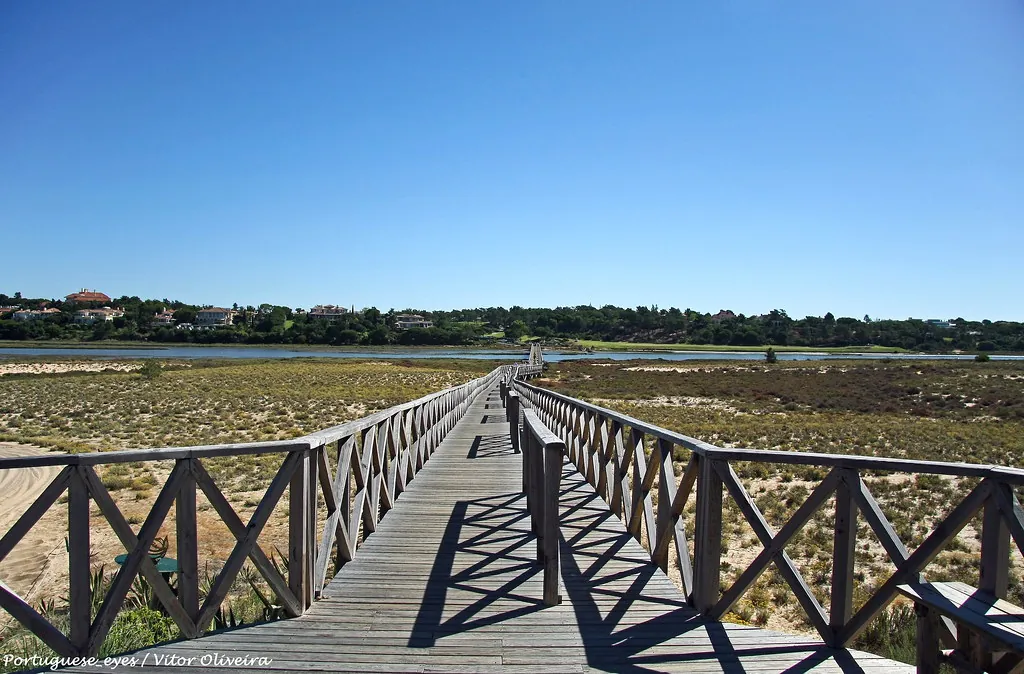
Drive south on the old road to Faro and red earth segues into wind-sieved sand without ceremony; you have crossed into Ria Formosa Natural Park without a signpost. The lagoon itself is invisible behind dune cordon, yet its presence arrives overhead—greater flamingos in October, spoonbills banking like paper aeroplanes, the occasional osprey carrying a mullet still flapping. Local birders keep a WhatsApp alert group; ask at the roadside café O Mestre pastelaria and someone will forward you yesterday’s GPS co-ordinates for purple swamphens.
Grapes, Oranges, Michelin Stars
Vineyards are pocket-handkerchief, wedged between citrus hedges to exploit the maritime night-cool that drifts inland. The Algarve DOP covers four sub-regions; Almancil falls within “Lagos” for bureaucratic reasons, yet the wines—mostly Aragonez and Syrah—taste of sun-baked schist rather than Atlantic spray. Michelin-decorated chef Loureiro sources his fig-leaf oil from a two-hectare plot behind the church; dinner at his São Gabriel restaurant begins with an amuse-bouche of carob brioche and sea fennel that compresses the parish’s geography into a mouthful.
The Sound That Lingers
When the last Lisbon-plated SUV has vanished towards the coastal resorts, the after-sound is botanical: carob pods snapping open in the residual heat, scattering glossy seeds across the patio. It is a noise both brittle and fertile, like the town itself—half logistics hub, half nursery for a slower Algarve that refuses to pose for postcards.