Full article about Querença: Algarve’s hushed hilltop of spring water & silence
Above Loulé’s cork ridges, carob-scented lanes lead to chilled fountains and almond-blossom hush
Hide article Read full article
Wind climbs to Querença the way a Londoner tackles a sixth-floor walk-up: slowly, lungs working, yet still sharp when it reaches the 368-metre shelf where the village sits. No briny Atlantic note up here—only the fracture-smell of dry earth and a hush that splits just twice: when the church bell counts the hour and when Café A Pedra’s hinges groan awake.
Between surf and summit
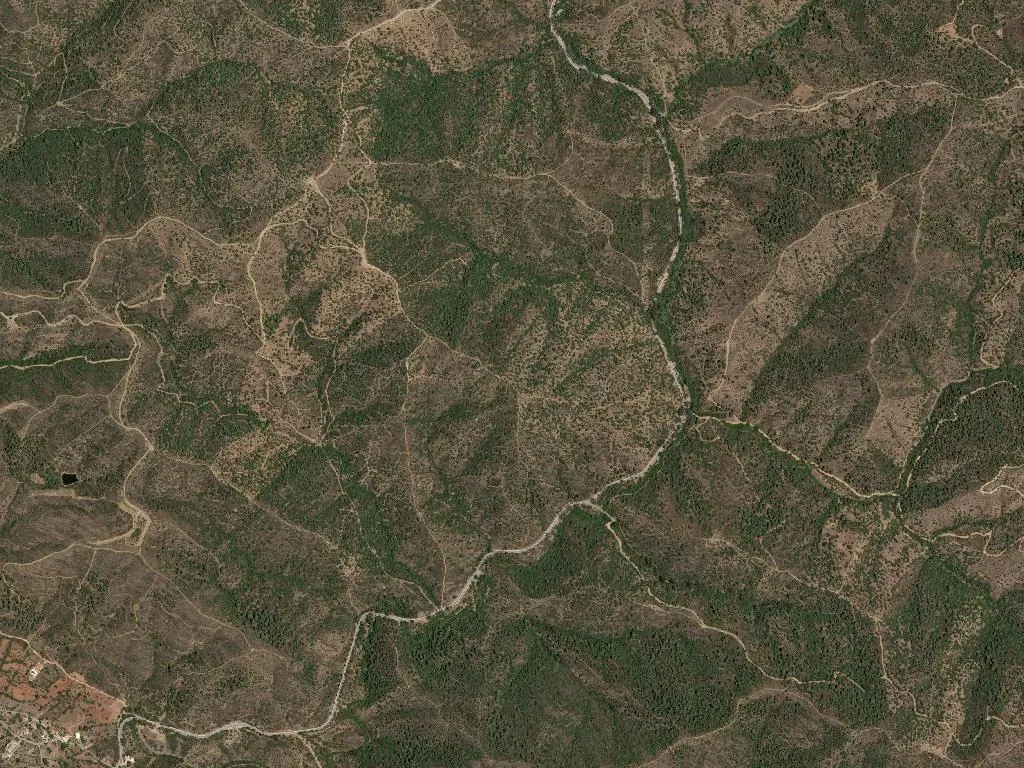
Querença belongs to Loulé council on paper, but in practice it hovers equidistant—twenty minutes west to the surf of Praia de Faro, twenty minutes east to the cork oak ridges of the Caldeirão. Drivers coming from the coast notice the air shed its salt; those dropping out of the hills feel the night-time sting leave their cheeks. In the middle spreads a plateau of almond and carob that survives six rainless months without flinching. The old EN396 bisects the parish, yet nobody crosses without looking both ways—not for traffic, which is thin, but because collective memory still flinches at the ox-carts that once hauled charcoal down to Loulé’s market.
The village square is simply compacted earth framed by box hedges and a single jacaranda. The Matriz church, whitewashed in the Algarve’s faintly anaemic style, is the compass: keep the bell-tower on your right and you’ll face the grocer’s; directly ahead, a stone spout delivers chilled spring water for free. The bench beside it is where time sits, swapping hunting tales and weather forecasts.
Low-density living
The 2021 census lists 406 legal residents; at weekends the number doubles with offspring who keep Lisbon or Paris addresses and never tick the box. Nine dwellings are licensed for holiday lets; the rest are passed along by word of mouth—cousins of cousins, retired teachers from Setúbal, a German illustrator who arrives for the almond blossom and stays for the silence. There are no hotels, no swimming-pool complexes, no itemised tourist receipts—only a spare room at grandmother-level, sheets sun-dried and ironed with a bar of soap, and the guarantee that after 23.00 the loudest sound is a gecko.
Vines exist, but as punctuation rather than commerce: a pergola clamped to a schist wall, its table-grapes ending each September in Zé Manel’s aluminium still. The serious wine country lies south-west around Lagoa; in Querença you drink what was bottled in a washed-up Fanta container last year and poured only once the host knows your grandparents’ names.
Clock of its own
Dawn is ratified when sunlight grazes the pastelaria’s side wall—time to roll up the shutters, release the perfume of papo-secos into the lane. Those without a vegetable patch buy; those with, barter: tomatoes for eggs, figs for rough red, gossip for gossip. Instructions on how to stuff chouriço or where the best medronho—arbutus-berry firewater—hides are available to anyone who lingers over a bica longer than five minutes.
Eating out is an exercise in surrender. Fonte de Sede is the only restaurant; it opens when the owner feels like it and serves what was shot—kid or wild boar—paired with potatoes that taste of the wood-oven smoke. Otherwise you walk into someone’s front room: television murmuring in the corner, price scribbled on the back of a receipt. Bring cash; the nearest ATM is seven kilometres away in Salir.
As the sun dips, the stone houses exhale the day’s heat. Light turns liquid gold, thick enough to ladle, and you understand why Lisboêtas drive down “just to think”. There is no signed viewpoint, no selfie frame—only a low parapet where you can park your elbows and watch the barrocal ripple away until it dissolves into sky. Take a jacket: after dark the hilltop wind has no patience for air-conditioned skin.