Full article about Alvor
Estuary air, boardwalk clacks, king’s last breath on the hill—Alvor slows every clock
Hide article Read full article
You smell it before you see the road sign. Roll down the window on the EN125 and the estuary pushes in: warm salt-marsh breath, iodine and sun-baked wrack, a low-tide hiccup of drying algae. At the first roundabout a three-metre iron mackerel pivots on a pole—half sculpture, half warning that from here the clocks lose interest in punctuality.
The tide has just turned. Wind peels back the lid of water, revealing a slick of charcoal mud. A purple heron stalls overhead, wings spread like black lace, then drops behind the reeds. Below, an old man in crimson wellingtons levers a garden fork, turning the sand for razor clams—the same choreography his father, and his father’s father, used. His mongrel, plastered in grey silt, sniffs, wags, unearths a shell the colour of old ivory. No fanfare, just dinner.
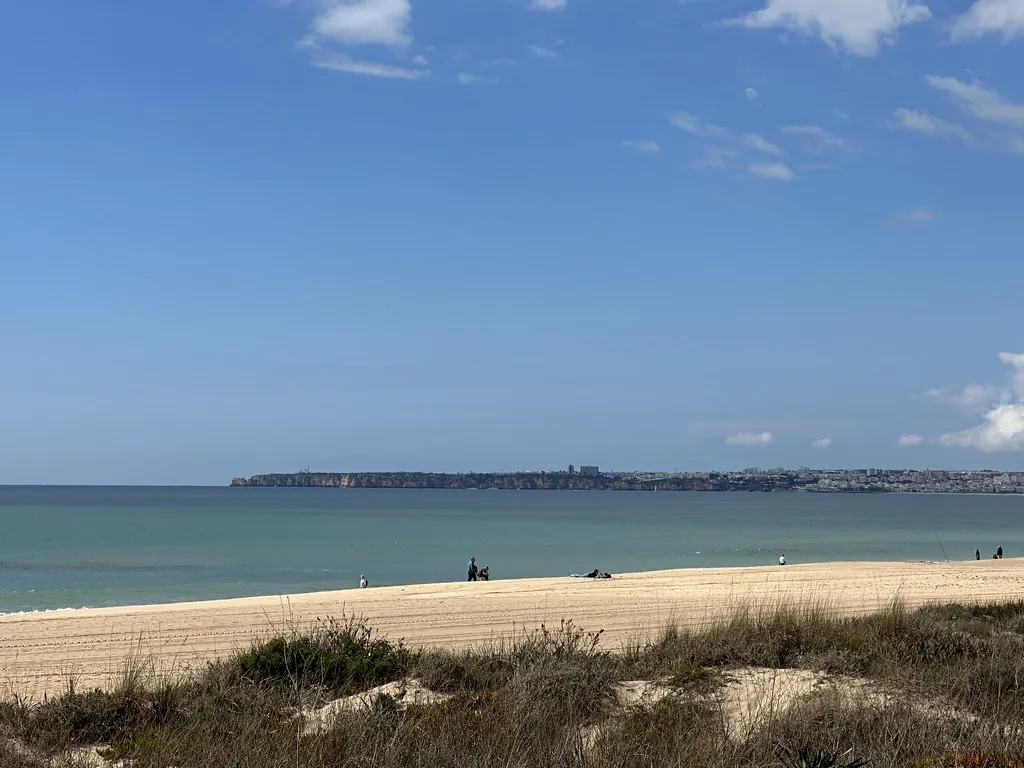
The boardwalk complains. Every plank is a short, wooden sigh, loose nails gossiping with the breeze. Walk fast and the percussion alerts the anglers wedged against the handrail, the teenage couple sharing earbuds, the toddlers zig-zagging after feral pigeons. Three-and-a-half kilometres later the estuary surrenders to the Atlantic and the beach appears in a glare of blond sand so wide it looks Photoshopped. Fossilised dunes, frozen since the last Ice Age, rise like loaves. On chilled mornings the sea is camomile; by afternoon it ripens to peach nectar. No postcard gets the colour right.
The hill where a king stopped breathing
Climb Rua do Poço until the cobbles turn to ankle-turning stone. Through the remaining town gate the ground becomes a mosaic of orange peel stuck in cracks, wild fennel rooting in fissures. All that is left of the Moorish castle is one curtain wall and a viewing platform tilted towards the estuary’s serpentine glide. Terracotta roofs stack below like pressed leaves; the five-star hotel that replaced the dictator-era rifle range sits discreetly among umbrella pines. A discreet plaque notes that João II died here in 1495. The lovers selfie-stick don’t notice they’re posing above a death chamber; the king’s feverish last breaths have been repurposed as golden-hour romance.
Whitewash, cobalt, wax
The Igreja da Conceição keeps Iberian hours: bolted at lunch, yawning open afterwards. Slip in through the north door where the sun never reaches and you’re wrapped in candle wax and cupboard camphor. Our Lady of the Immaculate Conception surveys the nave with carved wooden eyes that have watched plague, earthquake and package holidays. High windows drop blades of light that creep across the floor like sundial hands. On Wednesday evenings, after the seven-o’clock mass, the priest leaves the sacristy ajar: you glimpse gold-threaded chasubles and a walnut wardrobe breathing mothballs.
Outside, the south wall is a jigsaw of 18th-century tiles—faded cobalt flowers and cockerel crests. Opposite, the pillory once used for public punishment now props up multilingual maps. Tourists perch on the step, ice-cream dripping onto limestone already freckled with chocolate.
Copper that sings
Halfway down Rua da Escola a sliding door the colour of seafoam reveals a dining room no wider than a railway carriage. The cataplana is already on the burner, its copper dome clanging like a chapel bell. When the lid lifts, steam scented with tomato, coriander and open ocean rolls over the tables. Razor-clam rice arrives still bubbling inside the clam-shaped vessel; the translucent molluscs ribbon around the fork like party streamers. Pepper is redundant—the salt rode in with the tide.
At the end the owner pours a thimble of homemade medronho, clear until it catches the lamplight and flares like molten topaz. One sip burns, then leaves a rasp of red-berry coolness. “Just the one,” she cautions, “or the chair keeps you for the night.”
Three-and-a-half kilometres of salt and flight
By six the wind has swung northerly. Channels refill; flamingos—when they bother—touch down on the inner lagoon, pink paint dripped on grey canvas. One false step and they’re airborne, legs dangling like discarded rigging. The interpretation centre is officially closed, but knock softly and the warden lets you in. Press a button and a map illuminates: red for salt marsh, green for salinas, yellow for dunes. Alvor from satellite altitude, no drone required.
On the beach the sun grazes the horizon. Gulls stand on dinosaur-shadow stilts. Fishing boats idle home, engines coughing, nets empty. The last paddle-boarder tucks board under arm and glances back: the estuary has become a broken mirror, each shard reflecting its own sky.
December doughnuts, August rockets
In December the smell of fried dough drifts along Rua de São João. Stall bulbs glow amber over boiling oil; the Conceição procession inches downhill, hymns mixing with the creak of the Virgin’s litter. Outside the former hospital the elderly men doff caps; children beg euros from bemused Scandinavians.
August brings the seagoing procession. Boats strung with bunting and painted plastic bottles leave the pier at five; Our Lady of the Rock travels open-deck, flanked by jet-skis. When the flotilla returns after dark, maroons burst above the water—red, white, thunder rolling off the limestone cliffs. The population swells from 6,314 to whatever fits on a towel, yet at seven the next morning the bread van is still five minutes late, same as ever. The estuary sleeps on, but the smell has already clocked in.