Full article about Portimão’s Sardine-Scented Sunset Over Copper Arade Tides
Hear chains clank, taste blistered fish, watch ochre walls melt into molten river light
Hide article Read full article
Portimão: Where the Arade River Spills into Salt and Light
The scent arrives before the view. A low, insistent haze of sardines blistering over charcoal, fat spitting onto coals, white smoke curling skyward before the Atlantic breeze shears it away. Along the Rio Arade’s edge, the late sun ricochets off ochre plaster and turns the water to a sheet of molten copper. Gulls wheel overhead, screaming at trawlers nosing home, while metal mooring chains clank against masts and early drinkers murmur over glasses of chilled white. Portimão doesn’t wait to be noticed – it introduces itself nose-first, ear-second, eyes last.
With 49,000 residents packed into 75 km², the city is neither sleepy fishing hamlet nor manic resort. It breathes in two directions: south to the ocean, north to the Monchique hills. Yet step away from the marina and the crowds evaporate, leaving only the hush of tide nosing sand.
The harbour that named the city
Portus – Latin for harbour – appears in charters as early as 1175. First a fish market, later a medieval freight hub, Portimão grew at the pace of the tides. The 15th-century Igreja de São Bartolomeu still anchors the old quarter, its baroque gilt retable catching slivers of light and scattering them in warm shards across the nave. Run a hand along the pews and the wood feels glass-smooth, polished by five centuries of knees and calloused palms.
Piracy forced the town to armour up. Seventeenth-century Forte de Santa Catarina glowers from the cliff above Praia da Rocha – sandstone walls radiating the day’s heat even after dusk. From here the Atlantic shows its full width: indigo chopped white where swell meets schist. Soldiers once watched for Barbary corsairs from this same vantage; today the only invaders are selfie sticks at sunset.
Sardines, memory and gilded wood
Portimão’s industrial memory smells of anchovy, olive oil and soldered tin. The 19th-century cannery on the quay – red brick, iron sash windows – is now the Museu de Portimão. Inside, reconstructed brine tanks glint beneath overhead pulleys; sepia photographs show aproned women packing fish with surgical speed. The air-conditioning can’t quite mask the ghost of salt that clings to the walls.
Five minutes away the eighteenth-century Palácio de Belomonte – today the town hall – swaps factory grit for Rococo elegance. Beside it, the 1924 Mercado Municipal (the year Portimão was granted city status) keeps its neo-Arab arches and early-morning theatre: crates of iced sea bream, pyramids of IGP-certified Algarve citrus whose zest perfumes the air at the slightest squeeze.
Charcoal, almond and wine that tastes of south
Cataplana arrives sealed under a copper dome. The waiter lifts the lid and steam rushes out – coriander, garlic, briny clams. There is fish stew thick enough to stand a spoon in, and razor-shell rice where each mollusc gapes like an elongated finger pointing to the bottom of the pan. Yet the emblem remains the grilled sardine: split, salted, laid across sourdough that drinks the oil until it sodden and luminous.
Puddings belong to the almond. Dom rodrigos wrapped in wispy egg-yolk threads, morgado cakes dense with ground nuts and aguardiente, sweetness that sticks to the molars. Local reds and whites – Negra Mole, Arinto, Crato Branco – offer citrus cut and Atlantic salinity, a liquid antidote to seafood richness.
Sand, water and the hush of wings
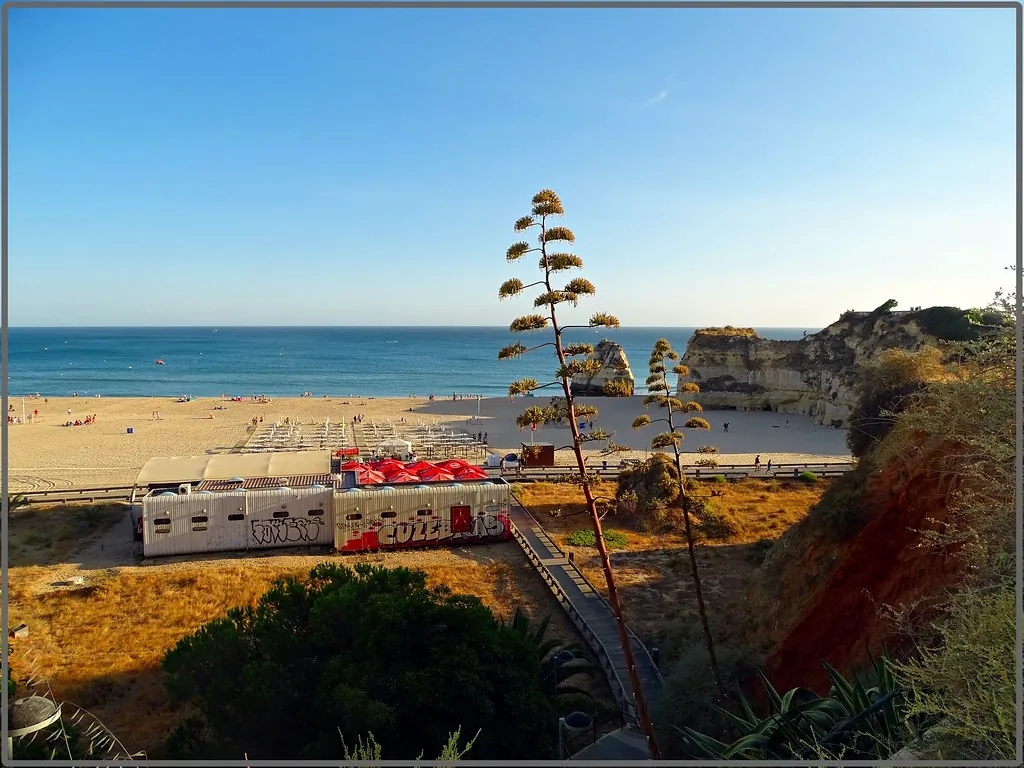
Praia da Rocha lured the first Victorian railway tourists in the 1890s, and the cliffs still deliver drama: ochre sandstone eroded into cantilevered balconies, sand so fine it squeaks. Westward, Praia do Vau and Alvor curve more discreetly. Behind them, the Ria de Alvor nature reserve flushes pink with flamingos in late summer; spoonbills and avocets pick through glasswort while the only soundtrack is water siphoning through mud and the low whistle of a marsh harrier.
Upstream, solar-powered skiffs nose along the Arade towards Silves, past reed beds and tamarisk that comb the current. Prefer torque to tranquillity? The Algarve International Circuit roars a few kilometres north, host to MotoGP and the World Karting Championships. Inland, Monchique’s chestnut woods replace briny air with cistus resin and eucalyptus chill.
Last light
There is a moment that belongs only to Portimão. Night has dropped over the Arade; on the quay the final sardine grill still glows orange against the river’s cobalt. Smoke is invisible now, but the smell lingers – charred skin, spent charcoal, tide-washed salt – riding a cool updraft from the estuary. It implants itself in fabric and memory, impossible to bottle or replicate, following you home long after the plane lifts off.