Full article about Armação de Pêra: dawn nets on limestone sand
Fishermen still haul tuna traps beneath the old fort while church bells echo quarry stone
Hide article Read full article
Armação de Pêra: where the salt still marks the hands
The scent arrives before the sight. A blend of brine, outboard motor fuel and freshly brewed coffee, all at once, as soon as seven in the morning on the coastal road. The boats — blue, green, with the paint peeling in thin flakes like scales — nudge one another on sand still damp from the night. A man in a faded cap gathers a length of nylon net, his hands thick and cracked, repeating a gesture that has been made here for seven centuries. The beach runs for three kilometres, white and compact, and the low morning light turns the surf into a gold fringe against the reef that keeps the water as calm as a pond.
Armação de Pêra owes nothing to pears. “Pêra” is a contraction of “pedreira”, a reminder that this coast was once a limestone quarry, its stone used for the lime that whitewashed the houses of nearby Silves for centuries. “Armação” refers to the fixed tuna-trap system that defined the village from the Middle Ages and, in miniature, is still re-enacted every August during the Festa da Rocha. It is the only place in the Algarve where the ceremonial cast of the net survives, even if today it is ritual rather than livelihood.
Limestone, rammed earth and a fort against corsairs
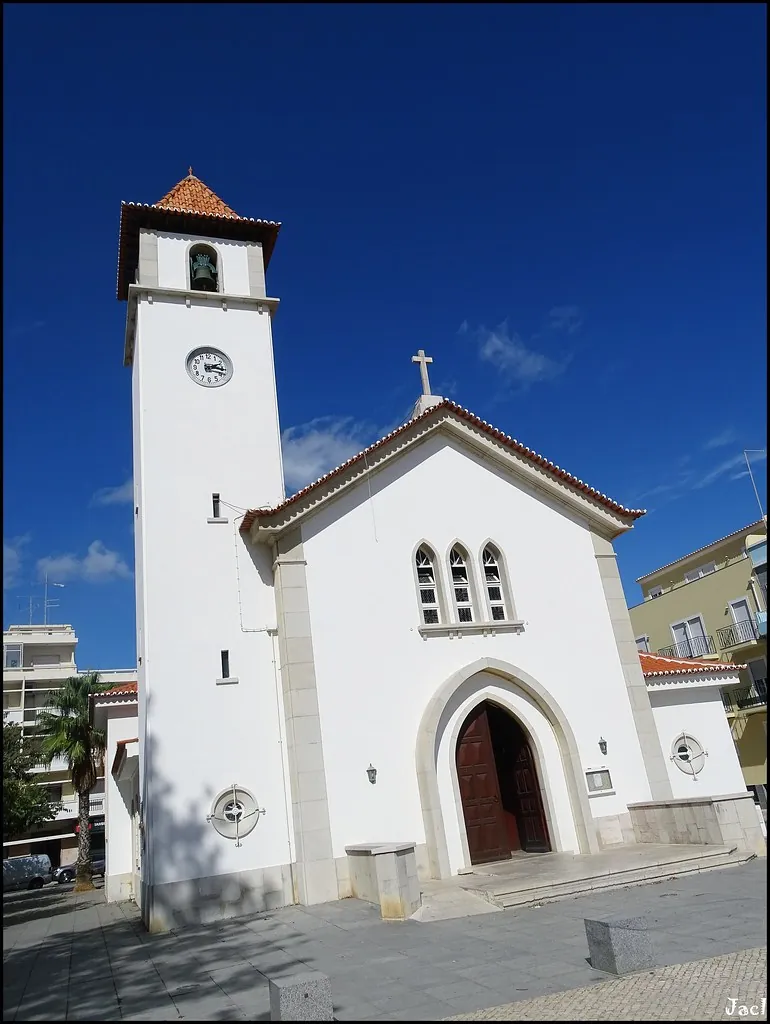
The history of the coast is written in its walls. On Rua da Igreja and in Largo 25 de Abril fishermen’s houses of rammed earth from the nineteenth century still stand – ochre walls a metre thick that stay cool even in July. Higher up, the parish church dedicated to Nossa Senhora da Assunção displays a neoclassical altarpiece and nineteenth-century blue-and-white azulejos that narrate maritime miracles. The door groans open and inside the air is cool with the smell of old wax.
At the western tip, on the promontory that commands the beach, stands the chapel of Nossa Senhora da Rocha, rebuilt after the 1755 earthquake swept away the original. The easterly wind – the same one the singers of cante algarvio invoke in their tuna-fishing ballads – hits here unimpeded, a continuous whistle through the stones. Below, the seventeenth-century Forte de Armação de Pêra, a square bastion with sea-facing bartizans, was raised to deter North-African corsairs. It now houses a small interpretation centre; the guided visit ends with a shot of house-made bitter-almond liqueur that burns the throat gently. The fort served as a location for the 1982 RTP television series A Ilha dos Amores.
Copper cataplana and fig cake
Armação de Pêra’s cooking speaks of sea and dry hinterland. The local fish stew layers sea bass, grouper and razor clams, simmered slowly with tomato, onion and peppermint – the steam rising from the pot is dense, almost visible. A cataplana of clams and eels from the estuary arrives sealed; when the copper lid is lifted the aroma is a humid explosion of coriander and lemon. There is also smoked tuna in shards, served with chickpeas and red onion, and tellins eaten from the shell with a sprinkle of sweet paprika, fingers and paper napkin the only tools.
To drink, the light whites of the Algarve – Arinto and Síria – provide a mineral counterpoint to grilled fish. If you insist on red, a chilled Negra Mole works with the cataplana. For dessert the morgado – a dense cake of dried fig and almond set in a fig leaf – is sweet without being cloying, often drizzled with Monchique mountain honey DOP, a dark ribbon over the compact crumb.
Flamingos, ochre cliffs and boardwalks to the tide
Nature here is not backdrop – it is protagonist. Fossilised and living dunes fringe the beach, harbouring endemic flora such as sea purslane, a fleshy grey-green plant that defies salt with botanical obstinacy. At the boundary with Guia, the Lagoa dos Salgados is a wetland observatory: flamingos feed upside-down in the shallows, little egrets stand motionless as pegs, and swallows skim the water surface. An electric tuk-tuk links the village to the lagoon; binoculars are included.
The Fishermen’s Trail (PR 4) runs six kilometres between the seafront road and the clifftop chapel, with viewpoints over ochre cliffs that flake slowly into the sea. At the Poço lookout, 54 metres above sea level, the natural platform offers a sunset that turns the water copper and burnt-orange. Offshore, hire a traditional wooden saveiro and you may spot bottlenose dolphins slicing the surface with dark dorsal fins.
The beach was chosen for a Portuguese national campaign on accessibility: wooden boardwalks reach the waterline and there is assisted-bathing equipment for visitors with reduced mobility. It is a detail that says much about a parish of 6,003 inhabitants, 1,731 dwellings and a density – 751 people per square kilometre – that makes it one of the most tightly knit settlements on the Algarve coast.
The second Sunday in August
The Romaria de Nossa Senhora da Rocha is Armação de Pêra’s ceremonial heartbeat. On the second Sunday of August the statue of the patron leaves the parish church and processes through the narrow streets to the headland, escorted by decorated boats at sea and fireworks that crack over the water. In September the Festas de Nossa Senhora dos Navegantes bring open-air mass, folk groups and dusk fado on the promenade – the singer’s voice competes with the rumble of waves and sometimes loses. At Easter the Compasso winds through the streets to the sound of marimbas, and sweet bread is handed door to door. In summer the Festival of Seafood fills the square with stalls run by fishermen’s associations, and on Wednesday nights there is open-air cinema on the sand, the screen glowing against the Atlantic dark.
When the film ends and the lights go out, the sound of waves breaking on the reef remains – rhythmic, constant, ancient – and the scent of grilled clams still hangs in the warm air, stubborn as the salt that never quite washes from the hands of those born here to fish.