Full article about Pêra’s Smoky Empadão Nights & Cliff-Top Chapel
Silves parish where vanished pear trees, cork groves and Atlantic cliffs frame age-old feasts
Hide article Read full article
The night the whole village smells of wood smoke
January wind snaps the smoke straight up from the bread oven and carries the scent of sausage fat, turmeric-stained fingers and chicken so tender it unthreads on the tongue before you remember to chew. In Pêra this is empadão night – nobody stays home. After the memorial mass the church empties its congregation into the lane and the entire parish squeezes through the school gates where women in spotless aprons ladle rice from iron pots with a wooden spoon older than most of us. No pear ever sits on top; that, the elders insist, ended when households marked their dishes with fruit before sliding them into the communal oven. Today a scrap of card skewered with a clothes-peg bears your name. The dish, though, has kept its title: empadão de Pêra. And no, it is not a pie – just rice, chicken and smoke that clings to your jacket long enough to ferry childhood back to you.
A parish that lost its pears but kept its stories
The name first appears in the 1258 Inquirições, yet pear trees vanished decades ago. Cork oaks with cracked bark remain, along with holm oaks that fatten pigs on acorns and fig trees that clock two shifts – June and August. The main church has stood since the 1755 earthquake flattened it; parishioners carried the gilded altarpiece up three flights of stairs on their shoulders for three consecutive days. Inside, a Madonna whose eyes allegedly swivelled mid-sermon still surveys the nave. Outside, the Chapel of Good Health is barely wider than a confession box, yet half the village crams in on feast days, the gentry jostling for the holiest pocket of air beside the statue.
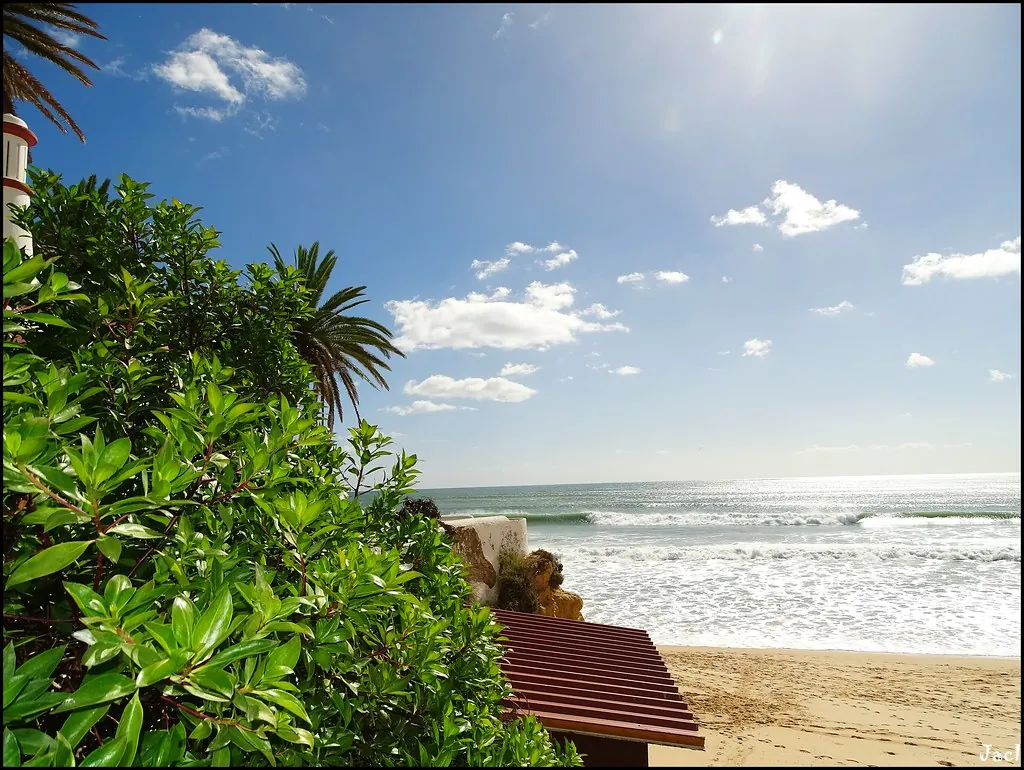
Six kilometres away, Nossa Senhora da Rocha perches on a sandstone cliff that looks ready to topple into the Atlantic but never has. The hermitage is whitewashed outside, dim and waxy inside; sea air slips through the door crack and carries salt up into the rafters. Below, polished limestone steps descend to a cove – what goes down must climb back up. Local boys still hunt for a blocked Moorish tunnel once said to lead to concealed gold; an iron sheet now bars the entrance, but small fingers probe the gaps every August when boats decked with tissue-paper flags and bunting process along the coast, singing a tune whose author no one can name but everyone remembers.
The barrocal: neither mountain nor shore
Pêra hesitates between land and water. To the south, the Ria Formosa’s lagoon system glints like hammered pewter; to the north the Serra de Monchique hovers, blue as a second sea. The Alcantarilha stream only bothers to run in winter; by August its bed is a dinosaur nest of smooth white stones. The Percurso das Fontes begins behind the football pitch whose pitch is more sand than grass, then climbs dry-stone walls that shelter dovecotes and wild-bee hives. Somewhere along the trail a spring gushes cold enough to chill Coca-Cola cans; kids wedge them between reeds and retrieve them syrupy-cold. Cork oaks split like over-ripe avocados, ancient holm oaks twist, and bee-orchids open only if March rain falls on a Monday, or so claims Zé do Carmo, daily walker and owner of a dog named Figo.
What the lagoon gives, the still gives back
The empadão is a once-a-year ritual. The rest of the calendar belongs to xerém – a creamy maize stew studded with cockles gathered at dawn before the tide turns. Cataplana arrives sealed in copper: clams, conquilhas and a fistful of coriander bought from Sr António’s road-side patch. Honey comes down from the Serra in five-litre tins sold at Saturday market by the wife of Tonecas; it is dark, resinous, tasting of rosemary and eucalyptus. Medronho, the wild-strawberry firewater, is technically domestic; most back-gardens hide a miniature still, yet the consensus is that Uncle Belarmino’s version, distilled with orange peel, burns brightest then leaves a whole-day sweetness on the tongue.
When the accordion starts, nobody minds the dust
Christmas Eve packs the church to the porch; the monumental nativity occupies the entire south transept, its hand-painted clay figures include a wise man who is the spitting image of the parish-council president and an ox modelled on the neighbour’s cow Branca. Easter Monday brings the Compasso procession: brass band, incense and a stop at every house where lace cloths and lit candles cover gateposts. Folk dancers spin the corridinho on the bandstand, embroidered shirts darkening with honest sweat; afterwards everyone drifts to Zézinha’s café for an espresso and a chocolate-stuffed fig she has been making since four in the morning.
When the last paper lantern is doused at Nossa Senhora da Rocha and the Atlantic growls like a distant dog, Pêra folds into the barrocal night. No pears, no rush, no seafront promenade – just the lingering scent of cooling bread ovens, a neighbour calling a cat, and the 7 a.m. school bus flicking stones against the aluminium shutters as it gears down for the first stop of the day.