Full article about Cabanas de Tavira: ferry to seven-kilometre island beach
Cabanas de Tavira’s wooden ferry glides to Portugal’s longest Blue-Flag beach, past bottlenose dolphins and a 1660s limestone fort now a guesthouse
Hide article Read full article
The wooden ferry swings left
The fishing boat nudges the island pontoon, diesel throttled back beneath the screech of gulls. One plank creaks, the hull rocks, and you step onto Ilha de Cabanas. Behind you, across the Ria Formosa, the mainland village stays motionless in the white noon—single-storey houses, sky-blue fretwork, a boardwalk riding the marsh like a bleached spine. Water laps the rim of the channel, smelling of rock salt, warm silt and fish just shaken from the net.
Cabanas began as a row of reed huts where tuna crews stored tackle in the 1500s; the name simply means “huts”. When Barbary pirates followed the same channel in the 1660s Lisbon sent engineers who, in twenty-four months, raised the star-shaped Forte de São João from local limestone and marsh-fired lime. Its cannon once commanded the entrance; today the keep is a small guesthouse, and breakfast on the terrace is watched by bottlenose dolphins surfing the flood tide.
A five-minute crossing
There is no bridge, never has been. To reach the beach you board a retired fishing saveiro fitted with two plank benches. The skipper knows every shoal and sandbank; at slack water he cuts the engine and glides, letting you hear only the hiss of hull through eelgrass. Seven kilometres of continuous Blue-Flag sand lie ahead, Portugal’s longest uninterrupted dune cordon. A raised walkway snakes between low marram-covered hummocks; at the far eastern end fossilised dunes rise like concrete reefs, compacted by Atlantic storms two millennia ago. The sea registers a balmy 18.5 °C in late May—often the warmest reading on the mainland—and the clarity is Caribbean.
Return at low tide and the Saturday craft market is unpacking: hand-painted azulejos the size of postcards, miniature reed traps, cowries polished to satin. Avenida Ria Formosa runs parallel to the channel, lined with cafés whose daily menu is a maritime census: caldeirada of sea bream, grouper and weever, tomato reduced to rust, coriander sliced tableside. Clams arrive steaming in their own liquor, finished with lemon crushed between finger and thumb. The fishermen’s own dish, massa de peixe, folds shredded grouper into potato and egg, bound with parsley. In August the cataplana is brought to the table hissing, its lid lifted to reveal clams bronzed by chorizo oil.
Where the saltmarsh breathes
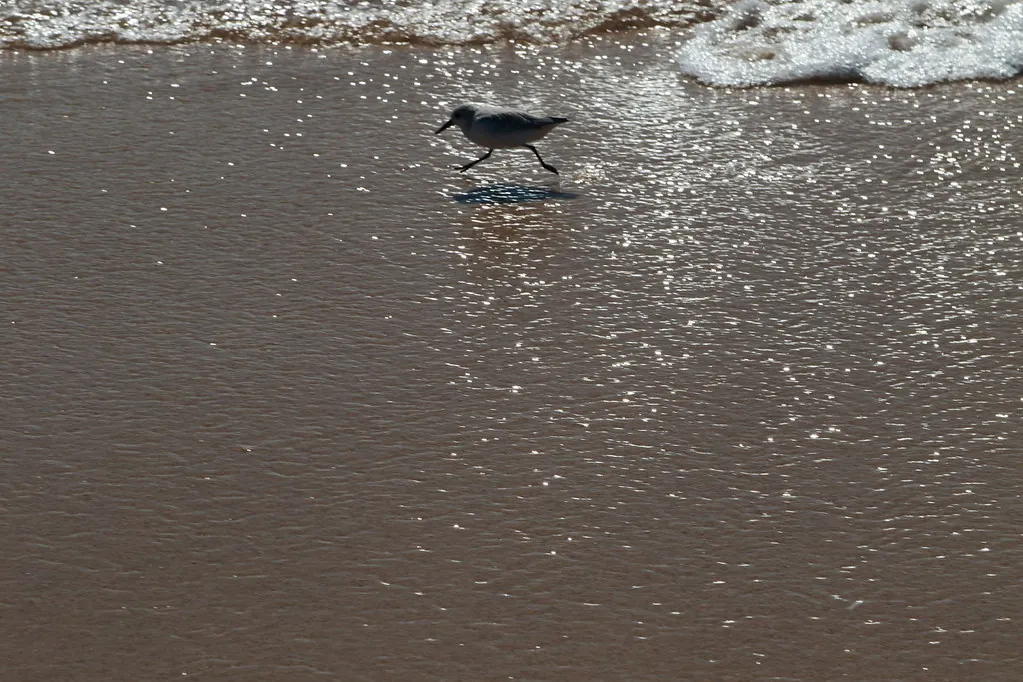
The Natural Park begins at the quay. Listed under the Ramsar convention, the lagoon system draws almost two hundred species of bird: greater flamingos treading the shallows like pink stilts, spoonbills sweeping their spatulate bills, avocets whose upturned beaks give a soft “kluit” at every step. A 1.2 km boardwalk, built in 2010, lets you walk above the sapal without denting its crust. At sunset copper light fills the creeks; wings clatter as shelduck lift off, and you can hear the soft rattle of tellins rolled by the tide—a sound local skippers claim they recognise blindfold.
In the tamarisk and acacia hedges the only chameleons in Europe cling to twigs, their skin shifting from leaf-green to ash. From a sit-on-top kayak you can slip into narrow guts where wild oysters fringe the banks and juvenile seahorses curl in shoals—the densest population on the continent. The paddle enters the water without a splash, and the sky mirrors back, unbroken.
On 15 August the statue of Nossa Senhora do Mar is ferried down the channel. Decorated boats form a procession, engines cut, oars raised in salute. At the quay the priest waits with a portable altar; mass is followed by sardines grilled over charcoal, the smoke rising straight in the still afternoon. By dusk the air is laced equally with fish and with medronho—the clear, sharp spirit distilled from arbutus berries in the Monchique hills, never absent from a coastal table even though the mountains lie forty kilometres inland.