Full article about Santa Luzia: Tide-whispering octopus capital of the Algarve
Ria Formosa channels lap pastel houses where clay-pot fishermen land silk-scarf octopus at dawn
Hide article Read full article
Santa Luzia, where the tide keeps the beat and the octopus is king
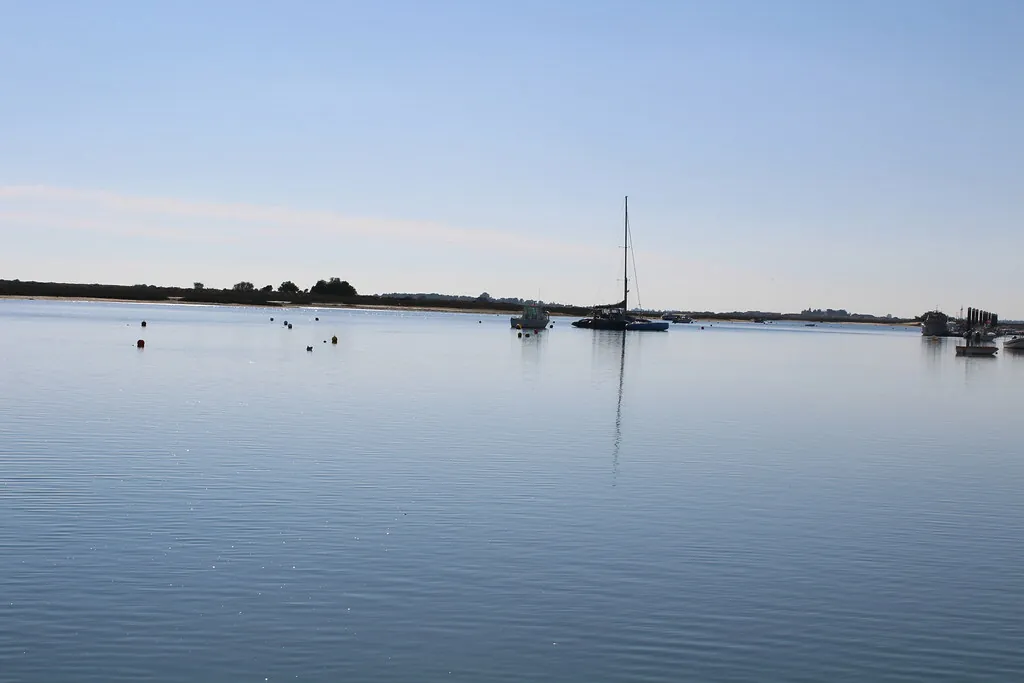
The first sound is water – not surf, but the hush of the tide sliding through the Ria Formosa’s channels. It slips between the tightly packed houses of Santa Luzia, rattling the hawsers of the small white boats that line the quay. At only 3.9 m above sea level the village feels half-submerged; the air carries a warm, briny film that settles on forearms and camera lenses and, within an hour, feels like your own skin.
The quay where octopus has a surname
Santa Luzia’s 1,589 residents have awarded themselves an unarguable title – Portugal’s “Octopus Capital”. The claim dates from 1927, when fishermen swapped tunny nets for clay pots (alcatruzes) and began lowering them into the lagoon. The mollusc quickly became the parish’s centre of gravity: it still arrives on the dock before most people have finished breakfast, tentacles folding and unfolding like silk scarves. Order it grilled with a thread of local olive oil and a split sweet potato, roasted until the skin crackles, or stewed with onion and bay. Shellfish rice and Ria fish soups appear on every menu, but the octopus commands the plate.
A chapel for sore eyes
Before octopus there was tuna, and before tuna, faith. In 1577 fishermen built a single-nave hermitage to Santa Luzia, the Sicilian martyr invoked against eye disease – a sensible patron for men who spent their lives scanning the horizon for shifting shoals. Her feast falls on 13 December, when the low winter sun sets early and the water reflects a copper sky. The early-twentieth-century parish church, paid for subscription-style by local families, still records their donations on its walls: stone for stone, candle for candle. Santa Luzia only became an independent parish in 1984 and a village in 1999, yet collective memory here is older than any charter.
Anchors planted like headstones in the sand
A kilometre’s trudge west – or a five-minute ride on a toy-sized train – brings you to Praia do Barril. The heat vibrates off the dunes, studded with sparse stone pine. Half-buried in the sand stands the “anchor cemetery”, 200 rusted iron hooks lined up like crooked teeth. They once secured the 1842 tuna-fishing frames that stretched nets across the migrating schools. When the fish changed route in the 1960s the frames were abandoned; the anchors remained, an open-air ledger of livelihoods lost to biology and politics. The old factory buildings have been turned into cafés and beach showers, but nothing breaks the quiet of the oxidised metal against bright silica.
Salt flats that breathe with the moon
The village sits inside the Ria Formosa Natural Park, and the tides write the timetable. At low water the canals shrink to coffee-dark veins; at full they swell to small lakes. Salt pans glitter with fresh crystals, and spoonbills and greater flamingos sift the shallow ponds. Take the small ferry to Praia da Terra Estreita and you step onto a thread-thin sand tongue: lagoon warmth on one side, Atlantic rollers on the other. Cycle the Ecovia eastwards at dusk and the marsh changes colour in real time – bottle-green to gold to slate-blue – while the smell shifts from brine to something greener, almost herbal, as the heat leaks out of the mud.
A village that refuses to hurry
With 172 residents under 30 and 473 over 65, Santa Luzia has the gait of someone who no longer needs to impress. Its 375 tourist beds absorb visitors without altering the cadence: boats depart when the tide says so, octopus pots are hauled when the arms are ready. In the hour before dinner the water drains away, exposing dark veins across the flats. The sun has already slipped behind the hills above Tavira, but the sky holds a washed-rose light that mirrors the salt ponds. Out on Barril the anchors keep their vigil; somewhere beneath the water the octopus sleeps inside its clay jar, waiting for tomorrow’s pots, tomorrow’s tide, tomorrow’s slow, deliberate rhythm.