Full article about Barão de São Miguel: Where Atlantic Wind Meets Firewater
A 1,487-hectare ridge village scented with medronho and salt, 7 km from wild beaches.
Hide article Read full article
The scent reaches you before the village does: a dry-sweet tang of fermenting medronho berries drifting through stands of cork oak and sun-warmed rockrose. Around the last bend the Atlantic glints cobalt, only ten minutes away by car yet present in every salt-laced breath that scuds across the 41-metre ridge. Barão de São Miguel materialises without ceremony – a clutch of whitewashed houses banded in ochre and turquoise, a single bell tower that concedes the sky.
Where the ocean is felt, not seen
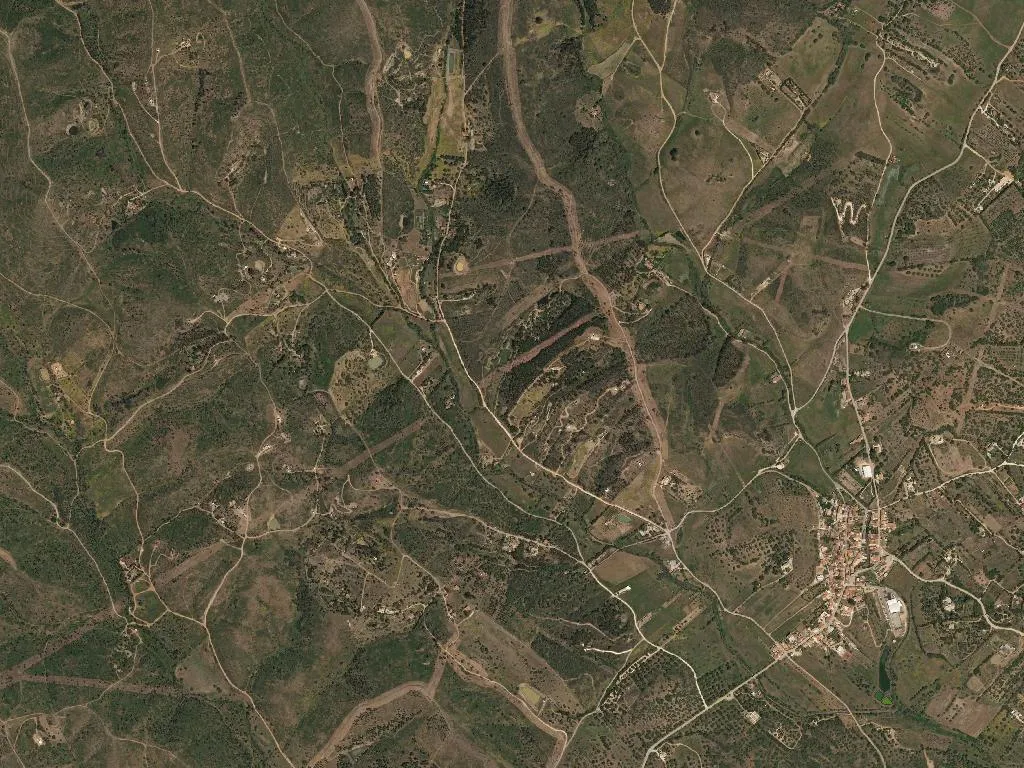
The parish spreads across 1,487 undulating hectares on the inland margin of the Southwest Alentejo and Vicentine Coast Natural Park. No sand lies within its borders, yet the wild coast haunts every view: the late-afternoon light that flares against white walls, the brine that crusts skin after a morning walk, the wind that sets umbrella pines trembling. Ingrina beach is 7 km south-west, Zavial 9 km; close enough for jade water and shale cliffs to slip naturally into conversation.
Footpaths link Barão de São Miguel to its sister hamlet Barão de São João through a quiet topography of cistus scrub that bursts into white bloom each spring, wild orchids wedged between schist, and the sudden slash of a peregrine overhead. White storks stand motionless on telegraph poles, and winter rain softens the red earth to the smell of wet clay.
Firewater and Jurassic ghosts
In João Maria’s distillery – one of the last legal alembics in the Algarve – copper stills have been turning berries into aguardente since 1962. Fermentation lasts three months in open oak vats; the final spirit, now protected under the Medronho do Algarve IGP, ignites the throat then blooms into honeyed warmth. Visits by appointment (tel. +351 282 639 285) end with a measured pour that catches the lamplight like liquid glass.
Look further back and the land liquefies again. In 2004 geologists from Lisbon University identified Upper Jurassic fossils – foraminifera and calcareous algae – in Cerro do Monte-U, proving that these hills once lay beneath a primordial Atlantic. One hundred and fifty-five million years compress into a split second when you hold the fossil-speckled stone in your palm.
Pork from the hills, fish from the edge
At O Serrano restaurant the menu wavers between interior and ocean. Eel stew (€14) arrives thickened with coriander and tomato; fish soup is built from whatever landed that dawn in nearby Sagres. Yet the star is black-footed Alentejo pork, roasted until the skin shatters, plated with roasted sweet potato and a chilled local white. Finish with dom rodrigos – yolk-sweet threads wrapped in silver foil – or a warm fig and almond morgado, the sugar balanced by a final thimble of medronho.
The village relinquished its own festival when the annual São Miguel fair moved to Vila do Bispo in the 1980s. Tradition survives in lower keys: September grape-picking shared among neighbours, impromptu guitar nights at Café A Parada, tasting sessions that begin with a knock on João’s distillery door.
The title no archive can explain
The name itself resists genealogy. “Barão de São Miguel” hints at both archangel devotion and a medieval feudal grant, yet Faro’s district archives yield nothing beyond a 1577 charter that refers simply to “lands of the baron”. The parish was dissolved and reinstated in 1928; the title still floats ownerless, a story content to remain unfinished.
Dusk stains the walls gold as the stills cool and the aroma of berries lingers, sharpened by wood-smoke drifting up from the valley. It is a scent that refuses to choose between sweet and austere – rather like the small, stubborn parish that produces it.