Full article about Budens: Roman fish vats, sea forts & fiery medronho
Dawn over salt-crusted ruins, clams sizzling in cataplana, medronho burning in the glass
Hide article Read full article
Dawn over the tanks
First light ricochets off the cliff, a hot limestone glare that makes you narrow your eyes. Below, the tide peels back to reveal a grid of dark, rectangular basins – not natural, but cut by hands that dissolved two millennia ago. These are the Roman fish-salting vats of Boca do Rio, where garum once bubbled under the sun before being decanted into amphorae bound for every corner of the empire. Salt water still slips in and out, patient, rinsing what is left of an industry that financed this stretch of coast. On the breeze comes iodine and wrack, cut by the honeyed resin of rockrose. Budens begins here, between the worked stone and an Atlantic that never clocks off.
Sea walls and sentry boxes
In the seventeenth century the Vicentine coast was a place of pilchard and panic. Moorish privateers used the coves to land, loot and enslave. In 1632 the Fort of São Luís de Almádena rose above Praia da Boca do Rio – low parapets, cannon embrasures staring west, a sentinel of lime and stone. Today it is only a knee-high outline, yet you can still trace the powder store and the barracks where soldiers slept above their own waste. Further south, on the bluff above Praia da Figueira, the Fort of Vera Cruz is even less visited; those who make the short scramble find a silence so complete it hurts, broken only by gulls and wind riffling through gun slots that no longer exist.
Ocean on the plate, arbutus in the glass
Caldeirada murmurs in a clay pot: mackerel, white sea bream, potato, tomato, coriander. The fish arrives before breakfast on beached trawlers working the strip between Salema and Burgau – arrive early and you will see the cats queueing. Clamshells part in a copper cataplana, releasing garlic, white wine and brine. Budens eats from the Atlantic, but also from the barrocal behind: stone-pressed olive oil that tastes of sun-baked earth, wind-toughened greens, and above all the Algarve’s medronho. The clear firewater smells of ripe strawberry-tree fruit and scrub; it is poured after dinner at Adega do Pescador in thimble glasses, always with a wedge of corn bread to soften the blow.
Cliffs, caves and blond sand
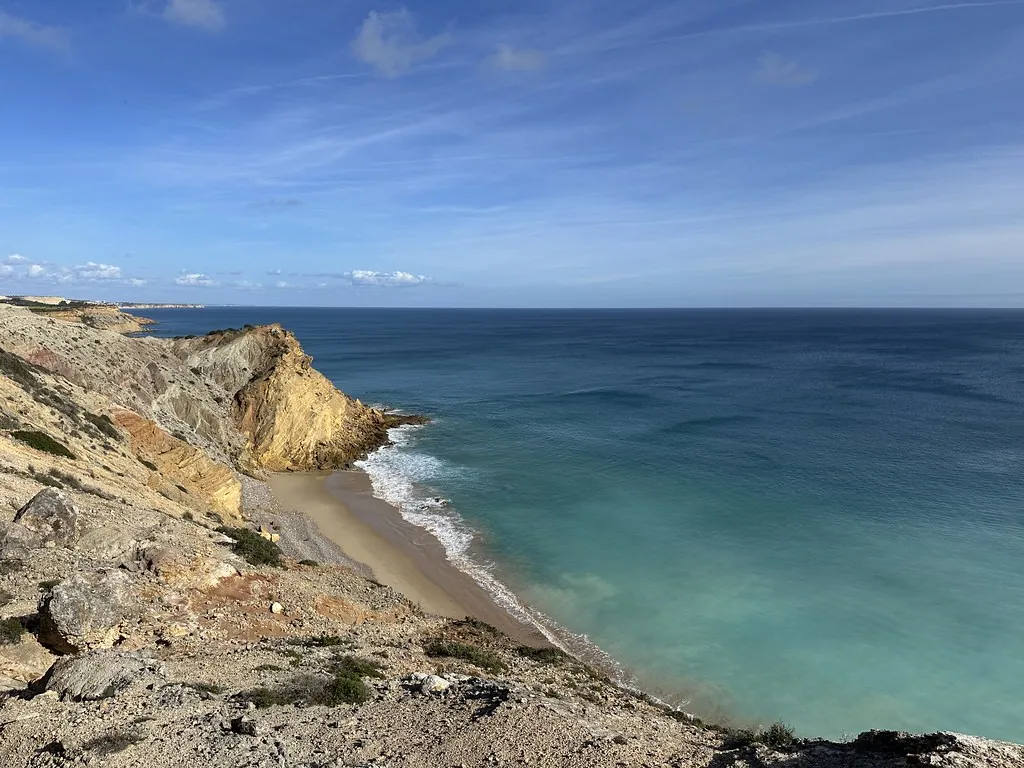
Between Salema and Furnas stretches four kilometres of coast that no one has managed to ruin. The limestone cliff is incised with coves and headlands, carved by wind and water into shapes that change with the light – sometimes faces, sometimes beasts. The “furnas” – sea caves and fissures – give the northernmost beach its name and provide natural shade on August mornings when the sand burns and only the German guests remain. Budens stream slips quietly between reeds and tamarisk, reaching the sea at Boca do Rio and creating a ribbon of damp where little egrets and yellow-legged gulls share jurisdiction. Footpaths link interior to ocean, threading through Mediterranean scrub that tattoos your shins if you wear shorts. There is no front-line construction – only sand, stone and a wave chill that stops your heart for a beat.
Tracks between stone and surf
The lane drops from the village to Boca do Rio between loose-stone walls and knotty fig trees that offer shade nobody requested. Ahead, Roman ruins surface through the sand – cetariae, vats, footings of a seaside villa that lived on salted fish. Low tide is the moment to walk the grid, feel the worn stone underfoot, imagine the ancient clatter of nets and salt. Later, Salema beach invites a snorkel among bream and urchins, followed by an imperial on the terrace while you wait for goose barnacles that always take longer than promised. In the afternoon Praia das Furnas gives coolness inside its caves and a mineral silence – only the sea and your own pulse. Burgau, a pocket-sized fishing settlement to the north, ends the day with medronho sipped slowly at Zeca while the sun bronzes the cliff and turns the houses to honey.
The last light ignites the limestone as if it were ember. Below, the tide folds back over the Roman tanks. Tomorrow the moon will haul the water away again and the carved stone will reappear, stubborn, repeating its story of salt, fish and people who never left.