Full article about Dornelas: Where Oak Smoke Drifts Over Schist & Time
Granite chapels, chestnut woods and communal ovens scent the high-plateaux parish of Dornelas.
Hide article Read full article
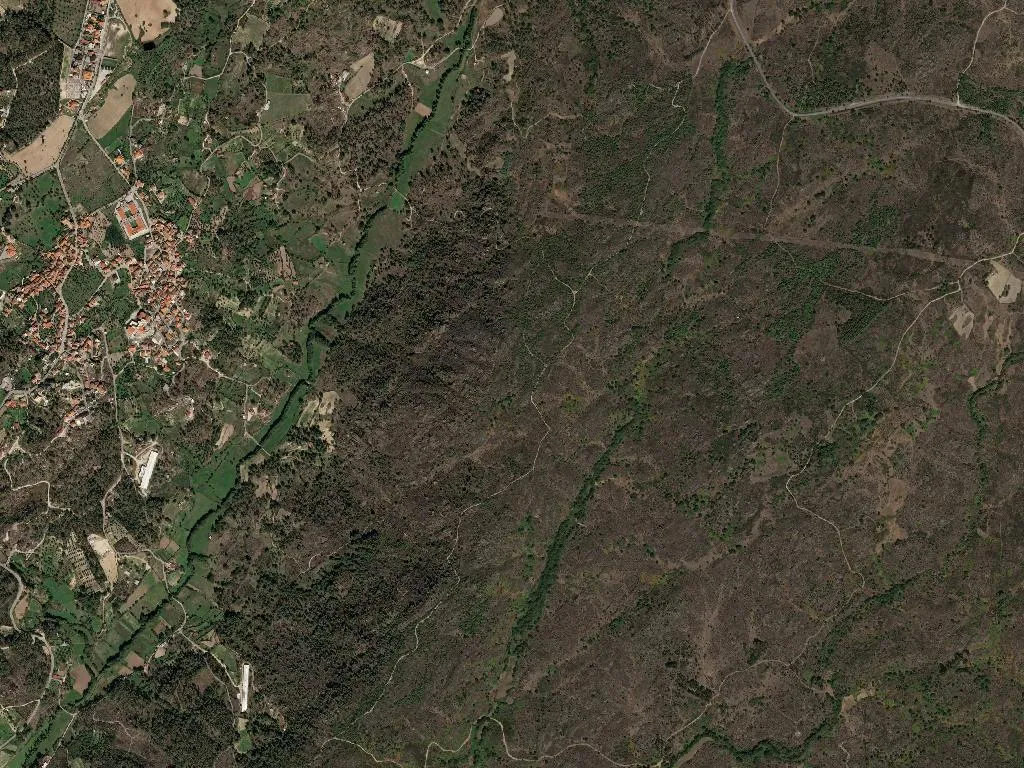
The scent of burning oak arrives before the roofs come into view. Dornelas inches into sight, its schist eaves ribbed against the undulating high plain of the Beiras, granite walls sketching frontiers in time. At 562 m above sea-level the parish unrolls across 23.8 km² of Dão valley where the river slits narrow corridors between sweet-chestnut woods and oak. Doorjambs still carry crosses chiselled in the 1700s – small defensive sigils that mutter a quiet prayer every time you brush past.
From wooden hut to granite hamlet
The name derives from the Latin dornus, “wooden house”, and local masons claim to find ghost-beams fossilised inside later stone walls. A 1514 royal charter issued by Dom Manuel I enrolled Dornelas in the Commanderie of Aguiar da Beira, anchoring it to the national grid of taxation and faith. The parish church, rebuilt after the 1755 earthquake, sits at the settlement’s gravitational centre: provincial Baroque gilding, a high altar where St Bartholomew grips the flaying knife that defines him. Around it, two 18th-century calvaries mark crossroads like devotional signposts, orienting daily life toward Jerusalem rather than Lisbon.
Outlying hamlets – Colherinhas and Porto de Aguiar – shelter miniature chapels: St Sebastian (1703) and Nossa Senhora das Neves (1687). On Pentecost Sundays villagers picnic at these shrines; in June the whole parish folds itself into a single outdoor mass, procession and football-field feast where Dão red washes down kid goat roasted over a wood-fired oven. August belongs to the Bread Festival at Colherinhas: dough kneaded in public, then slid into the 1947 communal oven whose oak-ash chute is still intact.
Granite look-outs and beginner boulders
Topography oscillates between 450 m and 650 m, but several outcrops give the horizon elbow-room. Pedra do Cume (622 m) carries a 1912 geodesic pin like a silent flagstaff; from its circular platform the Estrela range shows its snow-rimmed profile on clear days. Lower boulders carry blunt, story-rich names: Penedo da Lapa da Silveira, where open-air mass was celebrated during the 1598 plague; Penedo do Cavalo, whose natural steps helped shepherds mount; Penedo do Escorregadio, where, local legend says, “tractor, driver and pride all tumbled in 1974”. These slabs now double as low-grade bouldering problems for visiting climbers.
A 6.2 km way-marked trail follows the Dão to Colherinhas, passing the defunct Água Azul water-mill (closed 1963, wheel now a skeleton of teak-coloured spokes). In October chestnut day is celebrated at Cimo de Vila: Longal variety roasted on iron tripods, wine served in clay garrafões. Wild-boar, red fox and the reclusive wildcat leave prints in riverside mud; golden eagles circle at dusk over a EU-designated protection zone that has fenced the river from new vineyards since 1999.
Goat stew, mountain cheese and nut-bricks
Mountain logic governs the table: slow-cooked meat, smoke-kissed sausages, ewe’s-milk cheese. Chanfana – goat simmered in red wine inside a black clay pot – yields fibres you can part with a glance. Winter swaps goat for wild-boar and adds butter-bean soup with Galician kale. Between December and February kitchen fires perfume black-pork chouriço, morcela and farinheira with pine-resin smoke.
Serra da Estrela DOP cheese is still made at Porto de Aguiar with Bordaleira ewe’s milk, thistle-set and cave-aged a minimum 30 days. Sr Albano’s dairy (blue door, open since 1983) lets you watch the 6.30 a.m. curd break and buy the still-warm wheel. For pudding, Dornelas sponge keeps its loft by using only yolks – twelve per mould – while tijolos de noz, walnut-egg paste pressed into iron rectangles, deliver a compact, almost architectural sweetness.
Royal huts and collective memory
Casinhas d’El Rei – “the King’s little houses” – recalls the billeting of Miguelist troops in 1832; today only knee-high walls and a warped door remain, keeping guard over silence. The “Dão à Vista” cycle route crosses the parish along 25.4 km of compacted track, gliding over the thirteenth-century triple-arched bridge at Colherinhas. Despite demographic shrinkage – 666 inhabitants in 2021, median age drifting past 65 – electoral turnout hovers above 68 %, an indicator of communal will that surprises pollsters used to rural abstention.
As slanted light ignites the granite and hearth-smoke rises in vertical stillness, Dornelas offers no spectacle, only persistence: stone that refuses to slip, bread that swells hourly, cheese that quietly thickens in 12 °C granite cellars while the plateau sky rotates above.