Full article about União das freguesias de Souto de Aguiar da Beira e Valverde
Stone chapels, chestnut woods and vanished saints: everyday sacred in Guarda’s high country
Hide article Read full article
Stone that speaks, stone that prays
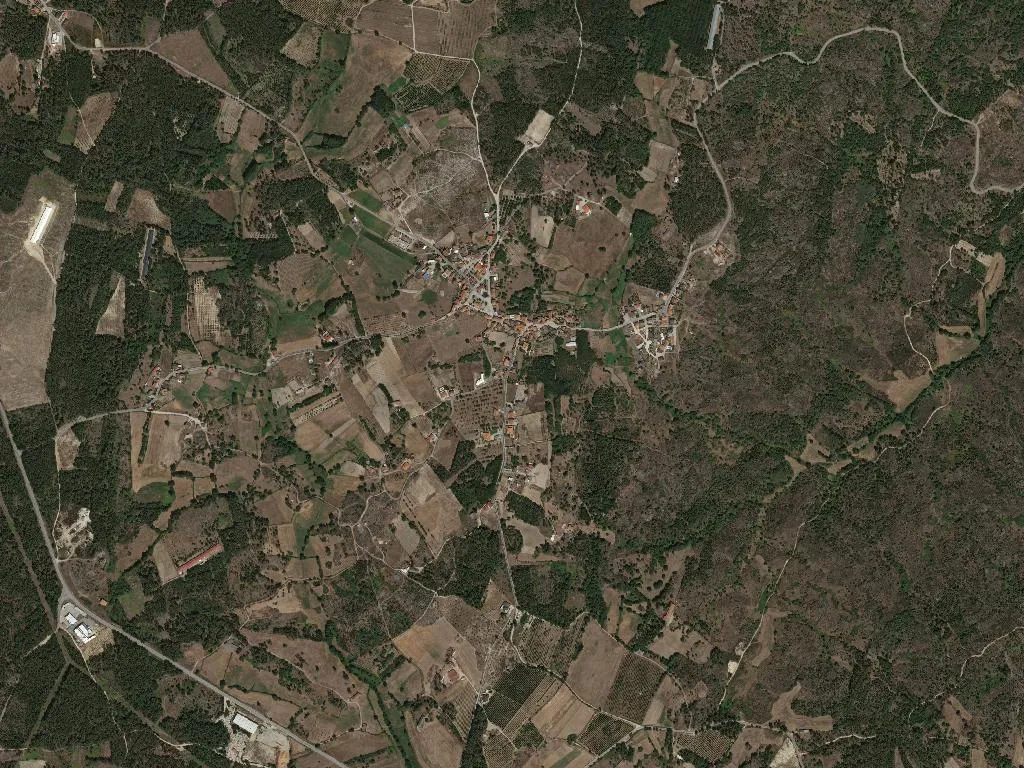
Look closely at the granite jambs of any farmhouse door and you’ll find a rudimentary cross chiselled into the rock. The masons cut it before the wall went up, a fleeting compass that simply says: main entrance here. At 763 m above sea-level, the civil parish of Souto de Aguiar da Beira e Valverde has 363 souls spread across 20 km² of chestnut and pine. The official map lies: what looks like two hamlets is actually three, because Souto splits into Souto de Baixo and Souto de Cima, two clusters of stone and schist that eye each other across a valley of potato plots.
Sunday mass begins at nine in Valverde’s parish church; the key turns reluctantly, the lock smells of iron and incense. Two kilometres east, on a rutted track passable only in a high-clearance car, stands the tiny chapel of São Pedro de Verona. Inside, the “holy souls” are not the usual whitewashed niches but glass-fronted boxes pinned to the wall, each sheltering a photocopied saint. Beside it, a three-step Roman spring still delivers drinkable water. Locals remember when the coat of arms above the door was intact; the grandson of the last owner sold the carved stones to a builder in Viseu, and the crest vanished into a garage wall.
Calendar of saints and processions
Festas have been nudged to the nearest weekend to suit diaspora schedules. In Souto de Baixo, Santo Antão is honoured on the Sunday closest to 17 January—grilled sardines and plastic cups of red wine at one euro a pour. The confraternity of São Sebastião has folded, so his procession no longer happens. Valverde shifted its own Santo Antão to August because April rain turned the field in front of the church into a marsh. The 800-metre procession of Nossa Senhora de Fátima leaves the church, descends to the roundabout, turns round and comes back: twenty minutes of rosary and candle smoke.
Cheese, wine and the memory of taste
Serra da Estrela DOP cheese is available from Quinta do Crestelo—ring 961… and order a day ahead; €8 a kilo, still warm, wrapped in muslin. Requeijão arrives in recycled Tupperware that you return the following week; €4 buys a tub of cloud-white curd. In the village cafés, Dão wine is served from plastic litre bottles: €2 for red, €1.50 for white. Chanfana, the goat stew slow-cooked in a black clay pot, appears only in January when the animals are slaughtered. Albertino’s restaurant in Souto de Cima serves it on Wednesdays if you book first. Dona Alda’s queijadas—small, cinnamon-dusted cheesecakes—are sold from her front door every Friday; one euro each, still warm from the wood oven.
Where the land keeps secrets
Five kilometres away, just inside the Trancoso border, the derelict uranium mines are barred by wire fences. The shafts yawn like dark mouths; approach at your own risk. Two way-marked trails leave from the azulejo-tiled signs in each village centre: the PR1 Souto-Verdial (5 km) and the PR2 Valverde-Moinhos (8 km). Above Valverde, on a heather-covered hill, five anthropomorphic graves are scooped straight out of the granite—no plaque, no fanfare, only the wind. The best viewpoint is the cruzeiro at Souto de Cima: on a clear day you can trace the snow-line of the Serra da Estrela; when the fog rolls in, you can hear your own pulse.