Full article about Almeida: Where Silence Weighs More Than Stone
Walk the star-shaped ramparts of this border fortress and feel time thicken in the hush
Hide article Read full article
Almeida: silence acquires mass behind the walls
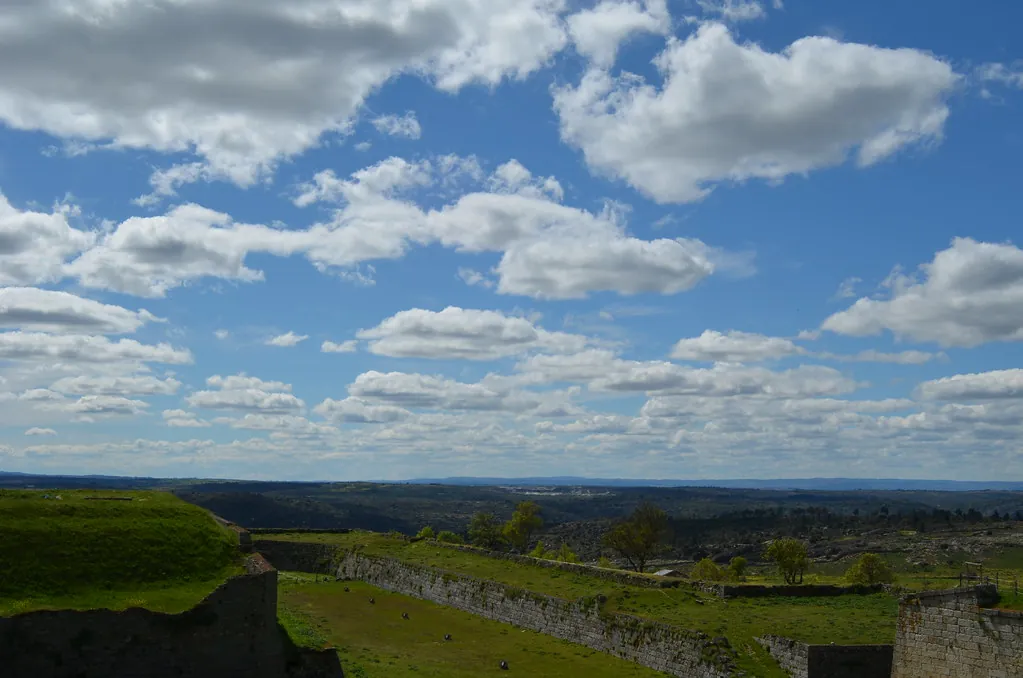
The wind arrives from Spain, skims the plateau, then smacks into twelve granite bastions before it gives up. Inside the star-shaped circuit the air behaves differently—thicker, slower, as though the 16th-century ramparts filtered out enemies and urgency in equal measure. At 744 m the late-afternoon light strikes the stone and returns a warm, almost treacly gold that softens the strict geometry of embrasures and ravelins. Almeida refuses the long-distance selfie; you have to walk through the single tunnel-gate, hear your footfall multiply under the vaulted arch, and feel the chill of shadowed granite on your skin before the place admits you.
Star geometry, cloister hush
From the air the fortress is a twelve-pointed petal of stone, one of the most complete bastioned enclosures in Europe. On the ground that maths translates into dog-leg lanes, dried grass moats, sudden sightlines that reveal a chapel belfry or a sentry’s narrow stair only to hide them again. Two national monuments anchor the parish—52 km² of plateau, 1,145 inhabitants, every last one of them living inside or in the lee of the walls. Population density is 22 souls per km², but the statistic is academic: what counts is the acoustic proof—no scooters, no raised voices, just the click of your own heel and, somewhere overhead, the soft wheeze of a stork gliding in from the border ridge.
Morning is the best audit. Mist clings to the parapets; wood-smoke drifts from chimneys; a single café opens its iron shutter with the rattle of a medieval portcullis. Of those 1,145 residents, 397 are over sixty-five and only 88 are children. The arithmetic is audible: Almeida is populated by people who stayed, or who left city grids and returned to purchase silence by the cartload.
Border on a plate
There is no neon-lit gastro-strip. Flavours surface in domestic kitchens, back-yard ovens and the cool darkness of larders where chouriços hang like burgundy silk ties. Cabrito da Beira—milk-fed kid with Protected Geographical Indication—carries the austerity of the plateau in its lean fibres, then repays it with a slow roast and a drizzle of olive oil whose fruitiness tastes almost indecent after the dry-stone landscape. Both Beira Alta and Beira Baixa oils hold DOP status; they thicken soup, anoint cast-iron grills, and lace the breakfast bread that is toasted directly on glowing embers. Local reds—Fonte Cal, Batuta, Rufia—are built for altitude: dark enough to match the night sky, tannic enough to stand up to goat, boar or the wind that scours the ramparts after sunset.
A historic village with the receipts
Membership of Portugal’s Aldeias Históricas network is more than a brass plaque. Restoration grants have repopulated vacant casas with cedar shutters and hand-forged ironmongery; planning rules keep concrete at bay. Inside the walls you will find 17 places to sleep—two-man apartments in former gunpowder stores, four-bedroom townhouses whose stone stairs are worn to a ripple, a small guesthouse that used to quarter Spanish officers during the Napoleonic occupation. No resorts, no wristbands, no poolside DJs. Night is blackout-dark; the loudest sound is the metallic creak of the fortress gate as the GNR patrol locks up at 2 a.m.
Military memory is written into street names—Rua do Cabido, Rua da Muralha, Travessa do Fosso—but the present mood is the opposite of siege. Almeida now defends its inhabitants from the outside world’s overload. The only invasion is slow-reading travellers who discover that a day here contains about thirty hours.
The plateau as frame
Beyond the glacis the parish unrolls 5,242 hectares of granite ribs and broom-scented scrub. Spain is a ten-minute drive; the horizon is uncluttered by infrastructure, so the eye rehearses the 18th-century officer’s daily sweep for dust clouds and enemy movement. There are no waterfalls, no kayak rentals, no Instagram pontoon. What the land offers is negative luxury: no queue, no soundtrack, no data signal for long stretches. Walk the old smugglers’ path at dusk and the only punctuation is the blink of a stonechat or the far-off cough of a farmer starting his tractor for the evening milking.
Last call
Twilight happens from the outside in. First the outer bastions lose the sun, then the curtain walls, finally the terracotta roofs around the main square. For three suspended minutes the entire fortress seems to inhale. You hear it then: a low, even exhalation as the plateau wind grazes the lip of the parapet—stone breathing after four centuries. It is the sound that remains when every engine is switched off and every visitor has closed the guidebook. Almeida does not do catharsis; it does interval—the pause between sieges turned into a lifestyle. Pack light, bring a watch you don’t mind forgetting to check, and remember that the walls were built to keep time out, not to let it in.