Full article about Freineda’s white glare & Wellington’s war room
Walk limestone gravel where Wellington mapped Masséna’s retreat amid thyme-scented gorse
Hide article Read full article
The gravel speaks first
Gravel mutters underfoot – not the creak of old floorboards but the dry rasp of limestone saibro in the main square. Wind arrives without notice, straight off the Spanish meseta, and the village, set at 765 m, offers no apology for the cold or the glare. Light here is surgical: it slices the whitewashed corners of cottages, flares against granite doorframes, throws noonday shadows as sharp as bayonets. Opposite the parish church a two-storey stone house keeps an English secret. Between November 1812 and May 1813 the Duke of Wellington plotted inside those walls, drafting the manoeuvres that would push Marshal Masséna back across the Coa. No blue plaque, no audio guide; only the same lace curtains at the sash windows, as though the clock stopped when the headquarters folded its maps and left.
Why a general stopped here
Open horizons explain everything. From the door of the so-called Casa Wellington the Coa valley unrolls like a parchment of possible retreats; water runs year-round in the Santo Antão stream; pine and holm-oak give discreet cover without blocking sight-lines. Wellington, a man who thought in contours, liked what he saw. The place was then Fresnedas, from the Latin frinium – ash forest – though the trees were long ago replaced by broom, yellow gorse and knee-high thyme that releases its scent only when you trespass. Dark maritime pines stitch the upper slopes; lower down, stray cork oaks still lure wild boar after acorns. On autumn mornings the smell of wet earth is inseparable from wood-smoke drifting from chimneys lit before seven.
A baroque shell with a Renaissance heart
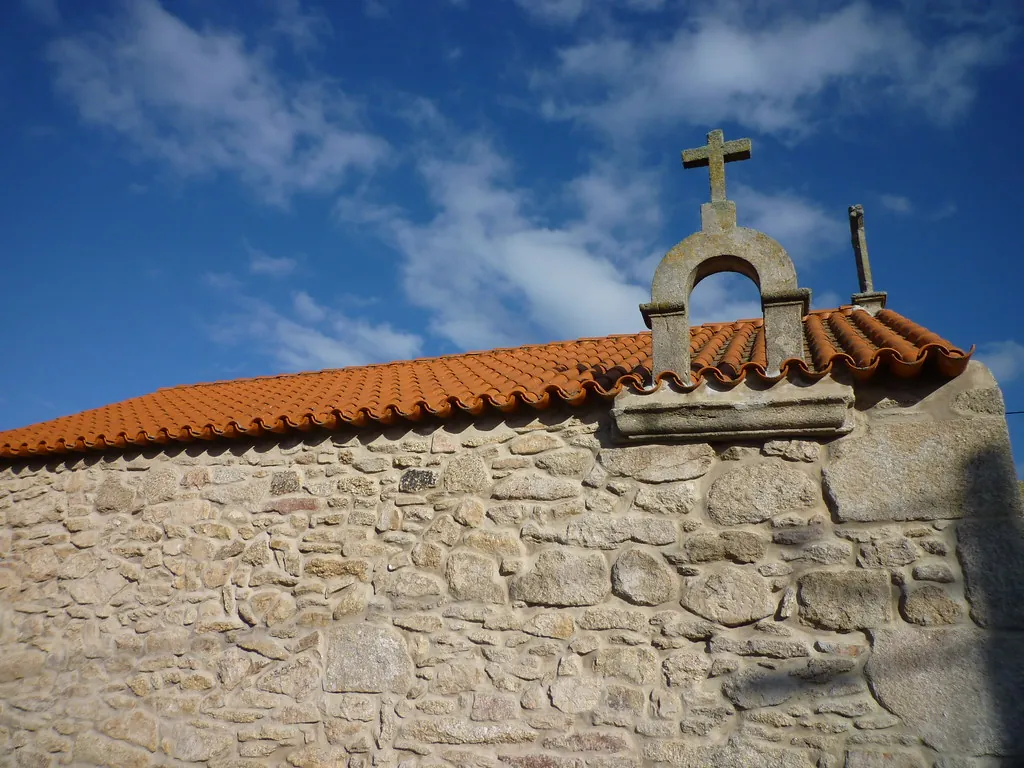
Igreja Matriz crowns the ridge, an eighteenth-century façade masking an earlier Renaissance high-altarpiece stripped of gilt but still catching candlelight. Grave-slabs in the nave remember names no one now can read. My grandmother swore they were “important people” and left it at that. A few paces away the tiny chapel of Santa Eufémia keeps its door locked except on 15 September, when the annual fair and pilgrimage inflate the population five-fold. Procession, sung mass, striped awnings, the smoke of roast kid mingling with sugar-dusted farturas – for twenty-four hours the square feels almost metropolitan.
Sausage, kid and oil that carries a postcode
March belongs to bucho: a bulbous rice-and-pork stomach that takes two days, half a dozen spices and a willing aunt to reach perfection. April and May bring wood-oven kid brushed with Beira Alta DOP olive oil, the region’s answer to the more famous Trás-os-Montes version. The rest of the year you may find hare rice shot in the surrounding scrub, wild-boar stew, ewe’s-milk cheese and cloud-light requeijão. Bread arrives in the Alentejo style – open-crumbed, built for sauce – and a thimble of herb liqueur ends the meal. Ask for medronho if you fancy an after-burn; locals claim it “kills”, then pour themselves a second.
Where the Coa lingers and the trails keep quiet
Two kilometres north the Porto de São Miguel weir traps the Coa in a limpid pool where trout nose upstream during the first autumn rains. Wild duck and turtle-doves loaf on the margins; the local hunting club organises dawn census walks. Footpaths follow the river to the Santo Antão ponds, but signposts are rumours – you ask at the bar or follow hoofprints dried into ochre mud. Near a spot called Cabaços, medieval anthropomorphic graves are scooped straight into the bedrock: narrow ovals that once cradled adults and children. My father called them giants’ bathtubs; I believed him long enough for the place to feel haunted. Even in August the nineteenth-century fountain runs icy. Fill a pitcher, wet your wrists, listen to stone echo and, at six o’clock, to the church bell catching the low sun as it ignites the granite. Dogs settle on doorsteps, conversations sink to murmur, and for a moment the village exhales before night pulls the plateau over itself like a blanket.