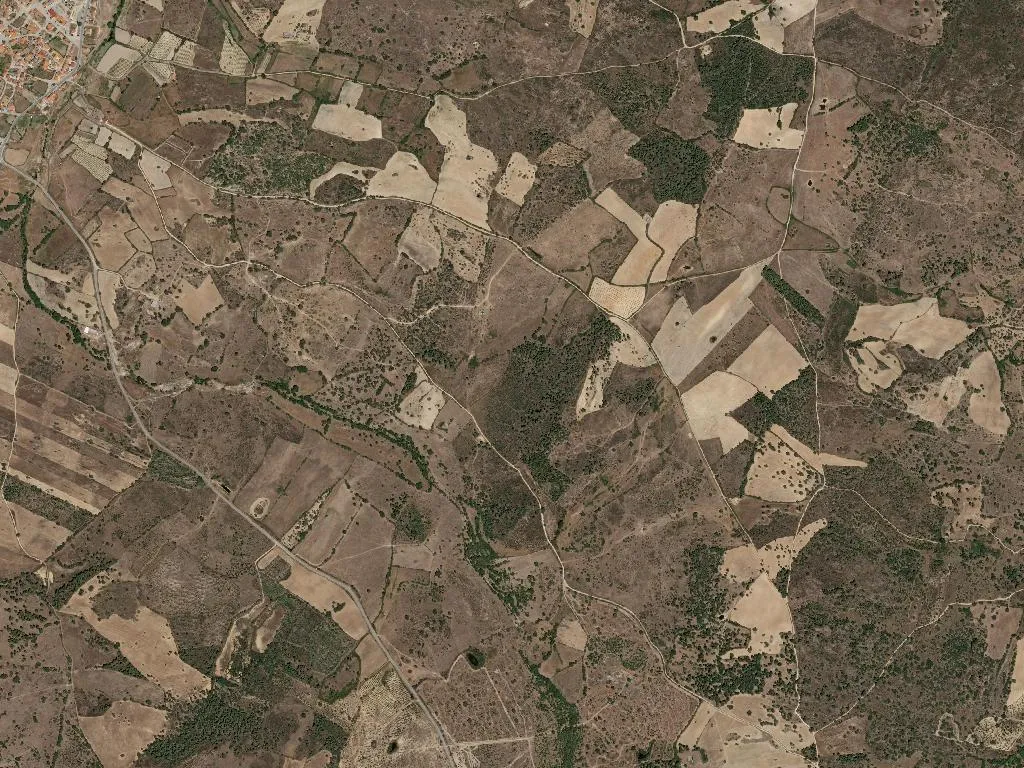
Full article about Malpartida & Vale de Coelha: 723 m of granite hush
Above Almeida’s star-fort, twin villages trade olives for echo and crystals for stories
Hide article Read full article
Dawn at 723 m
The morning light doesn’t glide here – it hits, blunt and absolute. Granite houses, limewashed to deflect the glare, turn cold to the touch the instant the sun slips behind a cloud; altitude has its price. The air is thin, threaded with wood-smoke and the metallic scent of soil just turned by a lone gardener who still works with a hoe. Silence is not a metaphor: you can hear a dog barking in the next hamlet as though it were tied to your gate, the sound travelling unhindered across empty ridges.
What you see on the map is labelled “União das Freguesias”, bureaucratic shorthand invented in 2013 when Lisbon merged Malpartida and Vale de Coelha for administrative convenience. Before that, each village kept to itself. Malpartida appears in 13th-century ledgers; Vale de Coelha scatters pieces of Roman pottery every time a trench is opened for a new water pipe. Both grew in the shadow of Almeida’s star-shaped fortress; when the Spanish frontier five kilometres away still mattered, locals gauged risk by counting foreign patrols.
Stone that once paid wages
Three abandoned quarries – known only to visiting geologists – hide seams of aquamarine beryl, cassiterite tin ore and other minerals that German buyers paid for in crisp Deutschmarks during the 1980s. No commercial trucks come now, but the initiated still keep a geological hammer in the boot: park by the verge, scramble down, crack three blows and pocket a crystal that will sparkle on a Lisbon dinner table. The rest is bragging rights for weekend mineralogists: “Beira material, darling, straight from the source.”
What the table receives
The olive oil carries DOP status, yes, but forget visions of endless groves: four-dozen pocket-sized orchards of fifty trees each supply five-litre cans sold at Almeida’s monthly fair – just enough to cover annual car tax. The kid goat is IGP-branded, yet real cabrito appears only at Christmas; the rest of the year locals braise billy-goat with tomato and bay, stretching one pot across three meals. Vines cling to slopes so steep a tractor can barely straddle the rows; the high-altitude grapes sometimes fail to ripen at all. When they do, the resulting red is stubborn on first pour – but open a second bottle and it begins to taste like deferred gratification finally delivered.
The Côa that refuses to flow south
Portugal’s most contrary river rises in the nearby Serra das Mesas and heads north, defying every textbook diagram. It squeezes through a miniature gorge here; in August you can paddle, in January even the sheepdogs keep their paws dry. Park on the single-track lane, walk ten minutes downstream, and bring water and lip-balm – shale turns slick as soap after rain, and the gorge echoes like a cathedral.
Inventory of the living
The 2021 census records 181 inhabitants. Ninety-six draw pensions, nine still catch the yellow bus to primary school in Almeida. Those in between patch together a living: building sites in Vilar Formoso, a milk tanker run, a few dozen ewes that Dona Rosa milks for cheese she sells to whoever knocks. The café opens Mondays – nominally until seven, earlier if no one turns up. Outsiders swear they have reached the end of the world; locals claim the world ends at the brow of the hill, and that is sufficient.
At dusk the granite seems to ignite without flame, the low sun gilding every block before the cold reasserts itself. Wood-smoke rises straight, unravelling into a sky already pricked with stars. You stand, hands in pockets, watching the plume dissolve. There is no programme, no next stop – and nothing else required.