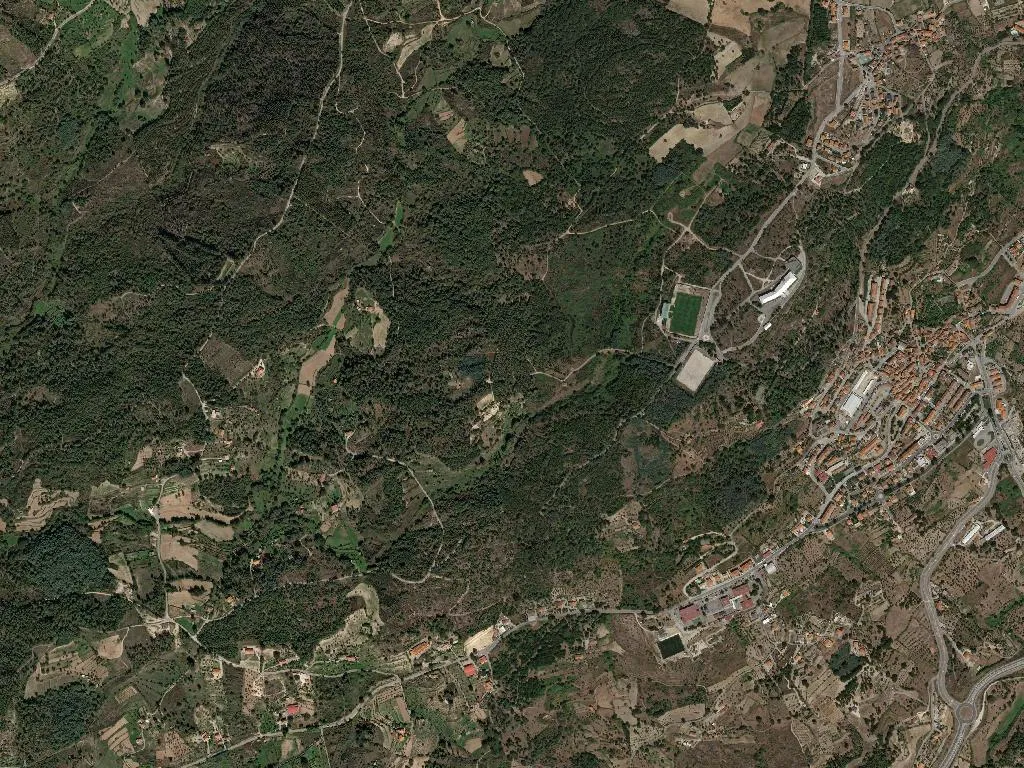
Full article about Infias: Granite Hush Above Fornos de Algodres
Cobblestone lungs of the Serra da Estrela, where church bells echo across thyme-scented silence.
Hide article Read full article
The Warmth of Granite
The granite warms under the late sun. At 618 m above sea-level, Infias inhales thin, dry air that slices through January dawns and thickens with pine resin in the stretched-out light of August. Houses sit low, stone first, terracotta second, their windows modest hatches against the mountain draught. Two-hundred-and-sixty-two souls occupy 278 hectares—enough room for silence to settle between buildings and for the slam of a single door to ricochet the length of Rua do Centro.
Geography of Quiet
Infias belongs to the municipality of Fornos de Algodres, suspended between the Beira Baixa plain and the granite bulk of the Serra da Estrela. With only 94 residents per square kilometre, space here is a measurable commodity: the distance between you and your neighbour, the unobstructed passage of air, the thirty-minute gap between footfalls on the lane that links Largo da Igreja to the primary school. Twenty-seven children still kick up ochre dust on that track; fifty-six elders can name every outcrop of schist along the way. The demographic seesaw tilts towards memory, yet life clings on, as stubborn as the moss colonising the north face of the ruined Pombal manor.
Two monuments enjoy Public Interest status. The Mannerist façade of Igreja de São Tiago, dated 1593, wears its stone scrolls with unshowy confidence, while the 1784 calvary cross in the churchyard once anchored Ash-Wednesday processions. Neither demands an entrance fee; they simply stand, carved by craftsmen whose names dried in the mortar, greeting passers-by like old acquaintances you nod to but never detain.
Taste of Altitude
Infias’ kitchen borrows from both Beira Alta uplands and the Serra’s shepherding culture. Serra da Estrela DOP cheese arrives velvet-white, a raw-sheep’s-milk disk coaxed into buttery paste and cave-cured until it smells of damp cellar and thyme. Requeijão, its fresh cousin, is spooned warm onto Dona Amélia’s rye, faintly sour, the crust blistered from a wood-fired oven. Lamb and kid certified under Serra da Estrela DOP and Beira IGP labels graze the same high meadows that feed the ribeiro; roasted low and slow, the meat tastes faintly of cistus and chilled stream water. Wines travel less than 40 km from the Dão: medium-bodied reds with polished tannins sharp enough to slice the next forkful.
Interior Rhythm
Crowds do not reach Infias. Coaches unload nowhere; the last espresso is served at eight. Visitors come for what is missing: no playlist, no queue, no need to nod at strangers. A full hour can pass on the footpath south to Colcurinho without meeting a soul—only the soft scuff of your own shoes on uneven granite.
Light behaves theatrically. At dawn it skims across schist walls, stretching shadows like pulled toffee. Midday erases edges; late afternoon gilds stone and forearms alike. When the sun drops behind the mountain, warmth drains in minutes—one moment your palm still registers heat in the granite, the next you shiver as shade advances. It is that sudden thermal snap, more than any monument, that the traveller carries away.