Full article about Matança: Dolmens, Saints & Shepherd Time in Guarda
Bronze-Age tombs, granite sarcophagi and river-side saints mark this high-plateau village.
Hide article Read full article
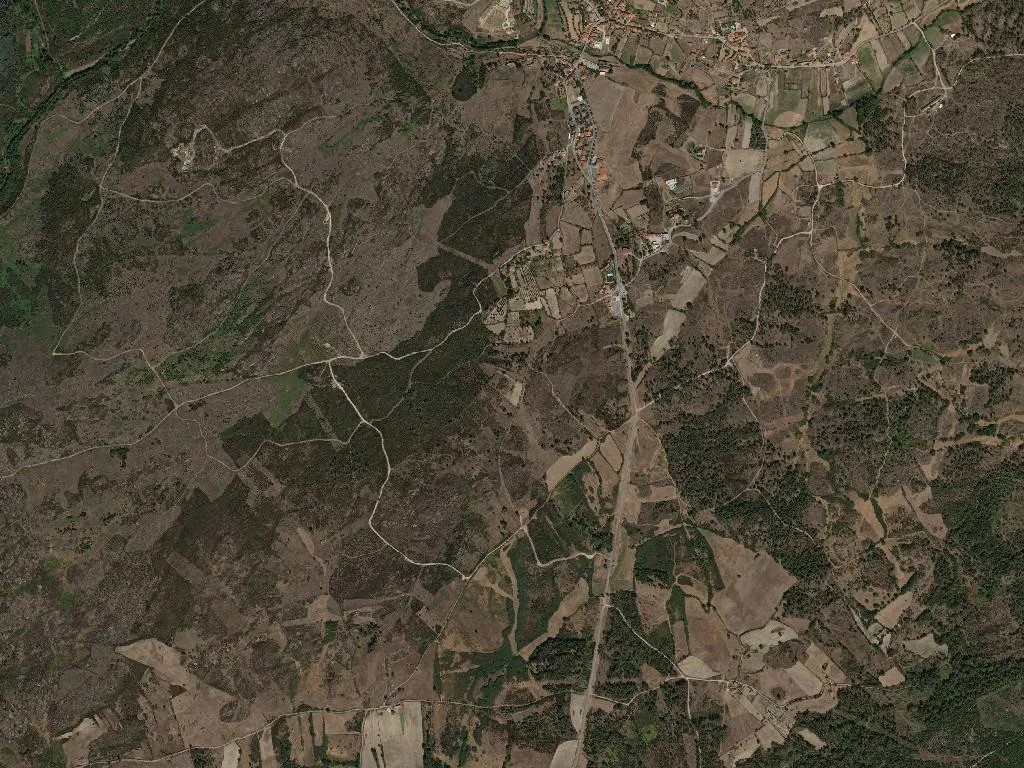
The silence arrives first. Not the hush of empty streets, but the weighted stillness of the Beira plateau where wind combs through gorse and broom and the Carapito river rehearses the same sentence it has murmured since the last ice sheet retreated. At 625 m, Matança’s 215 inhabitants occupy a wrinkle of granite hills between chestnut groves and broom-covered moorland; clocks feel optional when the year is still parcelled by equinoxes, olive picking and the twice-yearly migration of shepherds.
Stones that remember
A farm track, graded only by hooves and tractor tyres, leads to the Corgas dolmen, a four-metre-high megalith whose capstone still carries Bronze-Age cup-marks. Joaquim Leite de Vasconcelos, Portugal’s first scientific archaeologist, excavated here in 1888; stand beneath the slab and you share the sightline of people who 5,000 years ago watched the same star-rise over the Estrela ridge. Closer to the village, the medieval necropolis at Forcadas keeps its dead above ground: twenty-four sarcophagi scooped directly into bedrock in the seventh century, long before Matança received its first royal charter (Afonso III, 1270; renewed by Manuel I in 1514). The parish lost administrative independence in 1836, yet the granite pillory on the small main square still insists on former status like a retired magistrate in threadbare robes.
Roof-tile gargoyles and river-ward saints
A 30-minute footpath—dry-stone walls fuzzed with lichen—drops to the Romanesque-Gothic chapel of Santa Eufémia. Thirteenth-century corbels under the eaves grin with beaked demons and moon-faced saints; inside, a portable baroque altar is carried out each year so Mass can be said in the open air. Pilgrims converge twice annually: 16 September and the Monday after Easter, when flocks are herded uphill, wood-smoke drifts across spring furrows or late-summer dust, and an impromptu country fair spreads across the slope. Downstream, the single-arch medieval bridge carries the road over the Carapito; its tiny companion chapel, Nossa Senhora dos Milagres, keeps a painted river-gaze. Parish church Santa Maria Madalena counters with gilded wood that catches candlelight like a slow-motion flash.
Flavours that wait
Altitude and diurnal swing give the local Dão vineyards a crisp spine; bottles from 600–700 m taste of cold midnight and high-noon sun. In stone cellars the protected Serra da Estrela cheese firms from custard to sliceable over two months, while terracotta pots hoard requeijão as thick as clotted cream. Lambs and kids graze on heather and wild thyme; after slaughter the legs are rubbed with garlic and mountain paprika, then smoked over cork-oak logs that burn for days. Cornbread cools on linen cloths, rye broas are pocketed for fieldwork, and strings of chouriço hang like judicial nooses in the fumeiro, curing to a glossy ox-blood.
When the granite pillory’s shadow reaches the uneven cobbles, the church bell tolls six. Echoes slide down the Carapito valley and dissolve among chestnut trees. Somewhere a dog announces the evening, a fumeiro door thuds shut, and a single plume of smoke rises—scented with paprika, oak and centuries pressed into stone.