Full article about Sobral Pichorro & Fuinhas: granite, cheese & chapel smoke
Where Trancoso’s stream murmurs past slate-cheese cellars and 1730 candle-lit chapels
Hide article Read full article
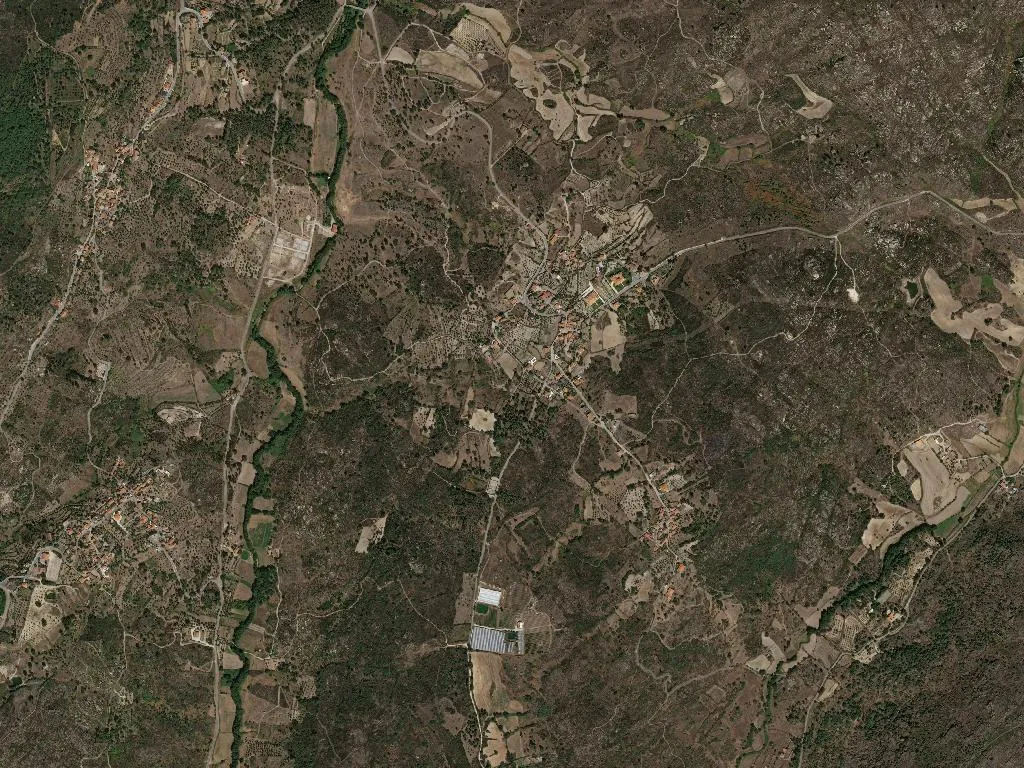
The stream that slips down from Trancoso reaches Sobral Pichorro without haste, gossiping between worn granite and the roots of willows. Its hush is the village’s soundtrack — not an empty quiet, but one dense with what has gone and what refuses to leave. At 487 m on the north-eastern folds of the Serra da Estrela, the stone walls drink in the day’s heat and give it back slowly at dusk. Two hundred and twenty-seven people share the parish — Sobral Pichorro and the hamlet of Fuinhas — yoked together officially in 2013, yet linked long before by dirt tracks, by sheep that still graze the same slopes, by seasons that refuse to hurry.
Stone & belief
In the heart of Sobral Pichorro the chapel of Santo Cristo rises, wrapped in stories that drag Romans, Visigoths and Jesuits into the same sentence. Documentary truth is plainer: inside, a tombstone carved with a praying figure testifies to older devotions. The Jesuit emblem that once crowned the façade was chiselled off in the nineteenth century, yet memory lingers in the murmur of older men outside the café. A few strides away the parish church of Nossa Senhora da Graça shows off its 1856 tower, paid for by subscription — one family a kid goat, another a day’s labour, a widow a basket of rye — each contribution mortared into the skyline.
Fuinhas, listed as “Funha” in the 1527 census, fragments into four microscopic places: Lameira, Casas, Corujeira and Santo. In Santo, the chapel of Santo Amaro hosts an annual fair every 15 January, when cold snaps the air and chimney smoke rises in perfect verticals. Inside the chapel of Nossa Senhora do Carmo, blessed in 1730, candlewax and old wood mingle with geometry of light thrown through slit windows onto stone.
Serra on a plate
Here, food is not theatre; it is ballast. Serra da Estrela DOP cheese ripens on slate shelves, its buttery paste holding the flavour of high pastures where Bordaleira ewes graze. Fresh requeijão, faintly sharp, is breakfast smeared on charred corn-bread. Serra da Estrela DOP lamb and Beira IGP kid roast in wood-fired ovens until the meat sighs off the bone, seasoned only with garlic, coarse salt and patience. Dão reds — dense, granite-scented — warm the ribs on foggy nights.
Tracks between hamlets
The unpaved lane linking Sobral Pichorro to Fuinha crosses meadows where Transmontano mastiffs patrol cream-coloured cattle. Spring gorse splashes yellow across scrubby slopes; isolated oaks throw shade over abandoned schist sheds and circular threshing floors where oxen once trod out rye. No waymarks, no selfie signs — just a shifting view framed by dry-stone walls and the occasional stone well.
At Quinta da Mata Gata, a manor that seeded the hamlet of Mata, you glimpse how a single estate can father a community — a process measured in christenings and funerals, invisible to the hurried eye.
Evening slants gold across whitewash, the church bell counts the hours, and again you hear the stream — the same low conversation that carried on before cartographers drew a line around Sobral Pichorro and gave it a name.