Full article about União das freguesias de Aldeias e Mangualde da Serra
Sheep-paths, wool-lined lanes and a 1,200 m-high Water Festival in Gouveia’s sky parish
Hide article Read full article
The Sound of Water
Water speaks first. Even when no stream is visible, it chatters through granite runnels that braid the lane called Rua de Baixo, drips from an 1897 drinking fountain polished each July for the Water Festival, and settles in the stone tank at Fonte da Praça where my grandmother scrubbed sheets until 1983. At 1,200 m, on the roof-ridge of central Portugal, the civil parish of Aldeias e Mangualde da Serra was created in 2013 by merging two microscopic settlements—yet its affair with water began when only summer shepherds bothered to climb this high. Since 2016 the Water Festival has crocheted 2.3 km of lanes into a sleeved mosaic: 18,000 m of coloured wool worked by 47 of the 424 souls who still call the mountain home.
Granite that Learnt to Resist the Wind
Houses grow out of the slope as if the mountain had a second, sharper skin. On Rua da Igreja a dry-stone wall—1.8 m high, raised in 1854 by Joaquim da Conceição—still shoulders the Carvalhos vegetable plot; great-grandchildren pick blackberries from its crown. Maize stores, four metres by three, stand on basalt stilts with 2 cm air gaps to foil the blind mole-rat locals nickname “rato-cego”. The parish church of São Cosme, quarried from Vale de Maceira granite between 1756-62, is a single 18-metre nave—towerless since the north-easterly gales, clocked at 120 km/h one February in 1887, toppled the earlier belfry and the villagers decided God could do without the extra stone.
Footpaths that Stitch Faith to Scenery
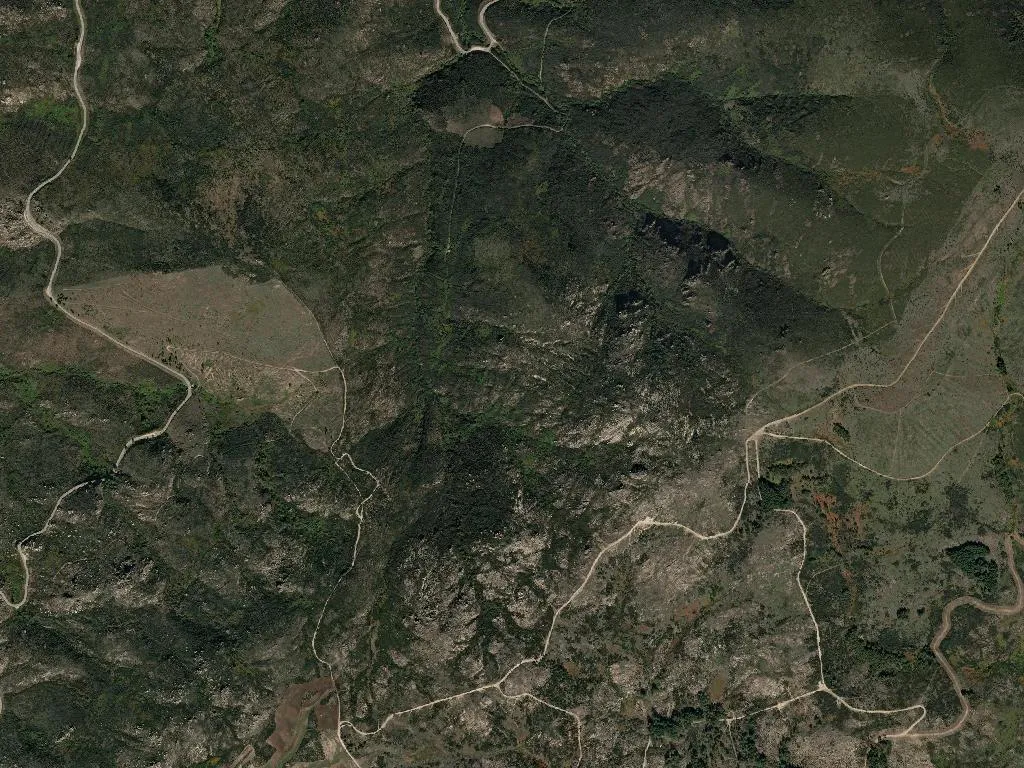
The Faith Trails footpath (PR2 GVE) crosses the parish like an invisible seam. Fourteen kilometres start at the 1723 granite calvary on Monte do Senhor do Calvário and pass the chapel of São Pedro de Mangualde—supposedly built in 1624 after a shepherd found a carved saint beneath a cork oak. From 1,380 m the Mondego valley lies 600 m below; in mid-October chestnut woods flare rust-orange like an Arraiolos tapestry suddenly unrolled. At kilometre eight the trail meets the Carvalhal levada, a 1936 irrigation channel engineered by the Mocidade Portuguesa that still carries snow-melt 3.7 km to the village on a gradient gentler than a hairline crack.
Mountain Cooking, Flavours at Full Pressure
Maria do Céu serves chanfana in the same red-clay bowls her mother used—six-month-old kid, Dão red from Quinta da Pellada, four hours in a wood oven until the sauce lacquers the rim. The cheese arrives from Quinta das Lezírias: raw Bordaleira ewe’s milk coagulated with wild thistle flower that grows only above 1,000 m, giving a velvet bitterness you will not find in supermarket Serra. Chestnut soup is autumn in a bowl—400 g of nuts from the 1923 Ribeira grove, winter squash, Beira Interior olive oil pressed in Folgosinho at 0.2 % acidity, fennel that self-seeds beside the village pump. December means bolo de tacho, grandmother Isaura’s recipe (1904): 1 kg of black-pork belly, 2.5 kg of rye flour, eighteen eggs, stirred for six hours in an iron pot that has outlived five generations.
Few People, Many Grids of Mutual Debt
Eleven inhabitants per square kilometre. Statistics cannot record the day António, the only carpenter, broke his femur and thirty-eight neighbours harvested his plot and staked his seventeen olive trees before the third sunset. They miss the Wednesday library session—seventeen children, eight adults—and the folk-dance troupe “As Estrelas da Serra”, thirty-four strong; nineteen no longer live here but return for every festival to swirl partners under strings of light bulbs. The Water Festival’s crochet begins each January: an average of twenty-three metres per person, knitted from Bordaleira wool bought by the town hall at €3 a skein from the last mill in Seia. The 1936 levada still feeds the communal vegetable patch—847 m² shared by fourteen families—and fills the tank where children now sail cork boats while a bagpiper rehearses on the church steps, D. Amélia sells pumpkin jam, and Luís, seventy-eight, teaches émigré grandchildren how to build a granary that will outsmart both wind and rodent.
At dusk the scent of burning oak drifts from seventy-two active hearths. The granite façades shift through a slow spectrum: bluish-grey at 17.30, lead-coloured at 18.15, matte black when Gouveia’s lights ignite far below. And the water keeps running—quiet, non-negotiable—through the runnel Joaquim repaired last Sunday, because, as he puts it, “if this ever dries up, the village ends.”