Full article about Avelãs da Ribeira: Where Granite Bridges Echo Footsteps
Roman paving, chestnut camino and moss-lipped fountains cling to a 604 m Guarda ridge
Hide article Read full article
The granite answers back
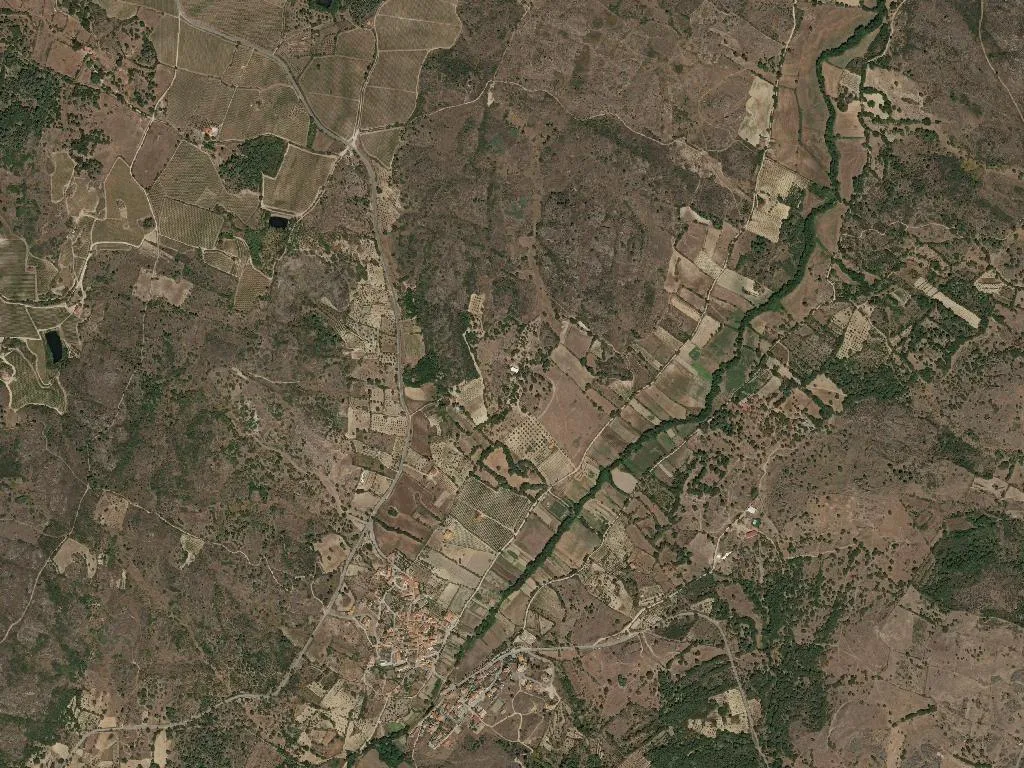
The Roman bridge stones grate under your boots, polished glass-smooth by 900 years of boots, hooves and cartwheels. Below, the Ribeira de Avelãs slides north-westwards, black even in July, carrying run-off from the 1,200 m Torre plateau. On both banks the schist has flaked into knife-sharp plates that snag the fetlocks of the few goats still grazed here. Avelãs da Ribeira – 142 residents, 604 m up, eleven square kilometres of thin grazing – is not a place you end up in. It is where you decide to begin.
Where the Via Lusitana exhales
The Inner Way of St James crosses the parish as an unpaved stripe you notice only when the gradient jumps. Forget the coastal camino’s credential stamps and albergue queues: here the infrastructure is a dry-stone wall and the soundtrack is your own pulse. The route climbs 250 m in the first hour, corkscrews through chestnut coppice, then drops into a wind funnel that tastes of pine resin and sheep. Locals simply call it “o caminho” – no need for further specification when there is only one.
The parish church, raised in 1810 after the previous chapel slid downslope in a cloudburst, stands austere on its plinth of granite blocks. Push the door and the iron latch rasps like a violin. Inside, light slants through a single east window, throwing a trapezoid across uneven flagstones; the air carries beeswax and the faint sweetness of damp stone you only ever smell in upland Portugal.
Water points still in use
Three granite fountains – Bica, Mija Velha, Portela – punctuate the settlement. None are ornamental; all still run. Mija Velha’s name makes every visitor smirk, yet no one can explain it. Its limestone spout is lipped with a moss-green stain that decades of scouring have failed to shift. Follow the fountains in sequence and you are tracing the vanished laundry map: where women knelt to scrub flax shirts, where mules drank, where gossip was exchanged in voices pitched over the splash.
On summer afternoons Bica doubles as a foot spa. Hold your ankles under the jet for thirty seconds and the mountain cold anaesthetises blistered heels faster than any pharmacy gel.
Geology you can read without a guidebook
The village lies inside the Estrela Geopark, so the ground beneath your laces is a textbook. Schist cliffs glare silver when the sun strikes at 4 p.m.; garnet flecks wink like brake lights. Glacial hanging valleys form natural amphitheatres that amplify the wind into a low bass note you feel in your ribs rather than hear. Every loose slab is a page of tectonic braille: Ordovician pressure, Jurassic drift, the slow divorce of Iberia from North America.
Fuel for the next climb
Cuisine here is calibrated for shepherds who think nothing of a 20 km round trip. Breakfast might be a slice of rye bread smeared with buttery Serra da Estrela DOP cheese; lunch is roast kid scented with mountain sage and enough olive oil to leave your fingerprints glistening. Dinner could be nothing more than warm requeijão – a loose, ricotta-like cheese – eaten straight from the copper pan, its acidity cutting through the fat of the chorizo you nibbled earlier.
Dona Alice’s grocery-cum-post-office is the only retail outlet. Cheese arrives on Friday morning; the wheels of cured ovino are spoken for by Friday afternoon. Telephone orders are accepted, discretion guaranteed.
Last light
When the sun drops behind the ridge, the temperature plummets eight degrees in as many minutes. Your boots are chalked white with schist dust; your calves tremble from the final scramble back to the bridge. The river keeps its own counsel, cold and constant. You stand on the parapet, listening to water that has already forgotten you, and understand why the Romans, the pilgrims and the goat-herders never lingered. Avelãs da Ribeira is a threshold, not a destination; cross it, and the mountain begins.