Full article about Longroiva: Soak in 47 °C sulphur, taste clay-baked lamb
Longroiva, Mêda—sulphurous hot spring, medieval castle, Terrincho lamb in clay pot; Guarda village where steam, stone and flavour endure.
Hide article Read full article
Sulphur, silence and schist walls
White threads of steam curl from the thermal pool and vanish into the dawn. The smell is blunt: struck matches, wet slate, a metallic tang that settles on the skin like a promise. Since 1821, when Lisbon’s Academy of Sciences first commended these waters for chest complaints, bathers have come to Longroiva to let the 47 °C sulphurous spring do what ibuprofen cannot. The nineteenth-century bathhouse still stands beside the stream, its bronze taps coughing softly while the river provides the only soundtrack.
What remains of a vanished county
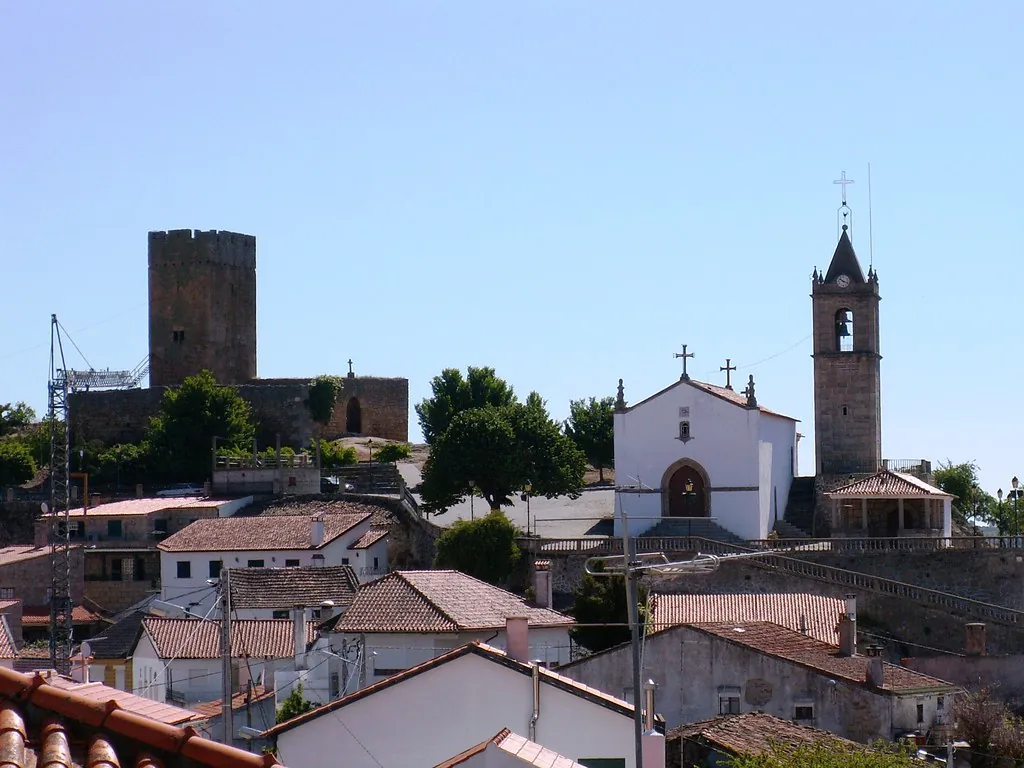
Longroiva governed itself for seven centuries—1120 to 1836—then was stripped of its charter and swallowed by Mêda. Where fifteen hundred souls lived in 1801, barely 218 remain. The granite-and-schist castle, a National Monument since 1927, keeps watch over a fold of olives and vineyards; at dusk the stone glows rust-red against the silver-green foliage. Below, cottages huddle along a single cobbled lane that leads to the parish church and its gilded retable dedicated to Nossa Senhora do Torrão. Her procession still gathers every September, but the cymbals echo differently when half the houses are shuttered.
Smoke, lamb and clay bowls
Kid goat is simmered for hours in a black-clay pot until the meat surrenders at the nudge of a fork. The local Terrincho lamb—DOP-protected, reared on the thyme-scented slopes—appears either as a rich stew or roasted over vine-pruning embers, paired with migas of kale and speckled beans. In autumn, chestnut soup thickens the evenings; smoked chouriço, alheira and morcela hang like charcoal batons from kitchen beams. Dessert arrives in the same clay: tigeladas, a slow-baked custard scented with lemon peel, served warm with Douro almond biscuits and a glass of sturdy Beira Interior red. The hands that ladle the soup are the ones that checked you in ten minutes earlier.
Castle loop and pilgrims’ marks
A three-kilometre loop sets out from the castle gate, skirts the medieval wall and climbs to the whitewashed chapel of São Sebastião. Chestnut shells crack underfoot; centenarian olive trunks twist like contorted dancers; in September the vines hang with ink-dark bunches. The path drops to the Longroiva stream where egrets pick through reed beds and the occasional small water-mill wheel still turns. Yellow arrows confirm this is also an interior route of the Camino de Santiago; carry on and you’ll reach Fonte Longa by nightfall. Mid-winter brings the Fogo de São Sebastião: bonfires lit on 20 January to bless the fields, their smoke stitching the sky with a scent that lingers on coats long after the embers blacken.
By bedtime the aroma of burnt oak has married itself to sulphur on your sweater. Longroiva is not viewed; it is inhaled, deliberately, until your lungs feel lined with Beira Interior granite.