Full article about Marialva: Stone Ship Adrift on Portugal’s High Plateau
Walk empty battlements where wind tastes of broom and only 177 souls remain.
Hide article Read full article
Marialva: A granite vessel adrift on the plateau
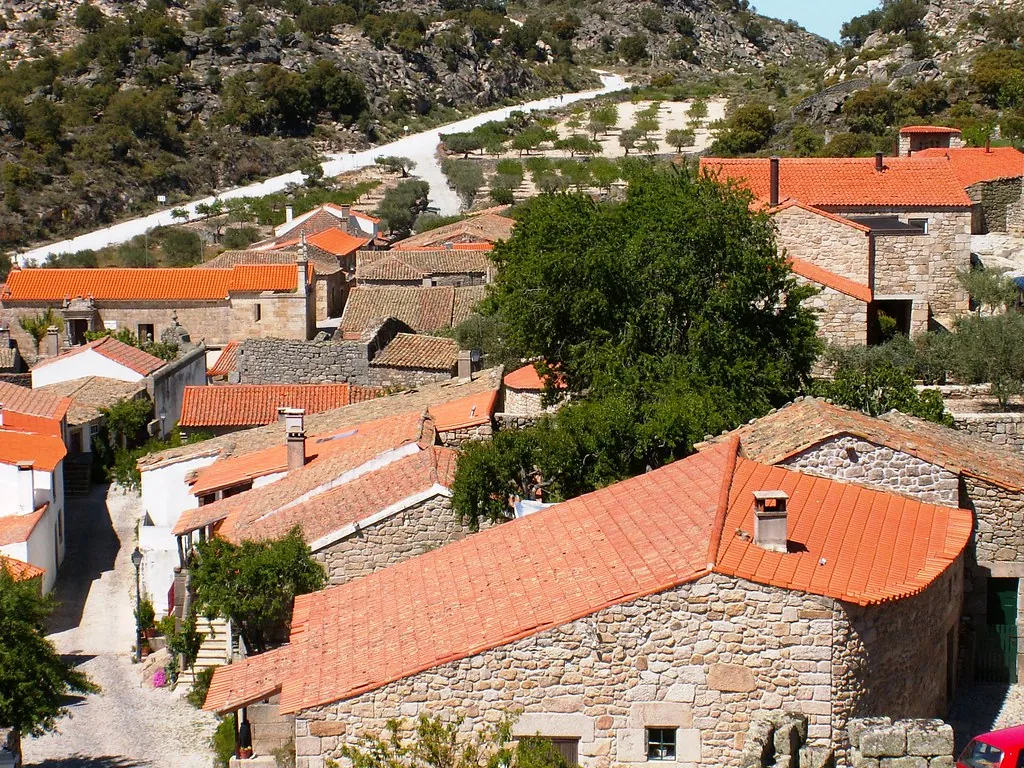
The silence arrives before anything else. It settles between the slabs of granite and the threadbare grass that forces its way through the joints, a silence so complete your own footfalls feel like trespass. At 483 metres above sea-level, on a ridge that drops away to the Côa and Douro valleys, only the wind keeps watch—dry, constant, tasting of dust and broom. Roofs have long vanished inside the walls, yet the stone still conducts sound like a tuning fork: every step on the uneven calçada ricochets through empty doorways until you begin to doubt you’re alone. Arithmetic is merciless here: 177 inhabitants, more than half over sixty-five, and a downward curve that started in 1864. The place has perfected the art of subtraction.
The hull of a boat cut into the sky
Stand on the road from Mêda at dusk and the citadel resolves into a silhouette: a stone vessel riding a dark tide of almond orchards, the keep acting as mast. Night lighting—subtle, amber, installed by a Lisbon theatre designer—makes the walls appear to float. Inside, the sixteenth-century pillory still marks where municipal power was once brandished; lower your head into the cistern and a cool mineral breath rises, a counter-current to the sun-warmed granite. The governor’s palace is now a hollow rectangle open to swifts, and the tiny jail keeps its menace—iron grill intact, key long mislaid. Afonso Henriques granted the first royal charter in 1179; Dinis added a monthly fair in 1286, a privilege still exercised every 25 July when the plateau fills with cattle, cork stalls and the smell of singed pigskin.
Where St James meets Maria Alva
The parish church of Santiago, buttressed against the keep, is a halting post on the lesser-known Interior Way of the Portuguese Camino. Yellow scallop tiles fade quickly here; walkers arrive dust-coloured, grateful for a tap with an unhurried flow. Down the slope, outside the walls, the lower settlement clusters round the Romanesque S. Pedro and the Casa do Conde—now a modest museum displaying a 1492 processional cross and fragments of Aravorum, the pre-Roman civitas whose stones surface every time a vineyard is replanted. Streets such as Rua da Corredoura keep their medieval width; granite sets are polished to a glassy patina by centuries of leather soles.
Legend claims the village takes its name from Maria Alva, a maiden who leapt (or was pushed) from the tower. Desperation or defiance? The chronicles refuse to choose, but the name stuck, later attaching itself—improbably—to the “arte de Marialva”, the Enlightenment science of horsemanship codified by the 4th Marquis, Pedro de Noronha Coutinho, in his 1756 Carta de Lei da Tauromaquia. The title had been created in 1441; its most celebrated bearer, Dom António Luís de Menezes, routed Spanish forces at Ameixial and retook Évora in 1663, earning the right to be buried—so he insisted—under the battlefield’s still-warm earth.
Cheese, lamb and the slow heat of a wood oven
In the single grocery, Dona Alda wields a matte-black-handled knife, sectioning Terrincho DOP at exactly sixty days. The rind is natural, the paste the colour of pale straw; it breaks into cleaved shards rather than neat slices. At O Celta, two streets away, Zé Manel fires his oven with carvalho gathered from the Devesa oak woods; Terrincho lamb and Beira kid roast through the afternoon while the baker’s peel occasionally sparks. Olive oil arrives from centenarian trees in the Côa valley, its bitterness offsetting the sweetness of almond blossom that flashes across schist terraces every February. Wines come from nearby Quinta do Cardo and Figueira de Castelo Rodrigo—high, granite-stressed reds that carry the plateau’s wind in every glass.
The Devesa and the plateau’s buried cities
Three kilometres east, the convent of Vilares—Our Lady of Remedies, founded 1447—lies in skeletal surrender, its cloister open to the sky. After the 1834 dissolution, the Virgin’s image was carried to Santiago; her baroque silver crown still travels in procession when drought threatens. Beneath the surrounding fields, geophysicics has traced the grid of Aravorum, a Turduli settlement later Romanised. Epigraphic stones, turned up by the plough, are now wedged into parish garden walls like footnotes no one asked for. Walk the dirt track south and the land billows into widescreen vistas—ochre wheat, viridian vines, the Douro’s blue meander fifty kilometres distant—layers so thinly washed they might still be wet on the paper.
Ballads traded between battlements
On St John’s eve, locals insist, you can still catch the cantiga exchanged between the Moor of Casteição and the Moura of Marialva—verses hurled across two valleys and four centuries. At first light on 25 July the annual fair re-enacts Dinis’s medieval charter: cattle market at six, brass band at eight, procession at ten, then lunch under canvas awnings where red wine is served in handle-less bowls. By late afternoon the forcados of Penafiel have wrapped their jackets around the bull’s horns and the single bus back to Guarda exhales diesel at 19:30. Silence reasserts itself; the walls cool; the keep’s shadow lengthens like a gnomon tipped on its side. Six licensed casas de turismo offer twenty-three beds between them; most nights, half remain empty. Which, of course, is precisely the point. Fall asleep with the casement open and you’ll hear only the plateau’s slow respirations, as if the whole landscape were a calm sea and Marialva a granite galleon drifting, crewless, to no particular shore.