Full article about Mêda’s granite hamlets where smoke tastes of thyme
Oak-fire kitchens, almond snow and wild-herb lamb above the Côa valley
Hide article Read full article
Smoke that forgets the calendar
Oak logs hiss, chouriço drips, and a white plume climbs the chimney as if March were still January. At 640 m on the Beira plateau, the hamlets of Mêda, Outeiro de Gatos and Fonte Longa obey thermometers, not time. Granite walls store cold the way cellars store wine; slate roofs release it slowly after dusk. Here the hearth is not rustic ambience—it is central heating, drying room, smokehouse and social hub, all at once.
Altitude on the plate
Frost sweetens pasture: Terrincho lamb grazes on irrigated meadows and rock-rose scrub until its meat tastes of thyme and wild lavender. The same ewes give the DOP Terrincho cheese, firm, buttery and faintly resinous from mountain rennet. Nearby presses release Beira Alta olive oil the colour of liquid jade, low in acidity, with a cut-grass bite. Between February and March almond orchards snow petals across the slopes; come Easter the nuts reappear in honey cornbread, aguardiente liqueurs and sticky doces de Pascoa. In smoke-blackened kitchens, linguiça and morcela hang for weeks, acquiring a lacquered skin and garlicky heart that no industrial smoker can fake.
Granite, schist and the naming of cats
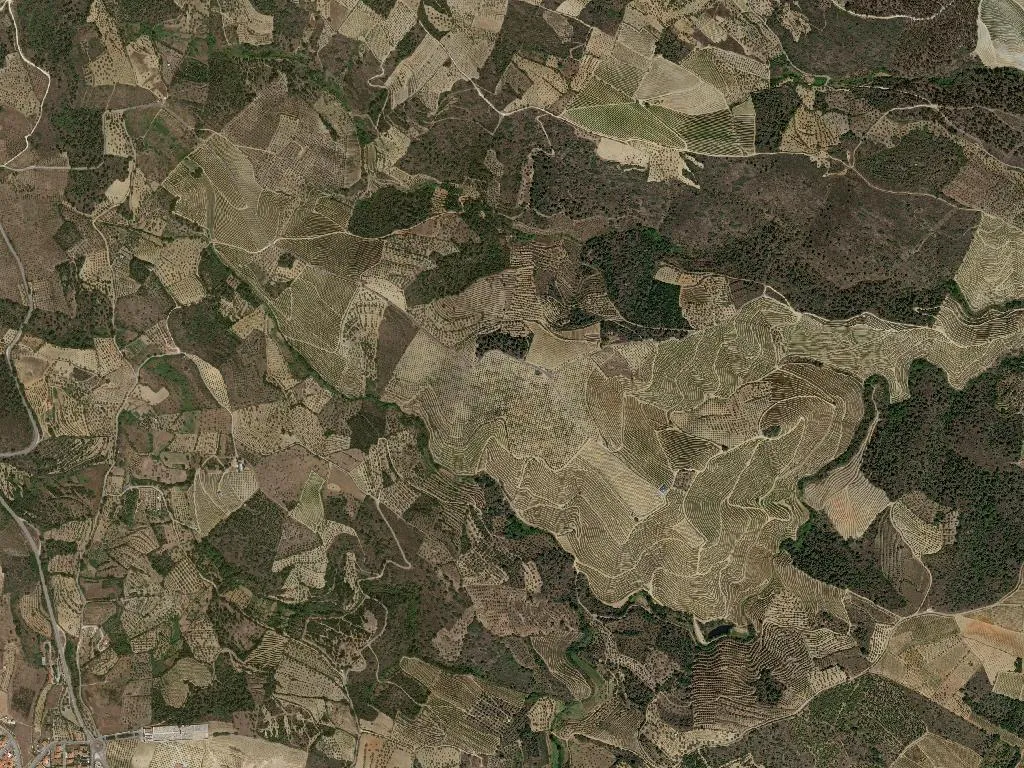
Outeiro de Gatos—"Cat Ridge"—owes its label either to wildcats that once patrolled the crags or to the feral livestock that replaced them. Either way, the topography agrees: boulders the size of box vans, gorse thickets, wind that whistles in minor keys. Fonte Longa, three kilometres south, translates simply as "Long Spring", a thread of water that irrigates small plots of maize and rye before disappearing into the Côa valley. Between the two, almond groves alternate with century-old olives whose trunks twist like overwrought ironwork. Every terrace wall, every ox-path, is built from the stone it crosses; nothing is imported except the sky.
The quiet pilgrim’s way
The Interior Portuguese Route of the Camino de Santiago crosses the parish without fanfare. You will not find scallop-shell waymarks at every junction, yet the logic is medieval: stay high, avoid the valley heat, sleep where there is bread and running water. Moss-covered millstones serve as sculpture beside the trail; in September walkers often pause to help smallholders harvest grapes for Beira Interior reds—tinta roriz, touriga franca—turning a day’s hike into a grape-stained working holiday. Between almond blossoms, hawfinches and Iberian green woodpeckers flash through the branches, easy prey for anyone carrying binoculars and patience.
Population 2,399: a census of names
Spread across 50 km², density averages 47 souls per km²—roughly one neighbour every football pitch. Seniors outnumber under-25s three to one, a ratio audible at noon when the only sounds are the church bell and a distant tractor in second gear. Yet anonymity is impossible: the grocer, the parish-council chair, the woman who rents out two carefully restored granite cottages all remember who arrived on yesterday’s coach from Guarda. Both guesthouses light their fires before you ask and serve cornmeal rolls still warm from the communal oven.
Dusk, and the smoke returns
When the sun skims the ridge, granite glows like embers and the temperature drops as sharply as a guillotine. Back in the kitchen someone splits another log, rekindling the chimney’s white column. It rises straight, stubborn, declaring that winter here is less a season than a state of mind—one that lingers long after travellers have folded their maps and gone.