Full article about Rabaçal’s Granite Echoes & Wild Cheese
Granite walls, wild herb cheese, almond snow—Rabaçal, Guarda, at 538 m.
Hide article Read full article
The granite is simply there. It shoulders field-boundaries that look more like cairns than walls, speckled in April with forget-me-nots. Outside the house of Zé Manel the lintel still carries 1898 and the name of his wife, chiselled in a hurry before the mortar set. Village crosses mark either a sudden death or an apparition of the devil—depends who’s pouring the aguardiente.
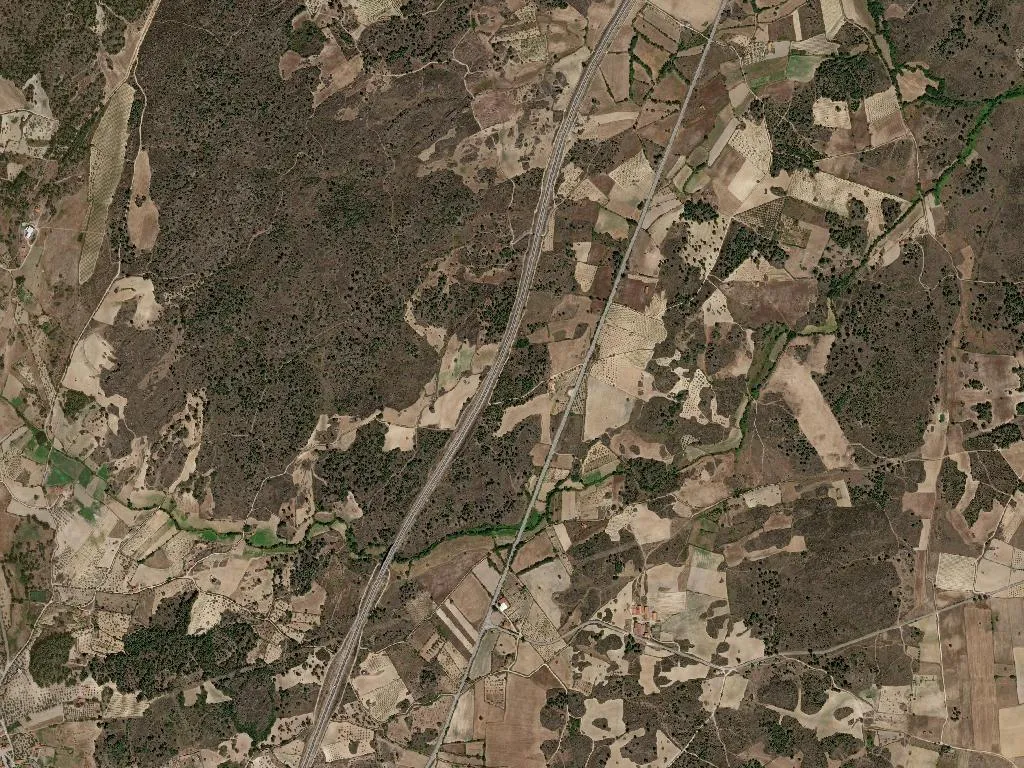
Rabaçal, population 220, sits at 538 m on the eastern lip of the Beira plateau—too low to be mountain, high enough for you to taste the sierra on the wind. Almond trees scatter white pixels across the winter-brown hills; olive terraces keep a tired green, the colour of too many Decembers.
What gets eaten when no one is watching
Terrincho DOP cheese arrives from Churra-da-Terra-Quente sheep that graze the scarps where tractors fear to tilt. It carries the tang of cistus and rock-rose, the flavour French importers relabel as “wild herbaceous” and triple the price in Paris. Maria da Luz rubs her lamb shoulder with a mixture kept in an old Royal biscuit tin; she claims it’s her grandmother’s, but the parish’s 18th-century Compromisso da Misericórdia records the same eight herbs.
The olive oil makes your throat catch—use it only when you need reminding you’re alive. Almonds are the hard-shell sort that threaten fillings. D. Fernanda toasts them in the bakery’s wood oven, drizzles them with honey from Nuno, an ex-bank clerk who fled Porto and now keeps hives on south-facing schist. He swears the bees prefer this air; perhaps it is he who does.
As for the wine—some cite altitude, others the underlying slate, but the white keeps an acidity that snaps your jaws, while the red has the backbone for a Sunday roast. In Joaquim’s cellar you still drink straight from the spigot; he insists it’s to keep his wrist in, yet every glass in the house is chipped.
Tracks that lead nowhere in particular
The Portuguese Central Way of St James crosses the parish like a man walking home late: thirty-odd pilgrims a year, 200 km walked, 400 mentally still to go. Yellow arrows, slapped on in haste, fade under winter rain, yet the route is older than the paint and impossible to lose.
You climb, you dip, you think you’re finished and another bend unwraps. The payoff is a horizon that slips north to the Douro gorge, villages tucked into folds as if playing hide-and-seek, plots of rye and maize patched together like a jigsaw with pieces missing.
Evening pulls the sierra’s shadow across the plateau. Wood-smoke and fireplace tannin drift down the lane; António’s dog barks at its own echo. In the grocery two men study a sky the colour of pewter and agree rain is due—three weeks of identical forecast.
There are no ticketed sights, no selfie plinths, no starred restaurants. There is only Thursday’s cornbread rising on D. Fernanda’s counter, the café where Zé draws ristrettos strong enough to power a small tractor, and a hush that gathers wherever clocks are treated as theory, not law.
Come if you wish; wear proper boots and leave the itinerary behind. In Rabaçal anyone in a hurry usually ends up sitting on the church step, staring at nothing—which, here, amounts to the same thing as staring at everything.