Full article about Manigoto
Ride the ridge above Pinhel to a Beira hamlet of bell-echo, gorse wind and emerald Cobrançosa oil
Hide article Read full article
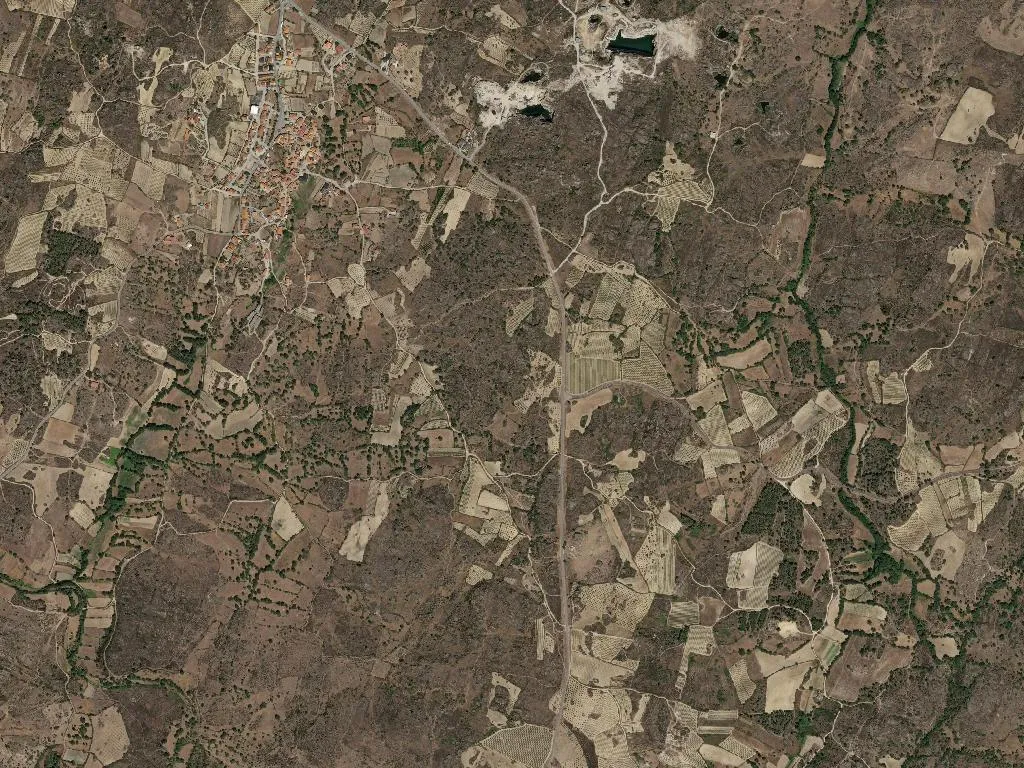
The church bell strikes twelve and its bronze note lingers for seven full seconds above the Ribeiro de Manigoto, a thread of water that barely glints in the noon glare. From this bench at 684 m you can count every roof in the hamlet: 63 slabs of pale granite stacked along a ridge that shoulders 1,588 hectares of heather and gorse. Nothing rises higher than two storeys; nothing disturbs the wind that drags the scent of scorched oak down from the Serra de Pinhel, residue from Pínzio’s cork-drying kilns.
One-hundred-and-fifty souls were logged here in 2021; 87 of them have already passed retirement age. Five pupils still make the 14 km run to Pinhel’s primary school. Walk the 600 m from the churchyard to the padlocked Casa do Povo and you will meet no one—three, perhaps four minutes of absolute silence, long enough to hear your own pulse against the granite.
Oil and stone
Medieval terraces still scar the Cabeço da Forca; they once supported 120 ha of wheat, now reduced to 23 ha of rough pasture. Between 1923 and 1947 farmers planted 1,800 Cobrançosa olive trees along those collapsing walls. Their fruit—hand-picked each November—yields 2,500 litres of emerald oil, bottled as Azeite da Beira Alta DOP and sold in Lisbon delis for £22 a half-litre. The cooperative press in Pínzio, opened in 1954, still hums for three weeks; its last upgrade was 1998 when cloth presses gave way to a single horizontal decanter.
The stone under your boots is Ordovician, 480 million years old. Quarrymen at Carvalhal hacked it out until 1973; you can read its silver flecks in door-jambs dated 1742, in the axle of the watermill that quit in 1967, in 47 horse-troughs mapped by the local hunting club. The oldest house, on Rua da Fonte, carries that same year above its lintel—rebuilt after the 1727 earthquake that rattled dishes as far away as Salamanca.
A Beira table
Serrana kid, granted IGP status in 1996, roams 800 ha of open holm-oak forest. Five times a year the communal oven is fired with louro and rosemary; the meat roasts for three hours at 180 °C while neighbours argue over football. On 15 August and 29 November the agricultural co-op uncorks 30 litres of Fonte Cal white for arroz de fressura, a liver-and-rice feast first written down by parish priest Américo in 1934. The rye bread is milled in Pinhel’s restored watermill—shuttered in 1982, reopened as a museum in 2003—its stones still smelling of fresh bran.
Walking through presence and absence
Service track No 3, cut in 1956 to haul cork, switchbacks 2.3 km down to Fonte da Pipa. A chiselled inscription reads “1929 – Ano da fome”, a reminder of the year chestnut flour ran out. The path drops 140 m through abandoned rye terraces last sown in 1975; now only nightjars clap overhead, and since 2018 a pair of Corujedo-da-Beira owls has nested here—the first record for Pinhel municipality.
At 17:30 the sun skims the slate roof of the primary school, closed since 2009, and throws a shadow exactly over the spot where “Viva o 25 de Abril” was painted in 1975, later erased by granite rain. No waymarks are needed: follow the coconut scent of rock-rose in May, or listen for the nightingale that arrives on St George’s Day and sings until the hay is in.