Full article about Pala: Dawn Harvests on Granite Terraces
Guarda’s sky-high parish where 20 % of land is vineyard and nights drop to 14 °C
Hide article Read full article
Dawn on the Granite Plateau
At six o’clock the first diesel coughs echo across the terraces. Harvesters crawl between the vines, headlights still on, their tyres raising ochre clouds from the dirt tracks that ribbon Pala’s 280 ha of vineyard. By eight the sun is already punitive; work stops at two.
The parish that chose grapes
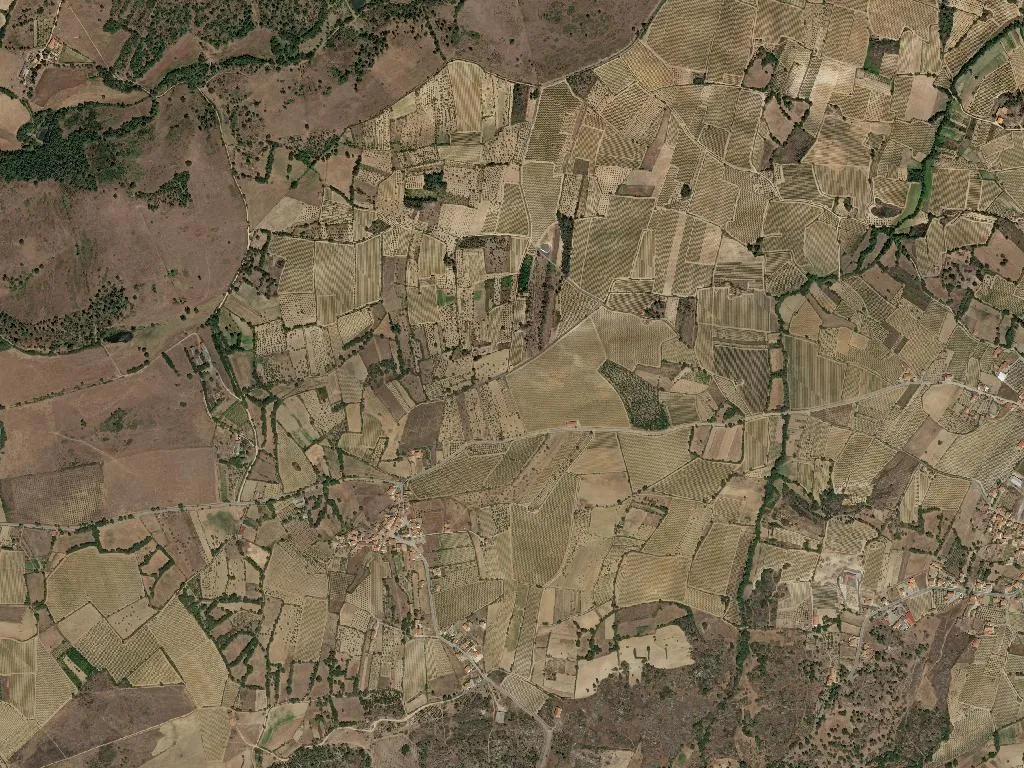
Nothing else pays the rent at 640 m. Cork oak and olive occupy the steeper fragments, but 20 % of the entire freguesia is planted with vine, a proportion unmatched anywhere in the Pinhel municipality. Granite skeletons push through the thin soils; gradients hit 25 %. Eighteenth-century cadastres list “vignais” because cereals failed here. The name itself—Pala—may derive from “pala” (shovel), the tool used to scrape soil into the walled platforms that still define the landscape.
Altitude in the bottle
Terraces are tractor-wide, not people-wide; the footpaths are merely service lanes. What matters is what happens afterwards: three family cellars coax 5–20 000 bottles a year from Jaen, Rufete and Bastardo, the high natural acidity preserved by sharp diurnal swings—summer days above 35 °C, nights that tumble to 14 °C. The resulting reds carry the Beira Interior DOP stamp, but you will rarely see them outside Guarda’s Saturday market.
Stone, locked
The 17th-century mother church is kept locked; the key stays with the sacristan in Pinhel, 12 km away. Inside, only the Blessed Sacrament altar is lit; the other three gather dust. Three kilometres of rattling track leads to the chapel of Reigadinha, opened once a year—15 January, Saint Amaro’s day—provided the priest is free.
September pop-up
During the Festa da Vinha e do Vinho, the parish council yard becomes an open-air museum: vintage basket presses, a 1950s Massey Ferguson stripped for show, plastic cups of last year’s vintage poured from jeroboams. The €300 000 EU-funded day centre reopened in 2021; 20 of the 415 residents use it, but 68 % are over 65. Twice a week the wood-fired communal ovens glow; order your kid three days ahead. By ten the municipal barrier closes the road to lorries, and the plateau falls silent—just the hum of refrigerators in the cellars and, every kilometre or so, a single porch light.