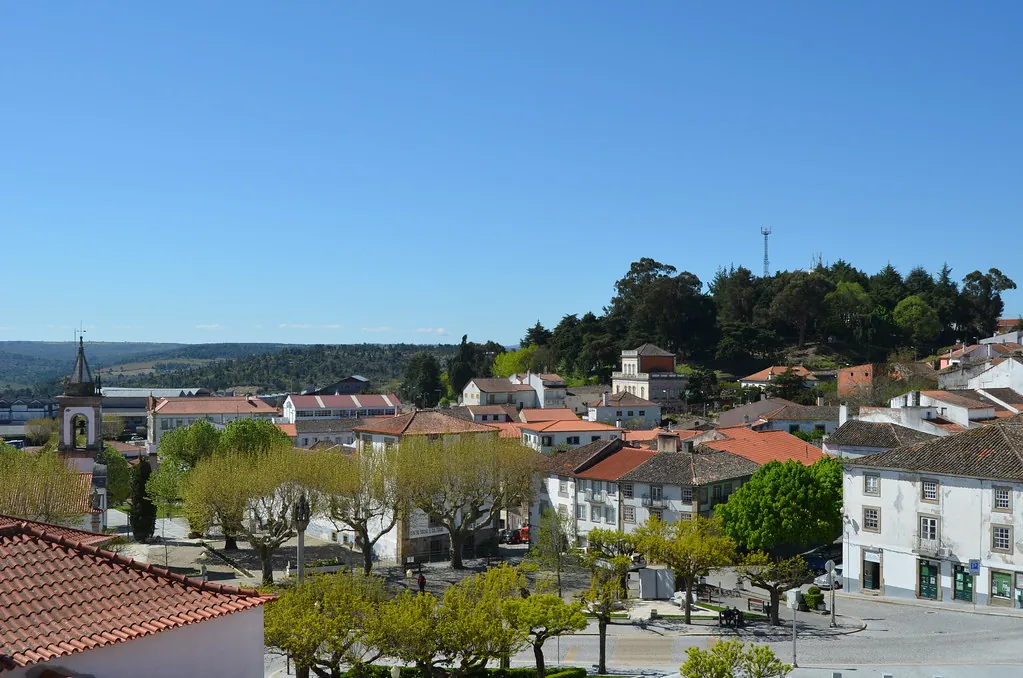
Full article about Pinhel: where granite sings and wine sleeps in caves
Pinhel’s wind-tuned castle, cave-aged wine and Serra cheese make Guarda’s hilltop village a sensory plunge into Beira Interior.
Hide article Read full article
The whistle in the granite
The wind arrives first. It slips between the schist roofs of Rua da Misericórdia, rattles the iron balconies and sets the castle’s solitary keep — the Torre de Menagem — humming like a tuning fork. At 585 m above sea-level the air is thin enough to carry the clang of the 4 o’clock bell clear across the Côa valley, yet thick with the smell of rockrose and hot pine needles. Pinhel needs no introduction; it introduces itself through temperature and echo.
Stone sentinel
Only two towers and fragments of the 800 m curtain wall remain of the fortress King Sancho I ordered raised in 1190. Climb the newly reopened patrol path and the reason becomes obvious: from the bartizans you command a 270-degree arc of olive terraces, quartzite cliffs and, on the Spanish horizon, the same ridge line that once warned of Castilian cavalry. Inside the Interpretive Centre, VR headsets overlay vanished ramparts onto today’s skyline, but the real revelation is physical — stand on the Manueline window ledge where a stone lion and elephant guard the view and you feel the hill’s weight beneath your soles.
Behind the wall
Drop through the Porta da Vila and the medieval borough folds in on itself like a letter: lanes just wider than a donkey cart, houses growing directly out of bedrock, cellar doors still scooped into natural caves where wine once slept in talha amphorae. The parish church of São Julião offsets its plain Romanesque nave with a riot of gilded cedar carved by the same workshop that supplied Viseu cathedral. Further downhill the Carmelite convent, secularised since 1834, keeps the region’s most resonant cloister — walk the square at noon and your footfall bounces back like a second pair of steps.
Taste of altitude
Pinhel’s cooking is calibrated for shepherds and harvest crews. Lunch begins with rye bread and Serra cheese, moves on to IGP kid stew thickened with DOP Beira Interior olive oil, and ends with tijolos — brick-shaped cakes of egg yolk and almond designed to survive a week in a saddlebag. In the shaded square of Largo do Zé, the eponymous cook still refuses to hurry his goat casserole; order a glass of high-altitude red and you’ll understand why — the tannins taste of sun-baked schist and wild thyme. November’s Olive Fair turns the citadel into an open-air tasting room: producers line up emerald-gold oils pressed from cobble-sized olives, each label carrying the GPS co-ordinates of the grove.
Falcon country
The town’s nickname — Cidade Falcão — dates from 1385, when villagers supposedly captured the Castilian king’s messenger hawk before the battle of Aljubarrota. Whether myth or propaganda, the falcon now adorns the coat of arms and the souvenir T-shirts. The real raptors are still here: griffon vultures nest in the Côa gorges, Bonelli’s eagles ride the thermals above the Marofa ridge. Follow the 17 km Castle Trail south-east to Sabugal at dusk and you’ll see them planing over abandoned olive presses and stone-walled terraces where the only other traffic is a goatherd’s transistor radio.
Evening light ignites the granite. When the sun slips behind the Serra da Estrela the keep glows amber, releasing a faint scent of lichen and damp stone that lingers on your fingertips long after you’ve left. Pinhel doesn’t reveal itself to itineraries; it accumulates in the body — a change in lung pressure, the taste of polyphenols, the exact weight of a place that measures time by the call of a falcon rather than the ring of a smartphone.