Full article about Vale do Massueime
Chestnut terraces, humpback bridge and baroque chapels thread the Côa slope
Hide article Read full article
The river arrives before the view
Water knocks on slate long before you see it, a cold percussion that keeps time even in August. The Massueime threads between alder and schist, one of the few Beira Interior rivers that never runs dry, fed by mountain springs the Romans first channelled. Beside the restored mill at Sorval the wooden wheel still idles, turning more for memory than flour, yet the oak axle groans exactly as it did when five mills depended on its rhythm.
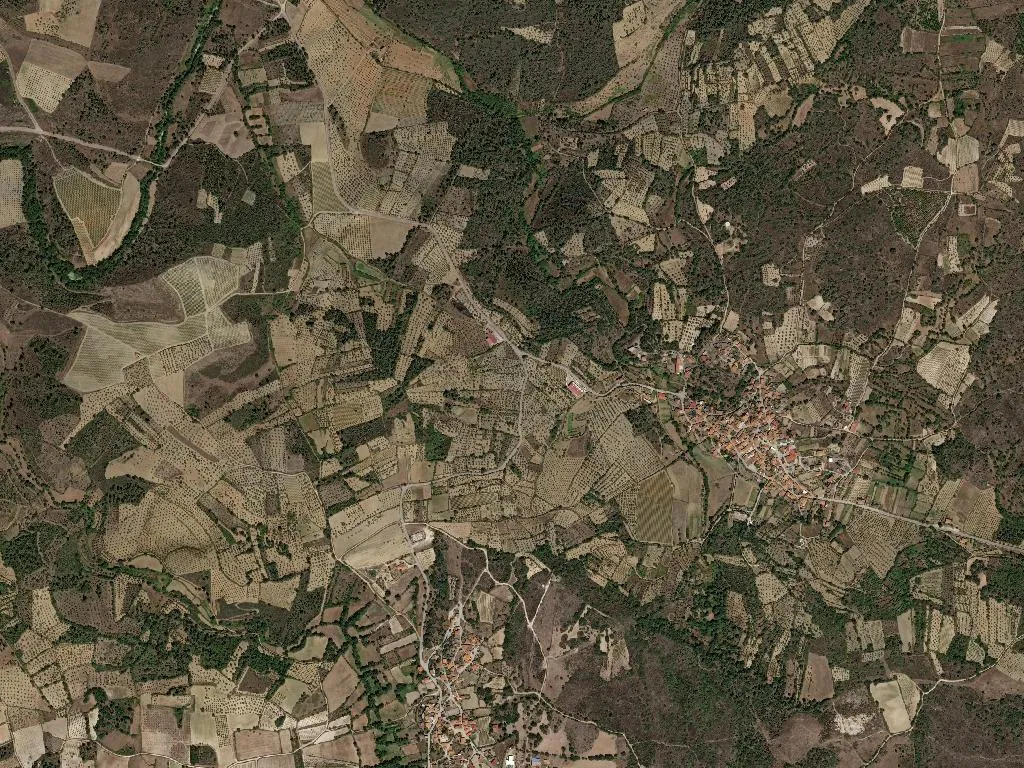
Vale do Massueime was stitched together from three hamlets – Santa Eufémia, Sorval and Póvoa d’El-Rei – all clinging to the same Côa-facing slope at roughly 500 m. Dirt tracks, pale as wheat, braid them through chestnut groves and olive terraces where trunks twist like baguette crusts. A packhorse bridge, its humpbacked deck of irregular blocks, still provides the shortest route between Santa Eufémia and Sorval on foot.
Three churches, one valley
Each cluster keeps its own church. Santa Eufémia’s parish church shelters a 17th-century Mannerist altarpiece, gold-leaf flames licking white lime; the churchyard spills over the valley and, on windy days, the bell clangs without a ringer. Sorval’s Santo André wears a baroque façade that frames an altar to St Andrew, while Póvoa d’El-Rei’s single-nave Chapel of St Sebastian, erected in 1753, stands in a granite-cruciform square. None appear in mainstream guidebooks, yet all have been listed by Portugal’s heritage agency since 1977 – quiet acknowledgement that history is also written in small stone.
Masks, chestnuts and emigrants’ return
February’s cold snaps the village awake. During Entrudo – Shrovetide – masked Caretos prowl Sorval, faces painted on alder-buckthorn, cowbells slung from scarlet sashes, concertinas wheezing them from door to door. The custom survives because emigrants fly home: 62 % of residents are over 65 and 255 houses stand empty for most of the year. On 16 September the feast of Santa Eufémia fills the vale with processions and the resinous smoke of sardines drifting through the chestnut canopy.
The first November weekend belongs to the Chestnut & Wine Fair. Growers pour Rufete reds and Síria whites – rare Beira Interior grapes that seldom travel beyond the district – while wood-coal goat (IGP Beira Kid) turns on spits beside wine-flavoured chouriço, rice blood-pudding, DOP Beira Alta olive oil and walnut-honey cake. Rye bread, proved in wood-fired ovens, is still sold door-to-door on Saturdays.
The loop that binds them
The Massueime Trail – a seven-kilometre signed loop (PR 2 PIN) – stitches the three settlements, brushes the mill, crosses the medieval bridge and climbs to the Carrascal lookout. From its stone balustrade you can watch Egyptian vultures plane over sun-shot schist to the south. Wild boar, genets and little owls complete the roll-call; Póvoa d’El-Rei’s chestnut grove is reckoned the best-preserved in the region, with 300-year-old trunks four metres round.
When the sun drops, oblique light ignites slate walls and water-meadows flare to copper. Beside the mill-leat, wooden tables under poplar shade, the river keeps its own calendar – faithful to the spring, as if five mills still waited for the water that starts here.