Full article about Águas Belas: Where Granite Streams Taste of Fossils
Remote Sabugal parish of 167 souls threaded by ice-cold mountain water amid wolf-country silence
Hide article Read full article
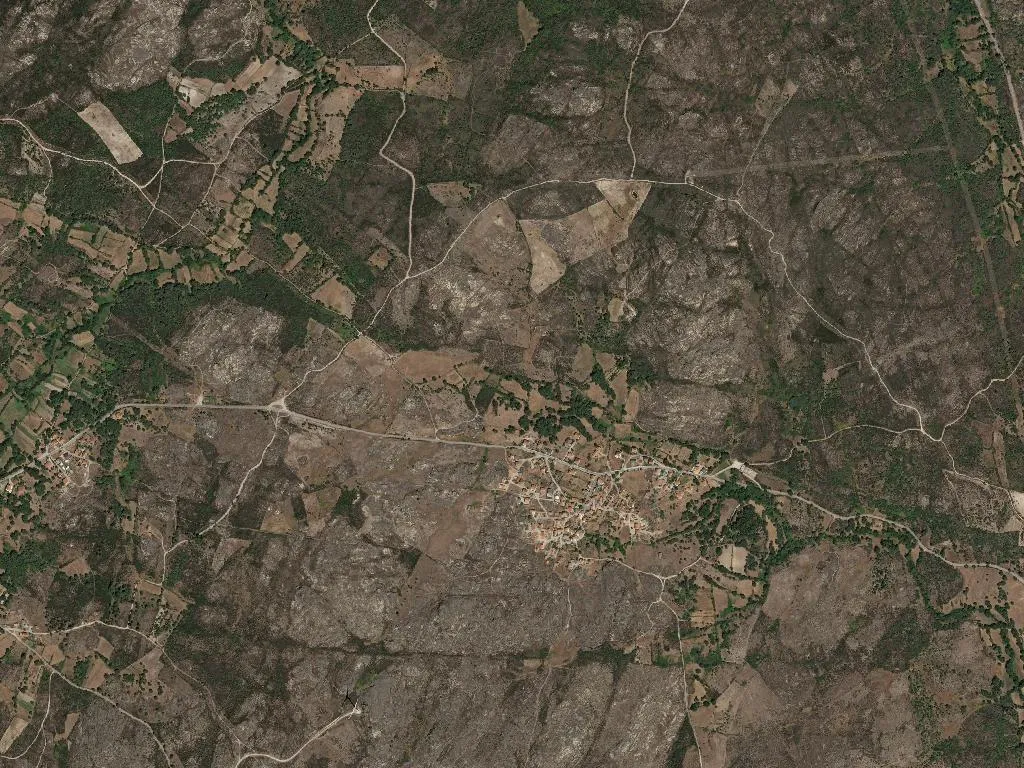
The road climbs through schist and stone-pine until, at 824 m, the air changes texture—drier, thinner, as though the oxygen itself has blown in across the Spanish meseta. This is the hinge where Beira Interior tilts into the Serra da Malcata, a place whose silence has mass, broken only by a church bell that rings three seconds late or by the wind carrying resin and goat on its back. Águas Belas—literally “Beautiful Waters”—keeps its promise: narrow streams slice through granite, drawing threads of ice-cold water between moss-soft boulders and ferns the colour of burnt green glass. Drink and you swallow a fossil or two; it still tastes better than anything bottled.
One-hundred-and-sixty-seven souls are scattered across more than 2,000 hectares of slope. Density is below nine inhabitants per square kilometre, a statistic you feel in the width of the sky and in the way houses sit apart, each with its own amphitheatre of olive terraces and a vegetable patch walled against wild boar. Seventy-six residents are over sixty-five; only fifteen have not yet reached fourteen. The arithmetic is written in shuttered windows with warped slats and in farm tracks where cars no longer pass—only tractors and Aires’ motorbike snaking down to the bar for a swift “copito”.
Between the Reserve and the Olive Press
The Serra da Malcata Nature Reserve begins where the parish ends—or perhaps the other way around. Borders are permeable: the Iberian lynx that slips through the night (no one you meet has seen it, but everyone knows someone who knows someone who has), the boar that trots to the spring, the goshawk that scores the winter sky—all ignore administrative ink. Walking here demands thighs accustomed to inclines and a healthy respect for ankle-twisting granite. Decent boots are non-negotiable; the rock is slick as set custard. Logistics are similarly unforgiving: single-track roads, signposts that shrug, distances better measured in minutes than kilometres. If you do lose your bearings, follow the water—it will spill into a village or a bar, whichever comes first.
Compensation is liquid and golden. Centenarian olive groves feed the Beira Interior DOP mills, some technically in Beira Alta, others in Beira Baixa, depending on which side of the ridge the fruit was picked. The resulting oil runs low on acidity, high on green-walnut bitterness, and carries a faint whiff of mown hay. On local tables it meets Cabrito da Beira IGP—kid goat fired in a wood oven until the skin blisters like crème-brûlée. Ask Zé to leave it in a fraction longer; he sometimes rushes and good conversation is part of the recipe.
Capeia: the Heartbeat that Remains
Capeia Arraiana is the moment the parish inhales and shows its teeth. It is not staged for visitors; it is identity made kinetic. For centuries this borderland was smugglers’ country—salt, coffee, men—so the festival keeps its own codes. A fighting bull careers through the lanes; men dodge with capes improvised from lorry tarpaulins; women lay trestle tables where Beira Interior red is poured like water. The party is raw, unvarnished, and refuses permission to exist. Wear sandals at your peril—consider yourself warned.
The rest of the year slips back into a seasonal cadence. Vines that survive minus-eight winters give thick-skinned grapes for ink-dark reds that snap on the tongue and smoulder in the ribcage. Smokehouses nurse sausages that will last until the first swallow. December light arrives metallic, the way it does on all high plateaux—convincing people to speak softer and dogs to press against shins.
At dusk, when the sun drops behind Malcata, the streams turn copper. Water keeps its cold, clean course over stones no one counted, indifferent to calendars. It is that sound—constant, ancient—that stays in the ear long after the winding descent to the valley. As a friend puts it: “Águas Belas is a place you carry in your ear. When the water falls silent, you know you’ve gone too far.”