Full article about Granite Echoes of Aldeia da Ribeira, Vilar Maior & Badamalos
Easter chants, Bronze-Age petroglyphs and lynx-haunted ridges above the Côa headwaters
Hide article Read full article
Granite That Was Once a Town
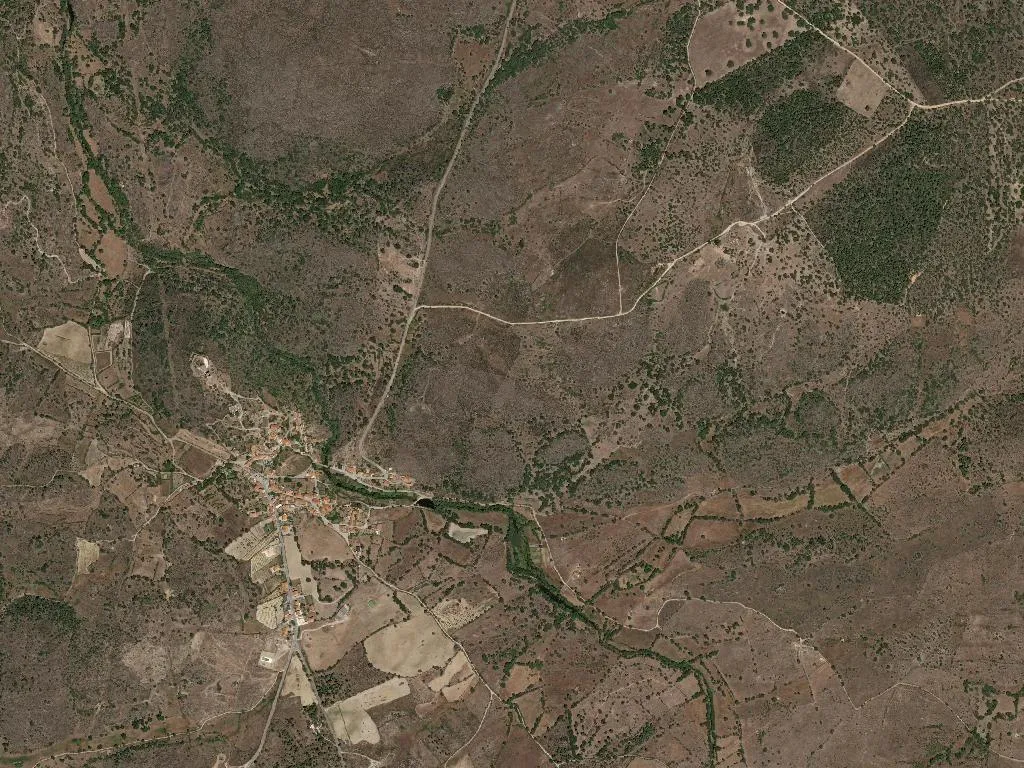
Vilar Maior’s stone houses absorb the afternoon sun and radiate it back long after dusk. At 796 m, the air is thin enough to carry the scent of rockrose and dry earth up from the Côa valley, but thick with the creak of timber doors and the slow tread of boots on schist. The village grew around a castle that served as the municipal seat until 1855; its walls still command the skyline above the Spanish frontier. Inside the parish church, the procession of the Endoenças—an Easter liturgy whose chant is older than the building itself—has fallen silent, yet the granite jambs are grooved by centuries of palms. A short scramble from the walls, Bronze-Age spirals are etched into an outcrop, proof that this plateau was inhabited three millennia before any charter was sealed.
Below the castle, Aldeia da Ribeira and Badamalos keep a lower profile—slate-roofed cottages, dark-schist granaries on staddle stones, and the 1626 chapel of São Pedro at Badamalos, its single nave unchanged since the Habsburg years. Between the three settlements, only 266 people remain, and time is reckoned by the agricultural calendar: sowing in November, sheep shearing before Ascension, the thud of olives hitting nets in December.
Where the Côa Begins
The river that eventually sculpts the famous open-air Palaeolithic art gallery at Foz Côa rises on the slopes above Vilar Maior. Walk the Grande Rota do Vale do Côa as it drops from the castle and you pass cork oaks warped by Atlantic storms, broom clawing into crevices, and the silence of the Serra da Malcata Natural Reserve—last Portuguese refuge of the Iberian lynx, though none have been camera-trapped here since 1992. Mornings start with hill fog that smells of wet granite; afternoons bake under a sky so clear you can pick out the Sierra de Gata across the border.
Tripe, Oil, and Slate-Baked Bread
Border cooking is blunt and honest. Bucho Raiano is a fist-sized pork stomach stuffed with minced meat and cumin, served with boiled potatoes and winter cabbage. Kid from the Beira hills—IGP-labelled since 1996—spends four hours in a wood-fired oven until the skin blisters into crisp shards. Local olive oil carries the DOP stamps of Beira Alta and Beira Baixa, emerald-green and peppery enough to make slate-baked country bread taste almost sweet. Ewe’s- and goat’s-milk cheeses mature in cellars cut from the same granite as the houses; finish with Rabaçal, a set custard of eggs, almond and sugar that tastes of convent kitchens and long afternoons.
August on the Frontier
On 17 August, Vilar Maior’s annual fair triples the population for a day; a week later, Badamalos stages its own. Between them comes the Capeia Arraiana, a rotating parish festival where brass bands duel across the cobbles and tables stretch through the streets until the wine runs out. The Confraria do Bucho Raiano, founded in 2002, keeps the recipe strict: no smoked paprika, no shortcuts. When the last fireworks fade, the castle shadow lengthens over the valley and the first wood-smoke of the season rises straight into a sky already pricked with stars.