Full article about Aldeia Velha’s August Dawn, Smoke & Straw Bulls
At 851 m, granite lanes echo with capeia drums and chouriço smoke in Sabugal’s high border village.
Hide article Read full article
The Smell of August at 851 Metres
A blue-grey ribbon of smoke corkscrews from the smokehouse, carrying the scent of onion-scented chouriço into the knife-cold dawn of an August morning. At 851 m above sea level, Aldeia Velha wakes before the sun. Granite walls still hold the night’s damp, and the bell of São Pedro strikes six. Along the lanes, wooden pitchforks already lean against doorways—tonight is capeia, and a straw-stuffed bull will career down the cobbles amid shouted lyrics and plastic cups of lager. If you intend to watch, arrive early. The best standing places on the tiny praça are claimed by nine.
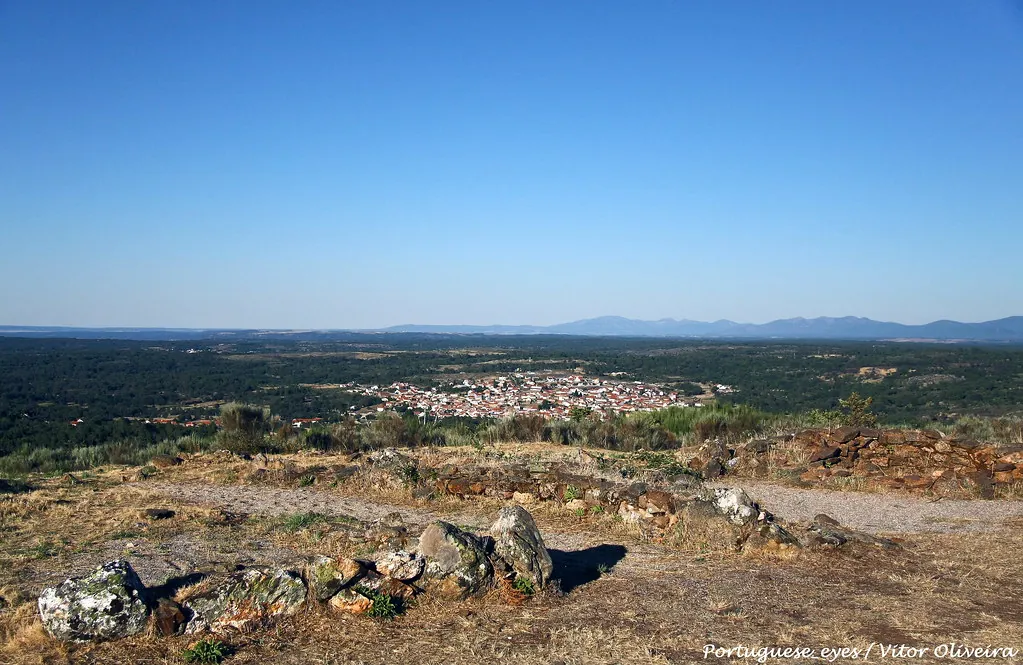
The name is literal: an earlier settlement once crowned the neighbouring hilltop and was abandoned during the Middle Ages. The present hamlet was formally recognised in 1836, but the memory of its predecessor lingers like a geographical scar in the local place-names. Seventeenth- and eighteenth-century Castilian raids thinned the population to almost nothing; only after the border quietened did smallholders and shepherds drift back to these high pastures. The eighteenth-century pelourinho—an unpolished granite pillory—still stands in the main square, monument to autonomy hard-won. Mind the loose cobbles; the ground cambers like a ship’s deck.
Stone, Strength, Flame
São Pedro’s church, rebuilt in the 1700s on medieval footings, lifts a plain pediment and a granite-block belfry you can spot from the valley road. Inside, gilded carving crowds a nave that feels too small for such opulence. Around the corner, the chapel of Nossa Senhora da Conceição shelters a baroque image of the patroness in a shadowy recess. Cross the single-arch medieval bridge—its rolled-cobble span once carried the old mule track to Sortelha—and you enter textbook borderland architecture: stone houses with timber balconies, granaries on stilts, roofs of weathered slate. Door lintels sit low; ancestors here were built close to the ground.
August belongs to the Capeia Arraiana, documented since 1873. Torch-bearing bulls of straw and canvas career through the streets while locals jab with pitchforks, spraying embers and singing improvised quatrains. June brings São Pedro’s romaria: open-air mass, procession, and circle dances that pre-date the waltz. In winter the “Smokehouse & Bread Crust” fair fills the square with pop-up taverns, wool-spinning demos and the sweet fug of burning oak. Bring cash—the nearest ATM is 12 km away down a switchback road.
High-Altitude Larder
Beira IGP kid goat rules the table, either fire-roasted or stewed with white wine and mountain herbs. O Caramujo serves it on Sundays, but you must book; there are only eight tables. Start with onion chouriço, rice black pudding and wheat farinheira, scooped up with corn broa and rye bread. Ask at Tasquinha da Ti Rosa for potato-barbeira soup—pig’s liver and garden mint—though only if the proprietor is in good humour. Runny Serra da Estrela DOP cheese arrives with a dollop of pumpkin jam. On the lower slopes, centenarian olive trees yield Azeites da Beira Interior DOP, a grassy, peppery oil you can have drawn straight from the cooperative’s stainless-steel vats. Bring clean bottles; they fill on the spot.
Inside Malcata
Aldeia Velha sits within the Serra da Malcata Natural Reserve, 16,000 ha of cork oak and hawthorn scrub where Iberian lynx still breed and griffon vultures ride the thermals. The signed Aldeia Velha–Malcata circuit runs 11 km through holm-oak woods and impenetrable strawberry-tree thickets, fording streams where barbel flick. Carry water—there is no kiosk, no café, no phone signal. The shorter Mills Trail links the village to the abandoned hamlet of Vilar de Amargo, passing two restored water-mills and a belvedere that drops straight into the Côa gorge. Dry-stone walls parcel out summer pastures for Churra da Terra Quente sheep and lean, long-horned cattle. When winter snow caps the Estrela massif to the west, the village bar fills with locals who have driven up merely to look at a view they have seen every year of their lives.
Dusk gilds the belfry and throws a long shadow across the square. The only sounds are the stream’s murmur and the angelus bell carried on thin air. Altitude here is not a number; it is a condition—rarefied, sharp-edged, a cold that bites even in August once the sun slips behind the ridge. Leave, and you will find yourself plotting reasons to return.