Full article about Sortelha: granite hush above the Côa valley
Walk 13th-century walls where 32 souls guard Templar crosses and Manueline stone
Hide article Read full article
The first thing you notice is the hush – not the absence of sound, but a kind of listening presence. It is the same quiet that met Fernão Anes in 1228 when Sancho II handed him the royal charter and ordered the castle keep heightened. Sortelha does not announce itself; it surfaces stone by stone, only as fast as unhurried feet will allow.
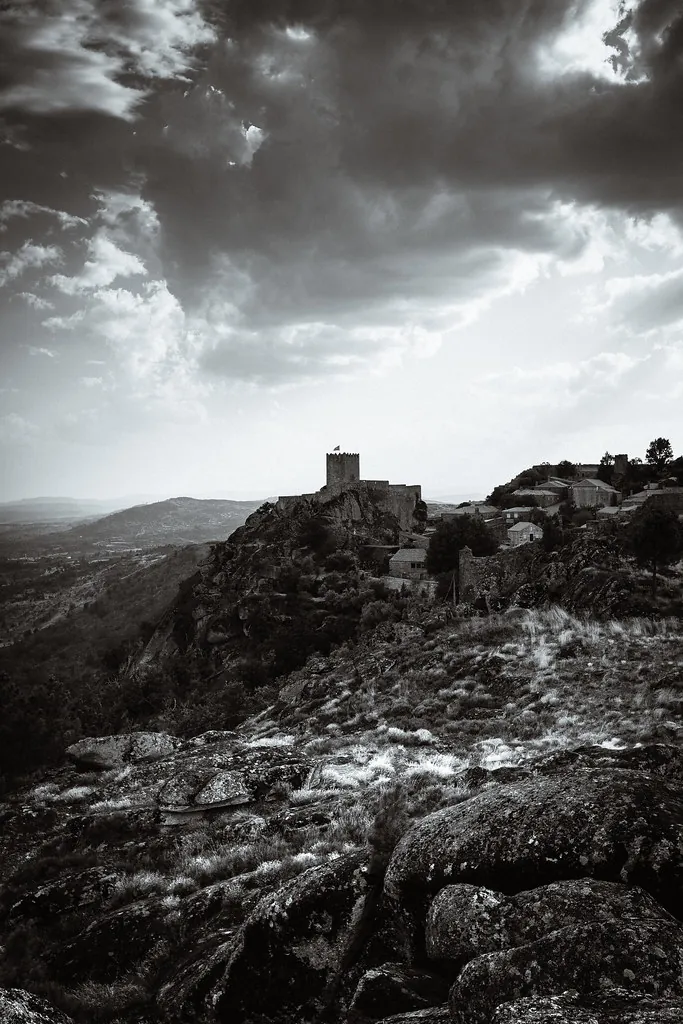
At 794 m on the western flank of the Serra da Malcata the parish spreads across nearly 4,000 ha, yet the granite-walled nucleus covers barely seven – today home to 18 permanent households and, at the last count, 32 souls. Pass under the ogival arch of the Porta da Vila (1238) and you brush against a Templar cross hacked into the lintel by a thirteenth-century mason. Inside, the keep – a National Monument since 1931 – rises 17 m above its Muslim predecessor, itself planted on a Late-Bronze-Age castro.
A belt of breathing stone
The circuit of walls runs 670 m, stitching together seven towers: two round, four square and the 1640 clock tower added after the Restoration War. From the parapet the Côa valley glints three kilometres south-west; on a crisp morning the five-sided keep of nearby Sabugal is visible twelve kilometres away. The stone under your palm is two-mica granite quarried on the ridge; the same rock forms the cottage bases, roofed with schist slabs hauled up from the Bazágueda valley. In winter, mist drifts up the Cesarão river and the village becomes an island, moored only by its own silence.
Faith carved in granite and lime
D. João de Menezes, alcaide-mor of Sortelha, commissioned the parish church of Nossa Senhora das Neves in 1530; the Manueline portal, dated 1542, still carries the armillary sphere and the five escutcheons of Dom João’s family laid over his own. Inside, a gilded altarpiece (1698) is attributed to Braga master-carver José Fernandes. The tiny chapel of São João Baptista beside the Porta do Concelho was raised in 1289, just after the Christian re-conquest; three Masses are still celebrated there each year – on the eve and feast of St John, and on the first Monday in August, when the statue is walked in procession to the rural chapel of Nossa Senhora da Orada (1653), 1.2 km away. The village pillory, 2.10 m high and inscribed “ERA DE 1563”, served as public gallows until the liberal reforms of 1834.
Pine torches on the cobbles, fire in the night
The Capeia Arraiana fills the second January weekend. The ritual began in 1936, when the parish priest allowed twelve men carrying a four-metre pine torch to drive a loose bull from the streets. Today the run keeps to the 480 m between the two gates, the animal supplied by the Vale do Coelho estate. In August the Medieval Fair pitches 42 stalls: potters from São Pedro do Corval, blacksmiths from Vilar Formoso, weavers from Algodres. The medronho brandy is distilled by Zé Mário of Piódão in a copper alembic dating from 1962, still technically illegal but politely ignored. On the eve of St John’s Day three tonnes of oak and cork are stacked in the chapel yard; the ash is later scattered on the cherry orchards that line the Ribeira da Vila.
Mountain kitchen, wood-fired oven
The kid comes from Adelino Ribeiro’s herd in Vale de Amoreira: IGP Beira, 45 days old, 6–8 kg, roasted over oak at 220 °C for two-and-a-half hours. Chanfana is made with 18-month billy-goat marinated in 2019 rufete from the Vilar Formoso co-op. Wild boar, shot legally between 15 October and 15 January, is stewed for four hours in an iron pot with Trancoso onion and Saborinho potatoes. Cheese arrives from Quinta da Lageosa, cured 60 days in granite cellars at 12 °C. The little queijadinhas follow the 1657 recipe of Viseu’s Convento das Maltezas – twelve egg yolks to each batch of pastry. The white on the table is 2021 síria from Casa da Passarela, grown at 700 m, 12.5 % vol.
Schist trails, crystal pools
The Trilho dos Ribeiros (PR4) is 6.2 km with 220 m of ascent, passing the Redondo water-mill, abandoned in 1953 yet still armed with its original chestnut axle. The Poço da Pica, 1.8 km below the village, is a natural granite tank four metres deep where the water holds at 8 °C even in August. Within the parish boundary lies 1,211 ha of the Serra da Malcata nature reserve; the last Iberian wolf caught on a trail-cam appeared at 03:42 in 2021 on the Corro slope. Cork oaks here wear 150–200 growth rings; the “Soberbo do Cão” measures 14.3 m in girth at chest height.
What stays under the skin
When the sun drops behind Cerro da Vela the castle tower burns gold for seven minutes – the same phenomenon the painter Carlos Reis captured in his 1923 canvas “Sortelha ao Entardecer”. Granite that has soaked up the day’s heat exhales it after dusk: lay your palm on the side wall of No. 14 Rua Direita, where 87-year-old D. Odete was born in the same room as her mother in 1934, and the stone still feels warm. The air smells of rock-rose drifting up from the sweet-chestnut grove; the hinge of Zezé’s bakery, open since 1956 and firing its wood oven at 4.30 a.m., gives its familiar creak. Thirty-two people remain, custodians of a map the rest of the country has forgotten how to read: sometimes the thickness of a wall is comfort enough, and silence, when it is shared, stops being absence at all.