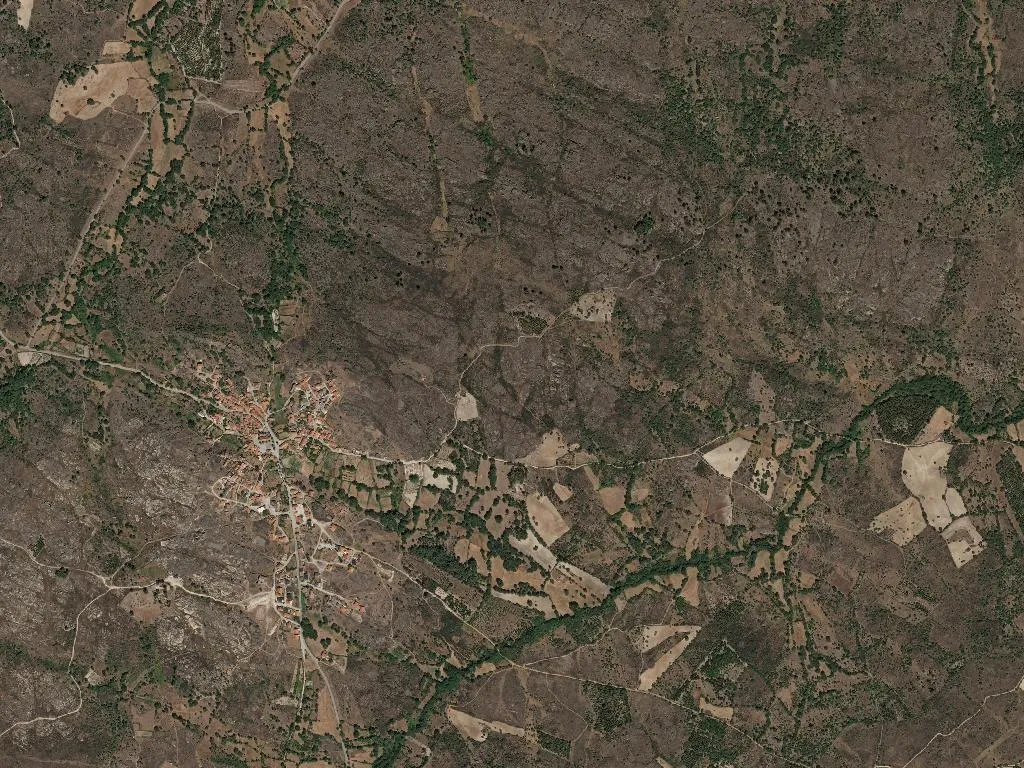
Full article about Vila do Touro: granite, goats & borderland bulls
Jesuit gold, August bull-runs and vine-smoked goat at 789 m in Beira’s quietest village.
Hide article Read full article
Granite and altitude
The wind arrives before dawn, ferrying the smell of wet heather and yesterday’s hearth smoke. At 789 m, Vila do Touro wakes reluctantly; chimneys unpick thin cords of grey into air that already tastes of winter, even in September. Granite walls exhale the night’s chill while the parish bell counts the hour like a metronome from the 1700s.
The mother church has presided over the square since the Jesuits raised it in 1693. Outside, the stone is uncompromising, the colour of storm clouds; inside, gilt wood explodes forward—angels, roses and a sunburst tabernacle that feels almost indecently lavish for a place whose electoral roll now stops at 177. Builders claim they recycled Manueline fragments from an earlier chapel: look for the armillary sphere carved on the north buttress and decide for yourself. Manorial houses with iron-wrought balconies still line Rua Direita, reminders that this crossroads between Beira Alta and Beira Baixa once funnelled cattle, grain and Portuguese gold escudos south to Coimbra.
Summer exodus in reverse
August turns the village inside out. The Capeia Arraiana—part bull-running, part border-country reunion—pulls back émigrés from Lyon, Newark and Geneva. You spot them immediately: white trainers, city wristwatches, the tilt of someone used to the Tube. For three days the arena scraped into the earth below the cemetery hosts loose bulls, brass bands that swap lyrics between Portuguese and Castilian Spanish, and plastic cups of lager that foam in the afternoon heat. On 5 August the feast of Nossa Senhora das Neves adds a procession, fireworks and a dance that lasts until the last accordion collapses. Then the cars head north on the A23 and the silence reasserts itself; the only café unlocks its shutters only when a tractor driver signals from the road.
Fire and smoke
Come in late September for the kid goat, slow-spit over vine prunings until the skin lacquers into a brittle bronze. Chanfana—goat stewed in red wine and black pepper—cooks through the night in clay pots sunk beside the embers; men stand guard with a glass of aguardiente, arguing whether the recipe needs laurel or cinnamon. In the smokehouse behind every farmhouse you’ll find morcela blood sausage and stubby chouriço stained with local paprika; the olive oil is pressed from centenarian trees that somehow root themselves between boulders. If you stumble on a basket of saffron milk-caps in October, ask no questions: mushroom patches are family classified information.
Where the Malcota begins
Walk 200 m east and you’re on the Malcota ridge, the granite spine that separates the Côa valley from the smoother plains of Spanish Castile. Cork oaks give way to maritime pine; carry water because after the first 300 m of climb there is no bar, no fountain, no one. Wolf tracks appear in sandy patches more often than wolves do, but wild boar are less discreet—if you meet a sounder, choose your tree quickly. Detour north for the Côa’s open-air rock-art shelters, Palaeolithic galleries older than Lascaux. When darkness falls the sky inks itself solid: Milky Way detail you thought only existed in long-exposure photographs. The bell tolls once more across the valley, the granite façade glows a reluctant gold, then the cold reclaims the stone and the village closes its eyes again.