Full article about Carragozela’s triple bell & goat stew in Serra da Estrela
Stone chapels, cork giants and wood-oven chanfana in Portugal’s sparsest parish
Hide article Read full article
The triple bell
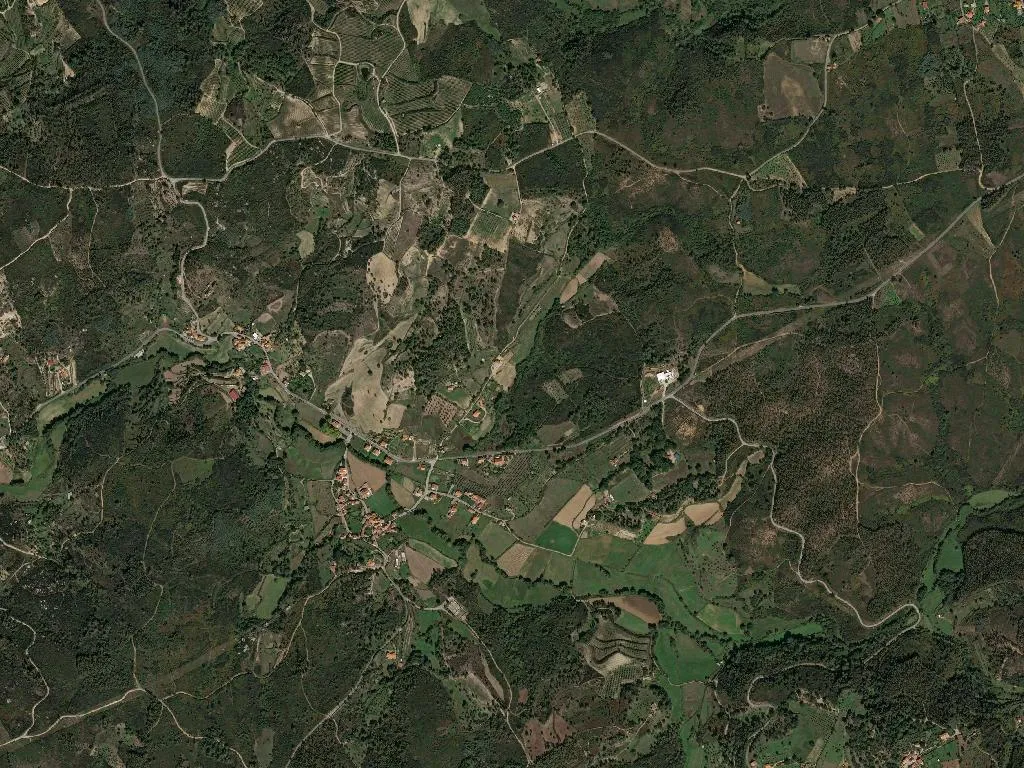
The bell of Carragozela’s mother church strikes three times, a pattern unchanged since French troops skirted these ridges in 1810. The note slides down the valley, ricochets off alvarinho oak and cork, and dies at the Ribeiro de Meruge where slate-dark pools form between schist boulders. Between 400 and 800 m above sea-level, granite outcrops and 27 cork oaks – each over two centuries old – preside over 546 souls spread across barely 1,000 ha inside the Serra da Estrela Natural Park. Density like this is rare anywhere in Portugal; here it feels simply inevitable.
Where the stone speaks
Carragozela stitches together carra (stone) and the local word gozela (throat), a geography you can pronounce. Várzea de Meruge keeps its Arabic stamp – meruge probably from al-marg – and the two parishes were yoked administratively only in 2013, though the Romanesque–Gothic bridge has bound them since the 13th century. Packhorses once shuddered over its uneven slabs; today it carries nothing heavier than the occasional trail-runner. Step inside the roadside chapel of São Sebastião – a 16th-century stone box with a single Mannerist portal – and morning light paints the whitewash gold; no gilding necessary when the architecture is this spare.
Curds, cork and wood-fired goat
At the village cheese house, curds still warm from the sheep are ladled by hand into reed baskets to become Serra da Estrela DOP. Visit in the second week of March and the cellars open for public tasting: thistle-flower rennet and mineral salt scent the air. Later, follow the drift of wine-dark gravy to O Abegoaria (yes, the sign really is spelled like that) where chanfana – goat slow-cooked for five hours in a wood oven – collapses at the touch of a fork. Reservations are compulsory; the pot either murmurs all afternoon or it doesn’t. Winter lunches lean on Rancho da Feijoca: butter beans, kale and smoked chouriço, finished with a lick of peppery Beira Alta DOP olive oil. Dessert is homemade requeijão topped with rose-petal jam, the flavour of convent kitchens that once dotted these hills.
Water lanes and star lanes
An 8 km way-marked loop links Carragozela to Várzea de Meruge, shadowing stone-walled water channels still fed by mountain springs. For a shorter outing, the 5 km Levadas da Meruge trail detours to the restored mill at Lapa: the wheel is motionless but the oak axle, split by decades of damp, smells like fresh-cut peat. Watch for the little grebe diving in the stream and the electric-blue flash of the kingfisher. At dusk, climb the granite outcrop called Alto da Lapa: the view frames the Mondego valley and, after nightfall, the Milky Way spills across the sky – the parish is a partner in the Dark Sky Aldeias scheme, so no LED glare interrupts the spectacle.
Snow ledger and the smallest graveyard
The winter of 1945 blanketed the ground for 67 consecutive days; older residents still time-stamp anecdotes by “antes ou depois da grande neve”. Emigration in the 1960s and 1980s halved the population, leaving Carragozela with the tiniest municipal cemetery in Guarda district – just 480 m², yet ample for those who stayed. Every August returnees swell the lanes for the Festa de Nossa Senhora da Assunção: mass held under the chestnuts followed by an outdoor supper where Dão whites – Encruzado and Malvasia – pour faster than the waiters can count. On 5 and 6 January, the Cantar dos Reis groups shuffle from door to door, bass and treor alternating in songs no one teaches; they simply absorb them. When the last verse fades and the valley settles, only the stream and the triple bell remain – one a constant murmur, the other a punctuation mark against the granite night.