Full article about Pinhanços: Where Serra da Estrela Glaciers Meet Dão Wine
Quartzite boulders, olive-oil cellars and sheep-cheese vaults at 477 m in Pinhanços, Seia
Hide article Read full article
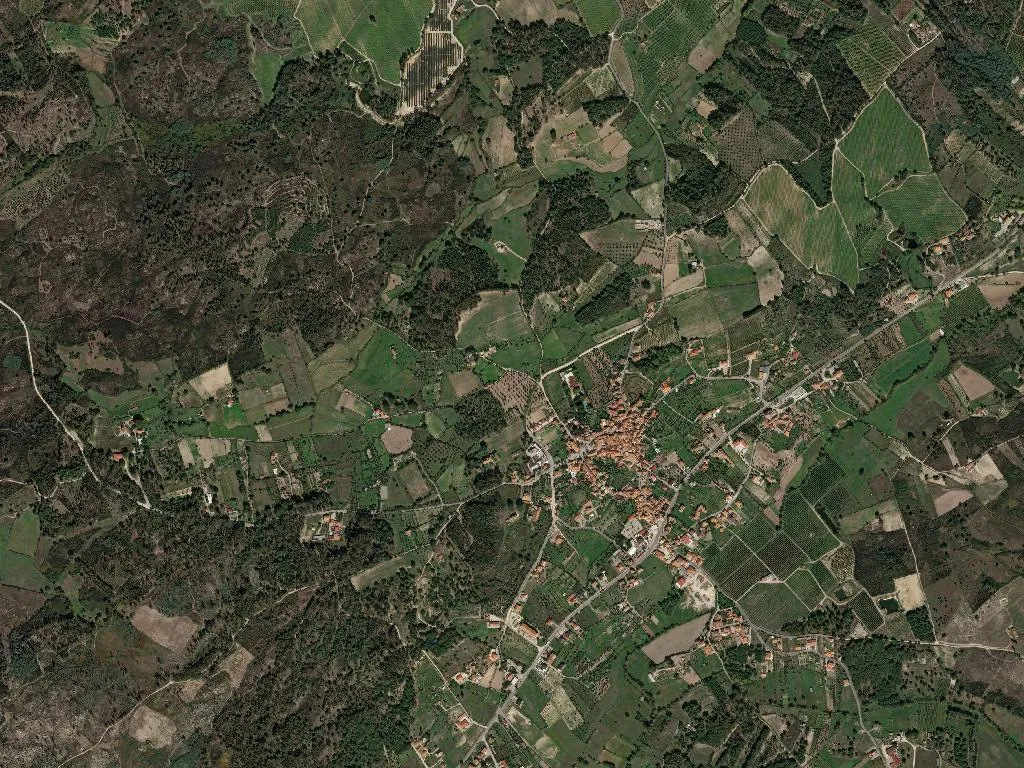
The first thing you notice in Pinhanços is the hush — a dense, deliberate quiet that settles at 477 m above the Beira Interior plateau. Wind combs through the marshy meadows; the only steady sound is the hush of the Ribeira de Pinhanços sliding between hedgerows. Twelve kilometres from the market town of Seia, the parish spreads across 832 hectares of gentle swells, olive groves and rye, its boundaries still marked by waist-high schist walls stacked in the 19th century. The air is high enough to carry the mountain’s chill, yet low enough for Dão vines to ripen on sun-tilted slopes.
Written in stone
Pinhanços became part of the Estrela Geopark in 2020, and the ground beneath your boots quickly explains why. Paths glitter with quartzite and granite that record two million years of ice and thaw; you don’t need to climb to Torre, the range’s 1 993 m summit, to read the story. Walk ten minutes from the hamlet core to the chapel of São Sebastião and you’ll find glacial erratics the size of delivery vans parked in the middle of wheat fields, left there when the mountain was a white desert. The Serra da Estrela Natural Park reaches its eastern fingers into the parish, but visitors arrive by accident rather than coach — a geology lesson without the selfie scrum.
Altitude on the plate
This is DOP country, where every other product carries a protected pedigree. Serra da Estrela cheese — made only with milk from Bordaleira ewes that graze these upland meadows — matures for sixty days in farm cellars. At Quinta do Pinheiro, Maria da Conceição still turns the wheels by hand, coaxing the texture into something you can spread with a knife like butter. Requeijão, the cloud-light fresh curd, is ladled out warm on Sunday afternoons and eaten with a spoon. Olive oil from centenarian trees planted in 1923 at Quinta da Ribeira registers 0.2 % acidity and smells of newly-cut grass; the trees survive minus-eight winters by keeping their roots in schist crevices that store the day’s heat. Lamb (Borrego Serra da Estrela) and kid (Cabrito da Beira) are wood-oven affairs — meat that sighs off the bone at the touch of a fork. Wine arrives from the Dão demarcated region: Casa de Pinhanços ages its reds for twelve months in French oak before bottling, so the granite minerality softens into something you can drink with the cheese.
Calendar left deliberately blank
Pinhanços hasn’t staged a parish feast since at least 1980. While neighbouring villages fire up the bandstand for solstice processions, this scatter of hamlets opts out. It is temperament, not decline. Of 727 residents, 267 are over 65; the 25 primary-school children take the bus to Seia every morning and return at dusk to a landscape whose clock is the sowing of rye, not the church noticeboard. The only puncture in the week is Sunday mass inside the 1832 Mother Church, rebuilt over a 16th-century hermitage.
Slow-motion field day
To see the place properly you have to match its cadence. Rural lanes link stone cottages whose roofs are still pegged with schist slates; moss cushions every wall. An 850-year-old olive tree on the path to Pombal has a trunk you can’t reach around. Short-toed eagles and hen harriers ride the thermals above the rye, scanning for snakes. Six Turismo de Portugal-licensed houses — Casa do Xisto, Monte da Ribeira among them — give you a fireplace, a stack of chestnut logs and direct access to Geopark trails. Ten kilometres away, Seia offers the Bread Museum or the road to Torre, but the real programme here is simpler: taste 60-day-cured DOP cheese at Quinta das Castanheiras; picnic beside the stream and watch fire salamanders climb the alder roots; stay until the low sun copper-plates the winter rye sown in October.
The last image you carry away is not a monument but a horizon: the jagged silhouette of the serras seen from the Cabeça Gorda meadow, green against grey quartzite. It is a geological beauty, almost abstract, that makes sense only when you have walked slowly enough to feel the exact weight of the silence and the precise temperature of air at 477 m.