Full article about Sandomil: Where the Alva River Keeps the Village’s Secrets
Granite chapels, Roman bridge and pine-scented Dão vines spill down a Guarda hillside
Hide article Read full article
The Alva speaks first
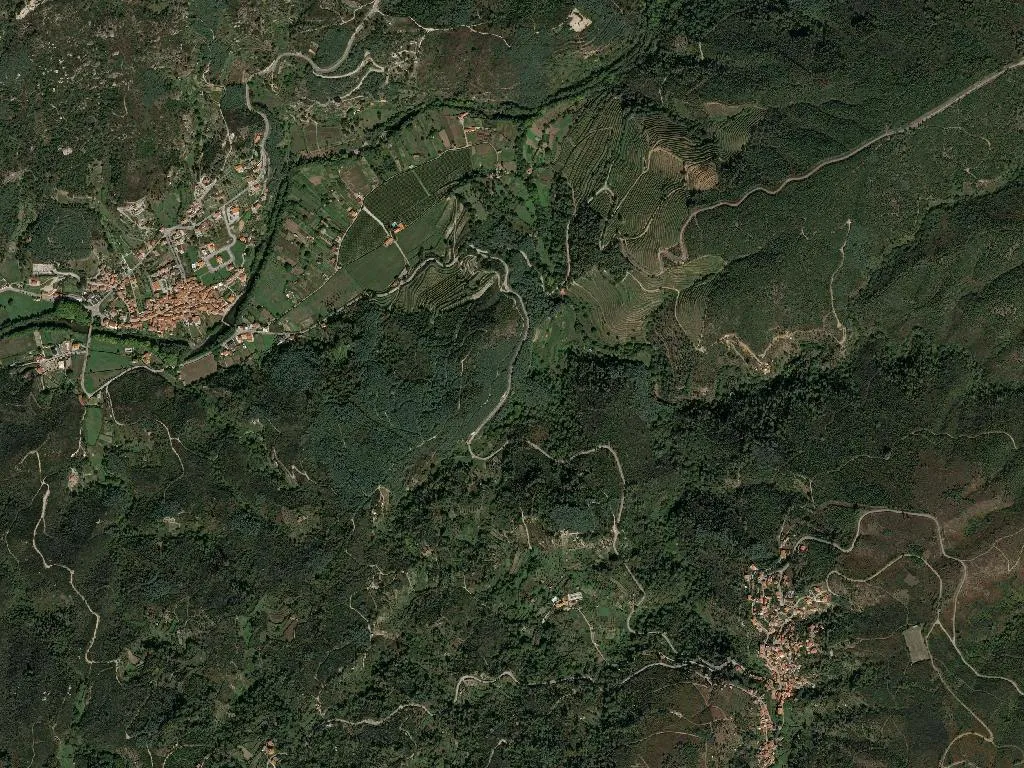
You hear the river before you see it: a low, steady hush rising through chestnut orchards and schist terraces of vines. Then the granite bridge appears, single-eyed and Roman-shouldered, its slabs polished by cartwheels since at least the twelfth century. Sandomil—745 souls, 385 metres above sea level—unfolds below in a tight amphitheatre of hillside. Once this was a chartered town with its own judge and seat at the Cortes; now the memory is filed away like an old deed in a kitchen drawer.
A thousand fields of stone and water
The name derives from the Latin saltus millenarius—“an expanse of a thousand paces”—and the terrain still feels measured out in ancient paces: hay meadows stitched with yellow broom, granite outcrops, the glacial trough of the Alva. On Easter Thursday eighteen parishes used to walk here to the mountain chapel of São Pedro for the public recitation of the Litany of the Saints. The chapel collapsed in the 1800s, the bishopric scolded, and the procession died. Nettle and ivy have since smothered the walls, but older villagers remember grandparents setting off before dawn, boots dew-dark, candles rattling in rucksacks.
The eighteenth-century parish church faces a small square of whitewash and black basalt. Around the hamlets—Cabeça de Eiras, Corgas, Corredoura—nine baroque wayside chapels stake medieval boundaries: Saint Anthony of the Lost Thing, Our Lady of Good Fortune, Saints Cosmas and Damian. Their locked doors are opened only on the saints’ own days, when the priest makes a circuit by car, collecting loaves and coins on the dashboard. The granite village troughs—Fonte da Praça, Fonte Romana—still run winter-cold; locals rinse lettuce there rather than pay for metered water.
Tastes that follow the slope
Sandomil sits inside the Dão wine zone. Vines climb until shale gives way to granite; the resulting reds carry a whiff of pine resin and sour cherry. Breakfast in a kitchen means cutting into a DOP Serra da Estrela cheese: butter-yellow, oozing whey, scented with cardoon thistle and raw sheep’s milk. It is swept onto shards of pão de xisto, a shale-baked loaf whose crust fractures like thin ice. Dona Alda’s wood-fired oven turns out queijadas of fresh requeijão, the curd collapsing into sugary custard.
Lunch is kid or spring lamb, both protected origin meats, slow-roasted in a bread oven until the rind crackles and the fat drips onto potatoes. Chanfana—billy-goat stewed for hours in red Dão wine, garlic and bay—finishes the colour of ink and falls from the bone at the touch of a fork. Smoked sausages hang in larders like dark musical instruments; dessert is doce de grão, a convent sweet of chickpeas, egg yolk and sugar that tastes of marzipan and confession.
Stone loop, water loop
The Roman Bridge Trail begins at Sandomil’s river beach, where the Alva forms glassy pools between polished boulders. A two-kilometre loop climbs through gorse and heather, passes two working watermills (their paddles still turning on Thursdays when the miller comes), crosses meadows where Barrosã cattle graze untethered, and ends at Fonte da Moura, a natural balcony over the valley. In April the air is loud with golden broom and the resinous breath of maritime pine; kingfishers ricochet upstream.
The parish lies inside both the Serra da Estrela Natural Park and the European Global Geopark. Walkers on the inland Caminho Nascente detour across the bridge to refill bottles at the square’s spring. After dusk, when streetlights are willingly switched off for the “Sandomil under Stars” programme, the Milky Way reclines over the granite rooftops; telescopes are set up on the football pitch, followed by supper of roast kid and Dão red.
The parish council opens only twice a week, timing its meetings to the agricultural calendar. In Cabeça de Eiras and Corgas, monthly assemblies still draw seventy per cent of voters—an electorate ratio London boroughs can only dream of. Of the 745 residents, 305 are over sixty-five; just 44 are children. Nine tourist cottages—stone-built, slate-roofed—fill from July to September, when the river temperature climbs to twenty-two degrees and the geopark trails hum with bootsoles.
Late afternoon, oblique light gilds the terraces and the granite warms like stored bread. The Alva mirrors a sky rinsed clean by altitude; the only sound is water negotiating stone, a negotiation that has outlasted charters, councils and capitals, and shows no sign of concluding.