Full article about Torrozelo & Folhadosa: Dawn Echoes in Granite
Bells, ewes and royal seals shape life in these two Serra da Estrela parishes.
Hide article Read full article
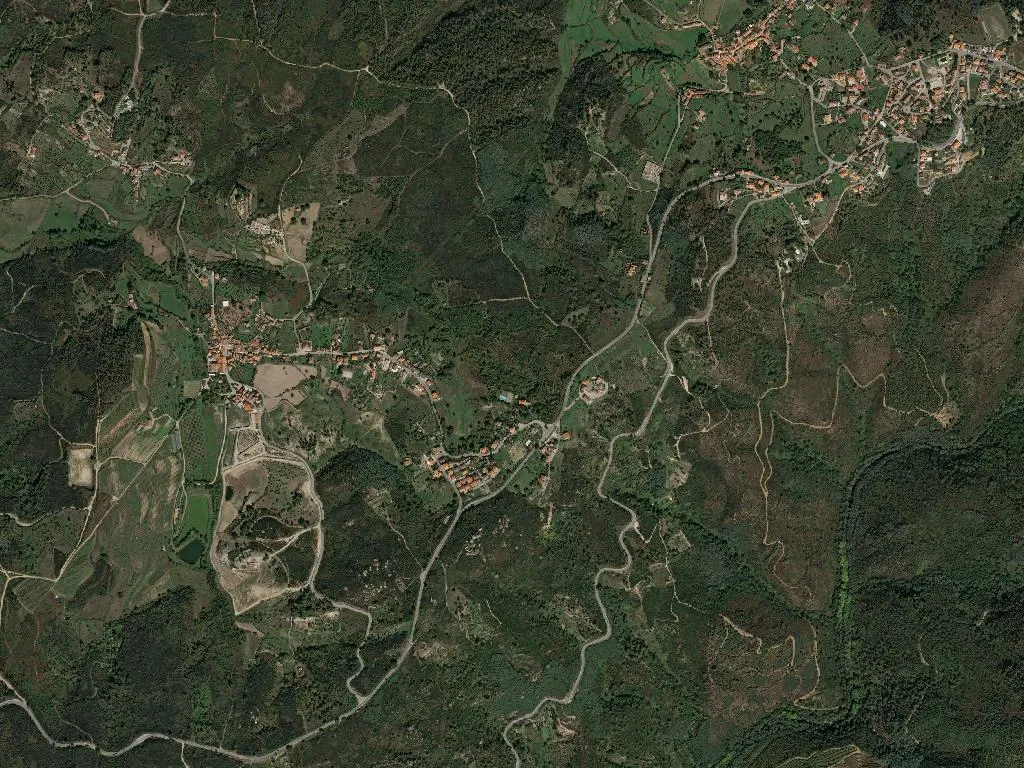
The sound arrives before the sight: a dry metallic jangle, bass and treble at once, threading through chestnut groves still grey with dawn. Then the animals appear – Bordaleira ewes, tight-packed and fleece-thick, moving downhill like a slow avalanche. Behind them the shepherd keeps measured pace, chestnut staff in hand; when he pauses at the Moorish spring the granite still holds last night’s chill. Torrozelo wakes this way, at 519 m on the western rim of the Serra da Estrela, not to smartphone alarms but to hooves that have set the tempo here since the charter of 1202.
The village that once kept the royal seal
Place-names tell. Torrozelo derives from “tower of the seal”, the stone strong-room where the royal die was stored to authenticate crown documents. For six centuries the settlement was a full-blown town with its own council chamber, pillory and gaol; the latter two still face each other across Praça da República, the iron ring on the pelourinho polished by centuries of chained wrists. Manuel I renewed the town charter in 1514, yet the settlement was already listed in Coimbra Cathedral’s tithe register of 1150. The parish church of Nossa Senhora do Rosário carries three dated stones – 1559 for the first campaign, 1751 for the Baroque refit, 1850 for a Pombaline tidy-up – giving the façade the stratified look of tree rings. Nearby, the fifteenth-century Solar dos Abranches displays a cracked coat of arms above straight-mullioned windows; its most famous resident, Deputy José Maria da Costa Brandão, helped draft the liberal constitution of 1821 before returning to serve as mayor of Seia.
Porridge, processions and bonfires
Easter Monday fills the lane to the hill-top chapel of São Bento: every household, from infants to nonagenarians, falls in behind the band. By 9 a.m. the procession is winding down Rua Direita; by 8 p.m. the last accordion has packed away and the wine cups are dry. Earlier, on the second Sunday of May, the village re-enacts the Festa das Papas, first recorded in 1623. Three hundred kilos of maize porridge, thickened with sheep’s milk and stirred in a cauldron the size of a tractor tyre, are portioned out to anyone who holds out a bowl – a living clause of the 1598 Mercy Charter. Mid-summer brings further fireworks: 13 June for Santo António with street-side brass bands, and the night of 23 June when São João’s bonfires light the sky and improvised choirs trade challanges until three in the morning. At Christmas twelve households around the pillory turn their ground floors into living nativity scenes; Mary and Joseph are played by neighbours who have known every cobble since childhood.
Milk that becomes cheese, and other alchemy
The 800 Bordaleira ewes never leave the parish; their milk travels only as far as the three licensed dairies where it becomes 15 tonnes a year of Serra da Estrela DOP cheese. Cardoon thistle from the Paul de Torrozelo coagulates the curd, which is then pressed into granite cellars for 45 days until it can be spooned like butter. The same milk yields Requeijão da Serra – a breakfast sweet or the filling for Dona Amélia’s pastel-like queijadas. At Easter whole legs of Borrego Serra da Estrela DOP are slow-roast with mountain potatoes and garden coriander; kid from the same flocks is grilled over vine prunings or stewed chanfana-style in Dão red from the 500 bottles still made by the Folhadosa quintas. Cold January nights demand tarreste bean soup, thickened with Bisaro pork chouriço, while 1,200 centuries-old olives at Olival da Carvalha produce Beira Interior DOP oil that bites the back of the throat like winter air.
Water, stone and wings
Enclosed within the Serra da Estrela Natural Park since 1976 and a UNESCO Global Geopark since 2020, the parish folds between 400 m and 800 m in a natural amphitheatre carved by the Alvoco and Alvogil rivers. The PR4 footpath follows the Alvoco for 8.3 km between Torrozelo and Folhadosa (population 78), detouring past the 1834 Carril watermills where maidenhair ferns still root in damp stone. River beaches at both watercourses keep a midsummer temperature of 12°C; slabs of polished schist serve as sunbathing terraces. From the Alto da Cruz lookout at 720 m the view dives into sheer valleys where a dozen pairs of red kite nest; scan the thermals patiently and you may spot the returning griffon vulture, back since 2018. In the chestnut groves of Carvalha and Cerdeira spiny husks crack underfoot, while on the exposed pastures of Cabeça da Velha gorse and heather bend before a wind that regularly clocks 80 km/h.
On Thursday evenings the village band rehearses inside the 1784 gaol; trumpet and tuba slip through the barred windows and mingle with the distant bells of sheep heading home. Some things are not set down in charters or carved into stone – they live in the precise frequency of a place, audible only to those who walk it.