Full article about Vide e Cabeça: Where Granite Outnumbers People
570 souls share 5,000 silent hectares in this Guarda parish of frost-split schist.
Hide article Read full article
The Silence That Weighs
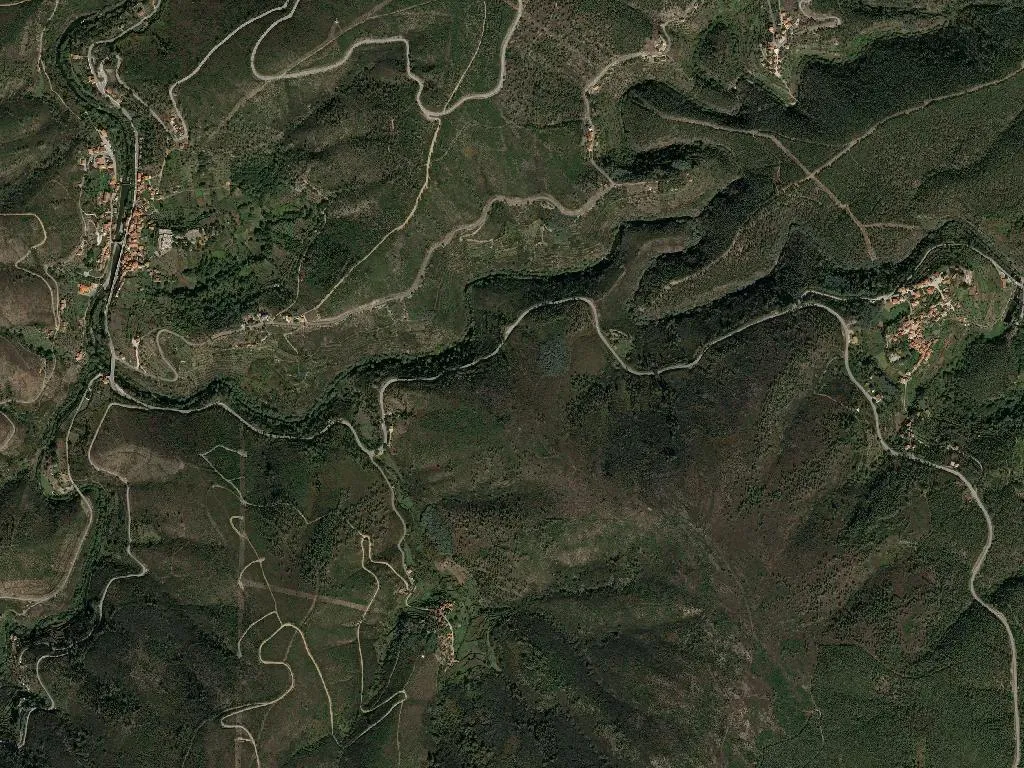
The hush in Vide e Cabeça has body. It settles on your shoulders as you pick your way along lanes where granite doorframes outnumber the people. At 405 m above sea-level, the air carries a metallic chill that rises from the Mondego’s distant course and clings to schist walls fissured by January frost. Five thousand hectares hold 570 souls; solitude here is cartography, not accident.
The parish was soldered together in 2013 when Vide (its name a memory of long-gone Dão-region vines) and Cabeça (christened for the head-shaped hill that looms above it) were forced into marriage by Lisbon statisticians. The bureaucrats left, but the villages refused to blend. Each keeps its stone chapel—modest, whitewashed, bell tower skewed a few degrees off north—like siblings who still mark their half of a shared bedroom.
Wool, Stone, Cheese, Oil
Cheese arrives as a litmus test. If it appears pre-cubed on a board, you are being patronised. Proper Serra da Estrela DOP comes molten in a strip of woven wool, the same fabric my grandfather stored with mothballs in the attic. Local Beira Alta olive oil is poured like you’re watering tomatoes: no drizzle, no ceremony, just glug. Lamb still goes into the communal wood-oven at dawn, after a late-night football match on the bar’s flickering TV—closing hours are theoretical. Chanfana, the mountain goat stew, demands three days: one to marinate in red wine and garlic, one to braise, one to rest. Treat it like a divorce you actually want: rush and you’ll regret it.
At the Foot of the Geopark
The Naturtejo Geopark is the famous neighbour no one visits. Trails begin behind Mário’s hay barn; bring him a 20-gram pouch of rolling tobacco and he’ll lift the gate. The climb to Poio do Rocim ridge takes 45 minutes—exactly the length of a decent marital row. From the top, the Mondego valley unrolls like a faded Kodak: oak woods where my parents gathered saffron milk-caps, chestnut groves that fed four generations before EU subsidies were ever uttered. There is no café, no signal, no safety net—just you and a schist ridge that predates Instagram.
Architecture That Outlives
Houses are not “heritage”; they are simply inhabited. Sr Albano’s porch still bears the scars of corn cobs threshed there in 1978. Dona Amélia’s granary, now a guest room with underfloor heating, smells of chestnut and mouse. The blue on front doors isn’t Farrow & Ball; it’s surplus paint from my uncle’s tractor workshop. Dry-stone walls mark a boundary dispute between grandfathers that began in 1932 over an olive tree and ended in a wedding. Vernacular building here is problem-solving with what the mountain gives you, then letting time varnish the result.
The Arithmetic of Staying
Ratio: 316 pensioners to 20 children—essentially a vast open-air nursery. The demographic train thundered through, didn’t stop: primary school shut in 2009, bakery in 2012, café in 2018. Yet António returned from Paris, bought three roofless cottages and fitted keyless entry. Catarina quit a Lisbon call-centre; she now makes cheese with milk from the parish’s last two shepherds. Twelve houses have been reassembled—not “lodging units” but the very rooms where my grandmother knitted socks, now equipped with Wi-Fi fast enough for Zoom and a Nespresso that takes compostable pods. The sequence is always abandonment, rediscovery, hashtag.
Smoke rises straight from the chimney of the house where I was born. Oak-wood aroma collides with mountain cold, and for a moment the entire landscape hovers between what was and what might still be—between a place that was mislaid and one that is quietly inventing itself again.