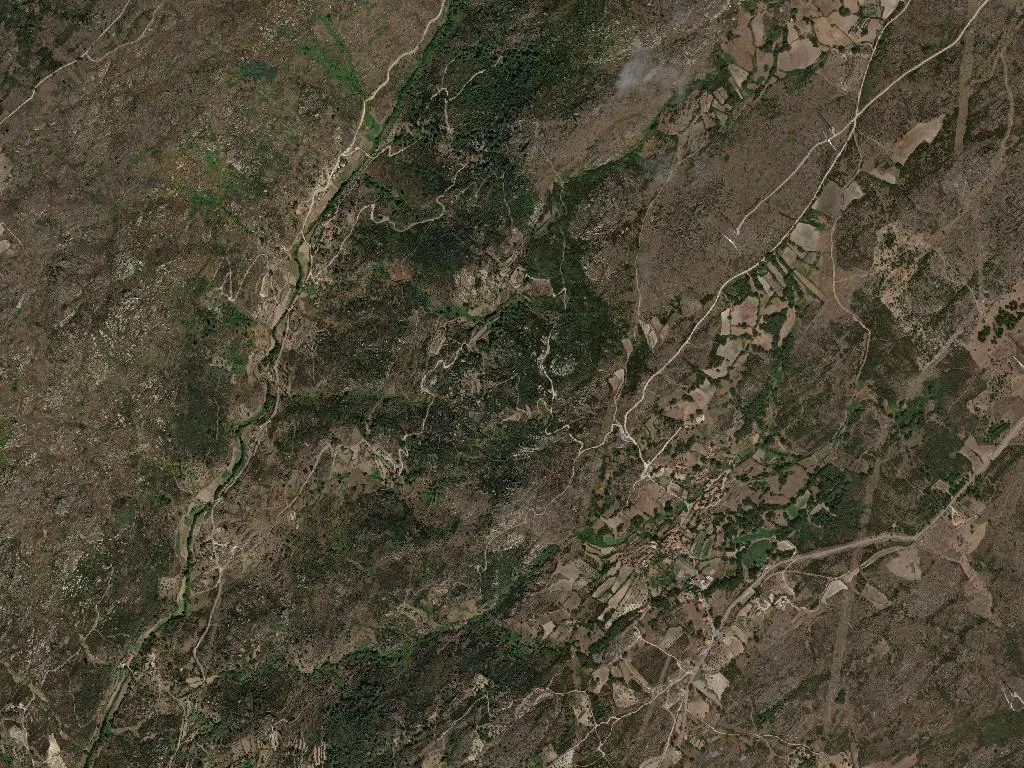
Full article about Aldeia Nova: Dawn Bell & Chestnut Smoke
Granite lanes, 1537 church silver, ridge-top pilgrim path—October fires crackle.
Hide article Read full article
Morning on the Plateau
The plateau wind combs slowly through the chestnut groves, carrying the smell of damp schist and woodsmoke curling from granite chimneys. At 685 m, dawn in Aldeia Nova is measured by the faint clink of a distant bell and the groan of a warped gate. Dry-stone walls quilt the slopes into irregular paddocks; October light gilds the chestnut crowns so thoroughly that the season itself seems suspended between summer gold and winter slate.
Granite & Gospel
Every lane funnels toward the single-nave Igreja Matriz de São Salvador, begun 1537 and finished five years later. Inside, a gilded altarpiece carved by João de Ruão glints above a Manueline silver chalice hidden during the French invasions and rediscovered only in 1962, tucked behind the high altar. Beside the south porch, a wayside cross dated 1732—"Ordered by Canon Manuel Pires"—serves as the village noticeboard and meeting point. Smaller chapels dedicated to St Anthony (1624) and St Sebastian (1756) repeat the theme in miniature, their ceramic-tiled façades glowing ox-blood red against the stone.
Pilgrims & Chestnuts
The 12.3-km stretch of the Interior Portuguese Way that links Aldeia Nova to Vila Franca das Naves climbs through heather and broom before levelling onto open ridge. From the top you can read the landscape like a relief map: the Távora and Massueime rivers incising shale valleys, the bulk of the Estrela massif to the south-west. Along the route look for the abandoned Pego water-mill, moss-slick leats and the Poço de São João, once used by labourers to scrub field-mud from their feet before Mass. October brings the village’s loudest day: the Chestnut Festival, held on the first Sunday since 1998. Locals still harvest by the traditional pau method—hooking the burs with a long wooden pole—then roast the DOP-certified fruit on sheet-metal trays set over open fires in the schoolyard. The cooperative’s jeropiga (fortified grape must) and rough Beira Interior red—bottled by the Carvalhão family since the 1930s—keep hands warm and conversation loose.
Cooking with Cold
Altitude dictates the larder. Clay-pot goat stew (chanfana) simmers for hours on a wood burner; Estrela DOP lamb casserole is thickened with winter potatoes; kid from the communal oven emerges with skin the colour of burnt sugar. In five licensed dairies, sheep’s milk coagulates with cardoon thistle gathered on Monte do Colcurinho slopes, yielding Serra da Estrela DOP cheese and cloud-white requeijão. On slaughter-day in January, the remaining 23 households gather around Sr António’s chestnut table for migas of breadcrumbs, kale and black-eyed beans—an assembly unchanged within living memory.
River Loop at Dusk
The PR2 footpath, opened in 2004, drops 250 m in 7.2 km to the Távora. Pass the stone threshing floor that served 28 families until 1975 and Sr Joaquim’s 1923 maize granary—still stocked with a few organic sacks. From the Cruzeiro lookout the plateau unrolls in ochre and ash as far as the Marão and Estrela ranges. When the sun slips behind the ridge, dry cold settles and the only sound is Bobi, Sr Alberto’s mastiff, barking his 21:30 circuit—each echo ricocheting off granite before vanishing into a darkness deep enough for 276 souls to breathe as one.