Full article about Rio de Mel: hear the bee-hum of Portugal’s sweetest spring
Granite troughs, thistle-cheese pantries and 279 villagers who still plough by ox in Trancoso’s sky-
Hide article Read full article
A low murmur between the stones
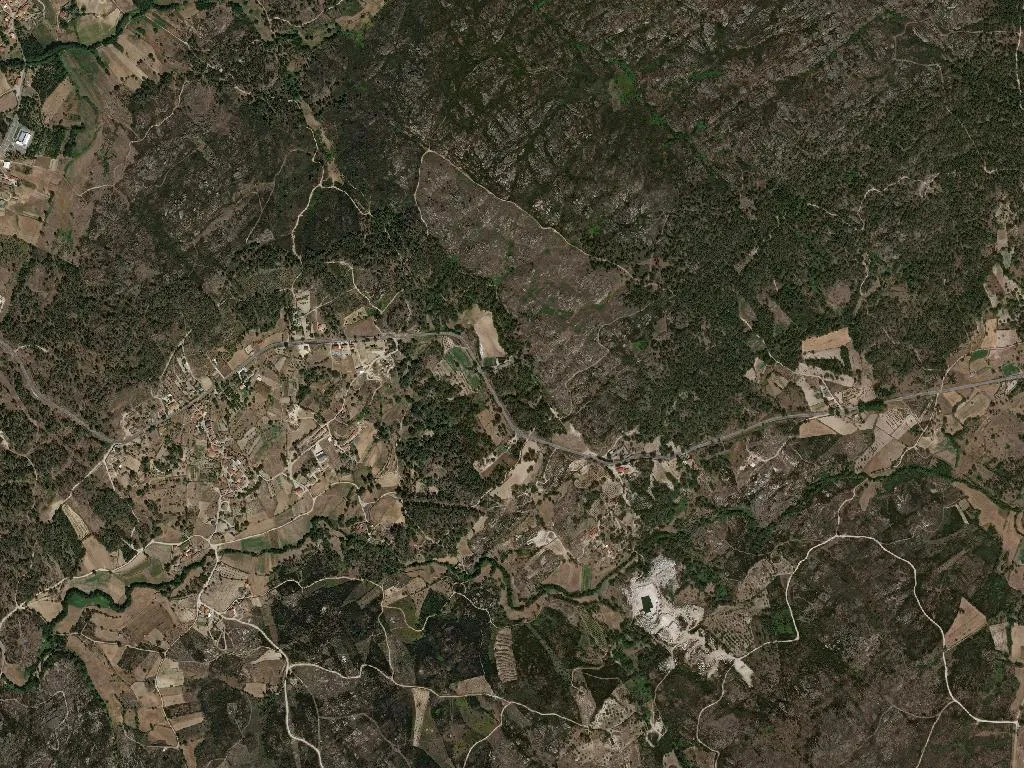
The water talks, but only just. A filament-thin trickle slips over granite, soft enough to be mistaken for wind in the gorse. Locals call the sound “the bee-hum”, and it is the reason Rio de Mel – literally “Honey River” – appears on maps at all. The name refers not to a river but to a spring whose sweetness once convinced shepherds it had been filtered through honeycomb. At 709 m above sea level, on the high plateau that buffers Spain from the Beiras, the parish unfurls across 23 km² of fractured granite, rye stubble and wolf-coloured heather. Less than twelve souls occupy each square kilometre; the census counts 279, of whom 112 have already turned 65. Come after the maize harvest and you may hear only the clang of a gate that has never been locked.
Sixteenth-century footings
Rio de Mel enters written record in 1527, listed among the crown lands of the House of Braganza. It was formally annexed to Trancoso in 1836, yet in practice the village has always governed itself by daylight and weather. There is no manor house, no pillared town hall – just a granite trough, a 17th-century threshing floor and a chapel whose bell is rung by pulling a rope that disappears through the roof. Subsistence left its architecture: low doors that keep out the north wind, haylofts balanced on mushroom-coloured mushroom stones, external staircases wide enough only for a single boot. The fields are still ploughed in the medieval strip system; the oxen move so slowly that larks perch between their horns.
Certified flavours of the high plateau
Shepherding dictates the kitchen. Wheels of Serra da Estrela DOP cheese – thistle-set, oozing like fondue in summer – rest on slate shelves in back pantries. Requeijão, the cloud-light curd, is sold warm in newspaper twists every dawn from a kitchen hatch marked only by the smell of scalded milk. Lambs labelled Serra da Estrela DOP and kids registered under Cabrito da Beira IGP graze the same altitude-scoured grass that flavours the local salt-cured ham; the meat arrives at the table tasting faintly of wild thyme and snow. In November the parish council lays mesh nets under centuries-old chestnut trees (Castanha dos Soutos da Lapa DOP) and roasts them in a drum until the husks split like over-ripe avocados. Ask at the single grocery and Senhora Alice will cut you a shard of cheese from the 180-day wheel, testing its readiness with a pocket knife she keeps in her apron knot.
Footfall at walking speed
The Interior Way of the Via Lusitana – the Iberian branch of the Camino that avoids the coastal crowds – crosses the parish along a Roman cobble still rutted by cartwheels. Pilgrims arrive with blistered heels, refill their bottles at the honey-sweet spring, and are directed onward by whichever farmer is leaning on the gate. There are no yellow arrows; instead, directions are given in time rather than distance – “two songs of a lark”, “until the wind turbine appears”. The path climbs through broom and dwarf oak to 870 m, then drops into the Côa valley, leaving Rio de Mel to its own quiet devices. Stay overnight and you will be woken by the same silence that sent earlier generations to emigrate: a hush so complete you can hear your own pulse in the pillow.