Full article about União das freguesias de Vilares e Carnicães
Where Serra da Broca splits Mondego from Douro, shepherds still tread transhumance paths
Hide article Read full article
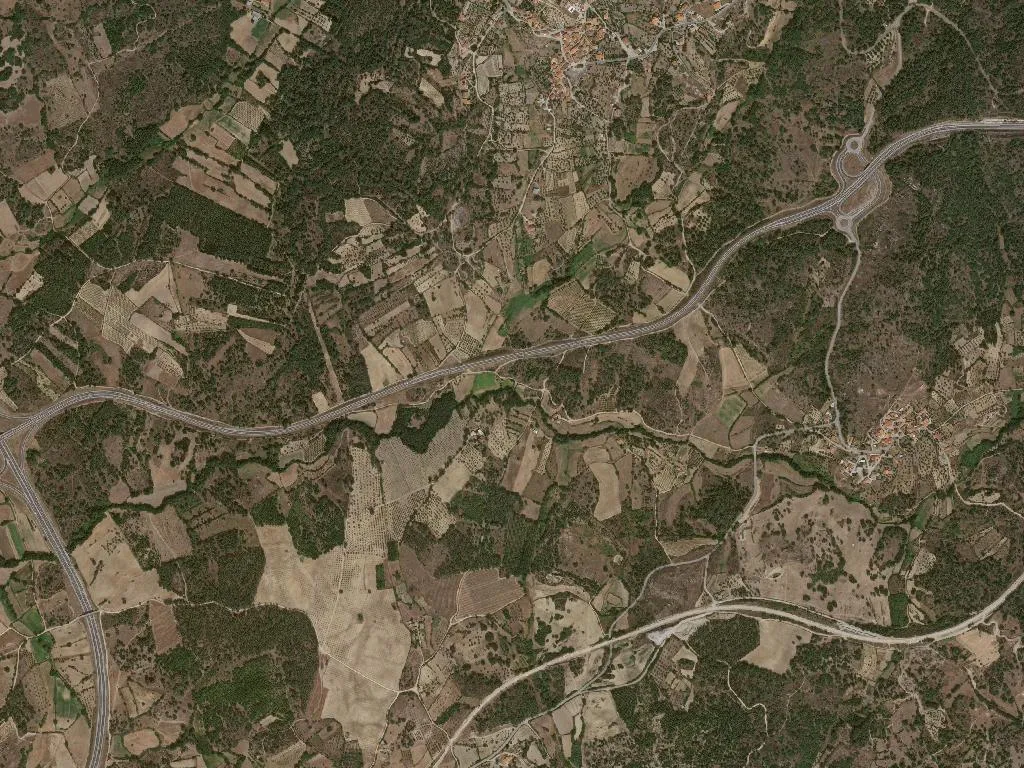
Dawn slips over the quartzite ridge of Serra da Broca and throws a ruler-straight shadow from every slate wall that divides the upland meadows. At 470 m the air is thin enough to carry the smell of damp schist and wood-smoke from the first fires of Vilares and Carnicães. Inside the stone dairies that punctuate the folds of the valley, sheep’s milk is still warm when it meets the wooden hoops that will coax it into Queijo Serra da Estrela DOP, a choreography unchanged since the 1700s.
Between Mondego and Douro
The ridge is more than scenery: it is the hydrological spine that drains one flank to the Mondego and the other to the Douro. Távora tributaries slide between Pyrenean oaks and solitary cork trees, carving micro-climates where strawberry-tree, rock-rose and heather flourish. On the limestone outcrops Apolo marbled-white and Spanish brassy-ringlet butterflies lift at knee-height along the rural footpaths, timed to the flowering of kidney-vetch. Walkers share the tracks with modern transhumance; shepherds still move 3,000 head between the Côa valley and these summer pastures under EU-certified routes.
Cheese rooms and high vines
Pastoralism has engineered the landscape as decisively as the Variscan orogeny. Lambs that graze the broom-covered slopes become Borrego Serra da Estrela DOP, while kids supply Cabrito da Beira IGP. Yet it is the milk economy that quietly underwrites the parish: every litre is funnelled into wheels of intense, butter-yellow cheese or into requeijão eaten warm, sprinkled with flor de sal. On terraced plots clawed from the hillside, night-time temperatures 8 °C below the daytime peak trap acidity in Touriga Nacional and Tinta Roriz, yielding Beira Interior reds that carry wild-thyme top-notes and a granite rasp. Come October, chestnut orchards drop their spiny globes; Castanha dos Soutos da Lapa DOP is fire-roasted, folded into azeviche pastries, or reduced into a dark, smoky jam that locals swirl into tawny port at dusk.
Stone paths and faith
The Inner Way of the Portuguese Camino cuts straight through the parish, stitching Vilares to Carnicães along five kilometres of worn schist already recorded in eighteenth-century ledgers as a transhumance corridor. Modern pilgrims pass dry-stone folds, granite calvaries and the odd wayside shrine smothered in ivy. In June 2021 the square of Carnicães hosted the national gathering of MARP – Rural Women Farmers – for seed-exchange workshops, botanical-distillations and moonlit talks on matriarchal land tenure. Their hand-drawn map of aromatic plants is now pinned inside the parish council room, opposite the 1630 baptismal font.
A silence that answers back
Three hundred and seven souls occupy 21 km² – a ratio that lets the land speak first. One hundred and thirty-eight are over 65; twenty-six under 15. Yet the arithmetic is not destiny. In the dairy where Luísa turns curd at 5 a.m., in the vineyard where Joaquim prunes by eye not app, in the evening class that teaches newcomers to distinguish wild oregano from pennyroyal, there is a quiet refusal to concede the skyline to bracken and ruin.
At twilight the perfume of roasting chestnuts drifts through open doorways. Inside Vilares’ only café, António pours bica into thick-rimmed porcelain and notes that the heather flowered ten days early this year. The hush is not absence but texture: the slow creak of a threshing-floor door, the tractor of Zé ascending a gear as it claws towards the fold, the red kite quartering the thermals overhead. Somewhere downhill a goat bell answers the church clock. Smoke from the nearest chimney rises vertical, as if holding its breath.