Full article about Custóias: Dawn over Douro terraces
Stone, silence and violet wine in a Guarda village of 191 souls
Hide article Read full article
Dawn on the granite
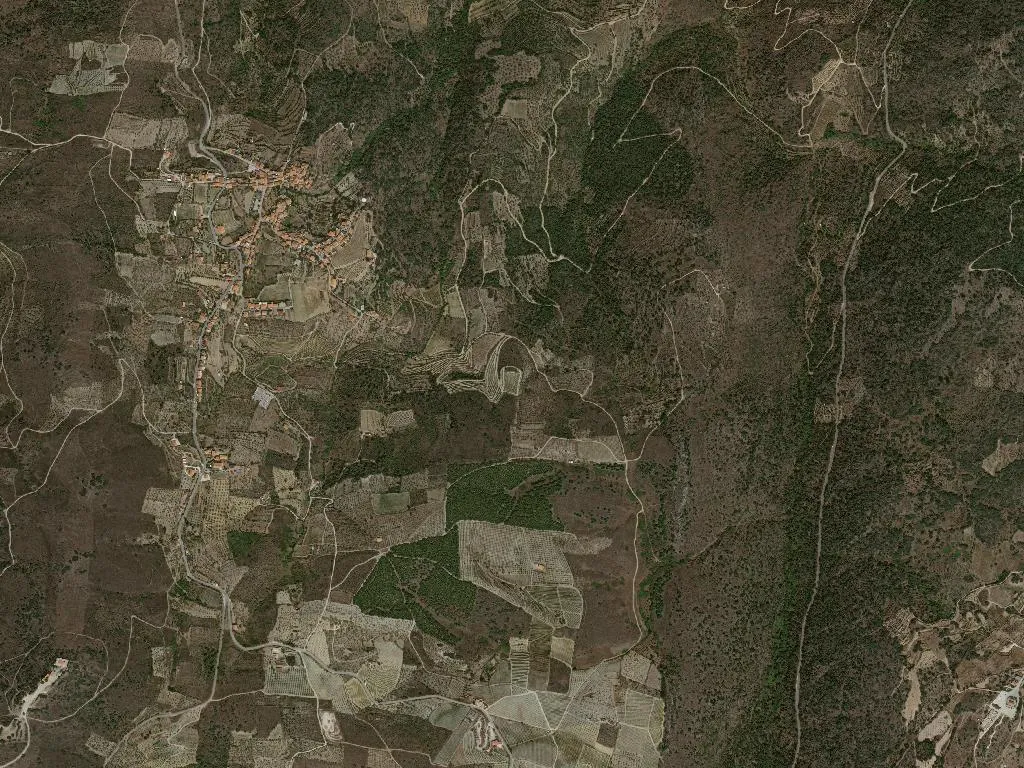
The first rays of sun hit the uneven slabs beside the 16th-century Igreja Matriz and the stone begins to exhale yesterday’s coolness. At 566 m, on a wind-scraped shelf of the Douro Superior, Custóias counts 191 residents, two cafés and one bus on weekdays. Vine terraces drop eastwards in disciplined rows; to the west, olive groves shimmer like pewter when the Atlantic wind arrives. Sound is measured here in negative space – a distant chain on a waterwheel, the single bark of a mongrel somewhere across the ravine.
A calendar of faith
Inside the church, reworked in the 1700s, the devotion is to Nossa Senhora da Veiga – Our Lady of the River Meadows – whose small chapel outside the village became a way-station for shepherds driving flocks between summer and winter pasture. One weekend each September her statue is shouldered down the lanes for the Festa da Padroeira: white-plastered walls bounce the high-summer light, voices ricochet off schist, and the air turns smoky with sardines basted over vine-prunings. The liturgy is unchanged since the 18th-century bishopric records kept in Lamego; the wine passed around after mass is modern Douro Superior – taut, violet, tasting of sun on slate.
Footprints on the Interior Way
The Portuguese Central Interior route of the Camino de Santiago cuts straight through the village square, way-marked with the familiar scallop. Pilgrims climb from the Côa valley on tracks originally carved for ox-carts hauling grapes to the river wharves. Each bend reveals geometry imposed on geography: centuries-old socalcos (contour terraces) drawn with ruler-like precision, white hamlets balanced on ridges, the Côa a silver filament far below. Even in March the sun feels Mediterranean; the wind, arriving over the Serra da Marofa, does not.
Tastes with postcodes
In kitchen larders Trás-os-Montes olive oil, DOP-protected since 1996, is kept in unlabelled tins for everyday use. Almonds from the Douro crack cleanly; Terrincho sheep’s-milk cheese, still patterned by the wicker moulds, smells of thyme the animals browsed on. Wood-fired kid acquires a crust the colour of burnt umber; Negrinha de Freixo olives, brined in the village, accompany either a youthful red from the nearby Quinta do Vale Meão or an unfortified Douro white whose acidity slices through the oil. Every flavour has a geographic boundary you can trace on an Instituto da Vinha e do Vinho map.
Palaeolithic echoes
Though UNESCO’s rock-art core lies 12 km downstream at Canada do Inferno, the presence of 25,000-year-old engravings changes the way you look at every outcrop here. Schist that seemed merely grey suddenly suggests the flank of a horse, a pregnant goat, an aurochs. Custóias itself has three documented panels – less spectacular, but enough to make locals glance at stones before sitting down for a rest. With only three children on the parish roll and 99 residents over the age of 65, collective memory feels as fragile as those pecked contours slowly weathering away.
By late afternoon the scent of oak and olive logs drifts from chimneys. Somewhere among the silver leaves a single cicada begins its mechanical rasp, and the church wall – warmed all day – starts to give its heat back to the cooling air.