Full article about Luz, Graciosa: church, vines & crater-top lunches
Above cobalt swells, black terraces nurse Verdelho vines by Igreja da Luz before crater-edge stews.
Hide article Read full article
The church that gives the island its bearings
A southwest wind lifts the taste of brine up the church steps. Below, black lava walls parcel the slope into miniature terraces where vines cling to basalt with the stubbornness of those who have known real thirst. The whitewash of Igreja de Nossa Senhora da Luz flashes against the cobalt of the channel; beyond, São Jorge’s silhouette lies like a charcoal smudge on a conservator’s paper. At 142 m above the Atlantic, the air is noticeably drier than anywhere else in the Azores—Graciosa receives barely 730 mm of rain a year, the archipelago’s lowest tally—and Luz drinks the deficit in every glass of wine it makes.
The eighteenth-century building that names the parish was raised between 1781 and 1787 on a natural podium visible from half the south coast. Azorean baroque shows its hand only in the curlicues above the door, the gilded cedar inside, the single flight of steps that turns the churchyard into an impromptu belvedere. Beside it, the red-and-white império do Divino Espírito Santo—a stone bandstand no larger than a London cab—remembers the Holy Ghost feasts when cauldrons of soup were ladled out to whoever arrived. The tradition still runs on the last Sunday of August, when the yard fills with wire-strung violas da terra and braguesas, women balancing trays of bolo de véspera (a citrus-flecked brioche), and men pouring thimblefuls of Verdelho drawn from stone-walled vineyards that almost dip their toes in the sea.
Lunch on the lip of a crater
Luz has no Michelin bib, no DOP label to flash, only the island rule of using everything and wasting nothing. Turnip broth sharpened with chouriço steadies January nights; molho de fígado, a cinnamon-dark liver stew, is ladled over Sunday’s massa sovada; cubes of home-reared pork crackle between the teeth, salt crystals still audible. Cow’s-milk cheese, cured for weeks in lava-basement larders, arrives with cornmeal bread; dessert is doce de gila, translucent shards of squash that dissolve like candied stained glass.
Walk twenty paces from the church and you are between vine walls again, the low parapets breaking the wind just enough for Verdelho to survive. Graciosa’s gentle 405-metre high point creates a rain-shadow that gifts the grapes their lemon-edge acidity. Drink a glass at 6 pm on a wall still holding the day’s heat, the channel flickering below, and you understand why viticulture persists on this shard of salt and cinders.
Up to where the island exhales
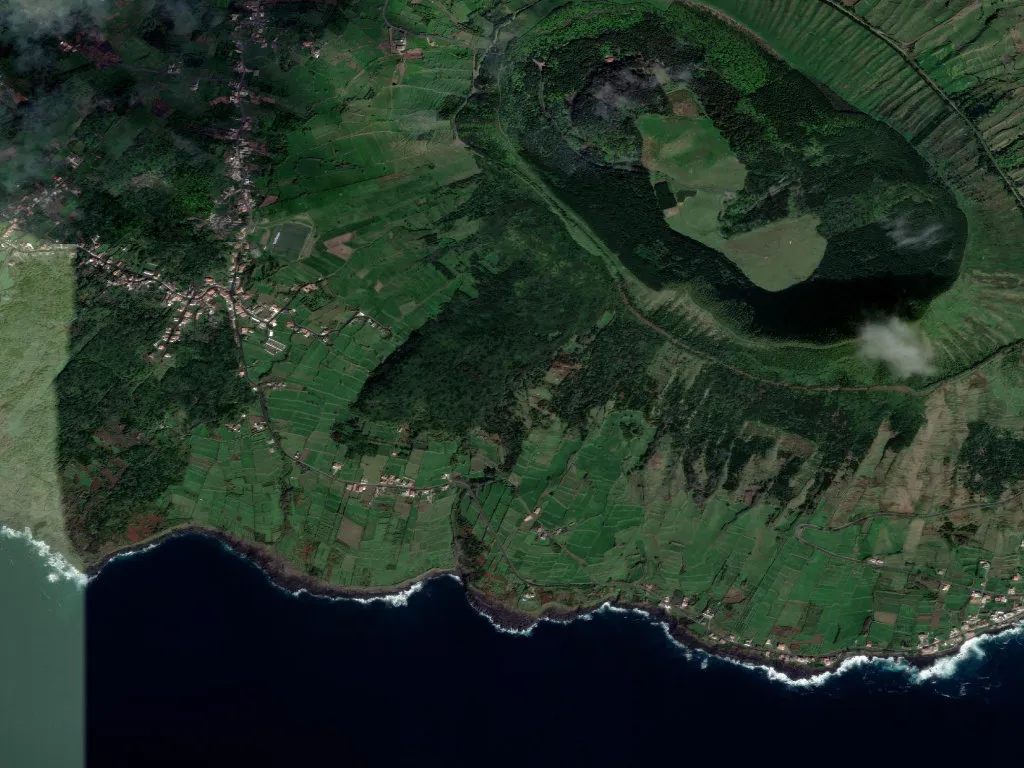
Trail GR01-GRA begins at the church gate, climbs the northern flank and loops 9.7 km through the island’s only tract of natural forest. Pittosporum and Azorean heather close overhead, filtering a green half-light where the only soundtrack is the wind and the goldcrest’s thin whistle—here the Regulus regulus sanctaemariae, a sub-species found nowhere else. Higher, pencil-thin juniper replaces the canopy and suddenly the Caldeira snaps open: a 1.6-km-wide, 405-metre-deep cauldron that looks less like a landscape than an anatomy lesson in the earth’s own breathing.
From the rim, Luz is a nativity scene assembled from basalt and whitewash. Its 631 residents occupy manor houses with painted wooden balconies, lanes so quiet you can identify the year of the distant tractor by the pitch of its diesel. Population density—53 souls per square kilometre—translates as space, the sort of unobstructed quiet that money can’t buy closer to Lisbon. When the slant light ignites the walls and the 1887 bell—cast on São Jorge island—calls out the Angelus, the note ricochets downhill until it dissolves into surf. At that moment it is clear: Luz does not simply steer sailors home. It calibrates the exact weight of silence for anyone still able to hear it.