Full article about São Mateus: Where a 1872 Bell Sings Over Volcanic Vineyards
São Mateus, Graciosa: 9-o’clock bell drifts over lava-walled vineyards, gilded church, 1753 fort and last wooden punts of the Azores.
Hide article Read full article
The nine-o’clock bell
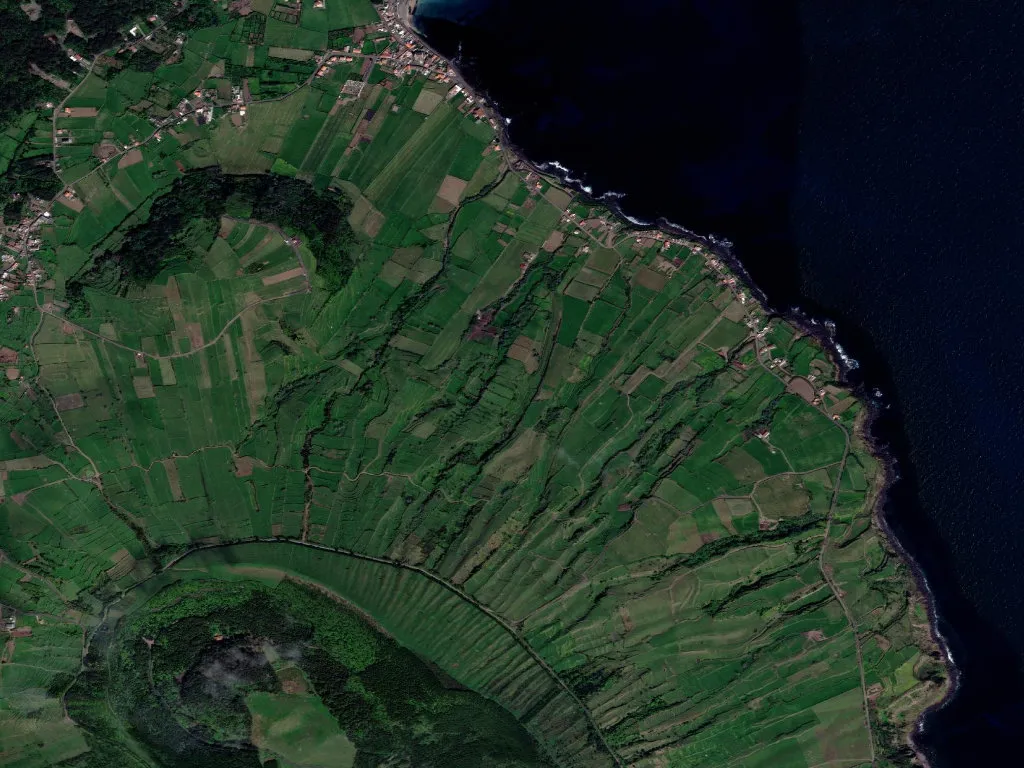
The bell of São Mateus parish church – cast in 1872 at Lisbon’s National Foundry with money donated by Captain António José de Melo, survivor of the brig Nossa Senhora da Luz – strikes at nine precisely and needs thirty seconds to die across the coastal plain. Its bronze note drifts over 42 ha of vineyard protected by the regional agriculture department as “lajido da Graciosa”, expiring only when it meets the basalt ramparts of Calheta harbour, where seven wooden punts painted blue and yellow bob at anchor.
Ballast stone and gilded wood
The church, rebuilt between 1746 and 1770 after the 1757 earthquake split its predecessor, paid for its gilded baroque retable in 1783 with twelve moios of wine shipped to Faial. The central panel shows Saint Matthew holding the Hebrew manuscript Liber generationis, a faithful copy of the 1640 codex once kept in the tower by parish priest Inácio de Silveira.
In the neighbouring hamlet of Relvas, the chapel of Nossa Senhora da Alegria was erected in 1970 on the exact spot where, in 1941, wooden bleachers stood for the first post-war tourada à corda. Holes for the uprights are still visible on the lava outcrops.
Fort São Mateus da Calheta, raised in 1753 (Royal Charter 12 April 1753), used 1,200 ballast blocks of basalt unloaded from the Sant’Ana, a Baltimore vessel that had called to load brandy. Two 8-pounder bronze guns, cast in Lisbon’s Arsenal in 1762 and stamped “JRF” for King José I, remain on the north-facing battery. Beside them, in Henrique Silveira’s workshop – the island’s only active boat-builders since 1984 – rests the mould of the “boca-de-forno” dinghy that fishes black conger 35 miles out on the Princess Alice Bank.
Light wine and liver stew
The registered label “Vinha da Graciosa” (Azores PGI, lot 2022) produced 18,000 bottles of white from verdelho and arinto grapes grown at Canada das Adegas, 80 m above sea level.
At Bar-Café “O Pescador” (14 Rua da Igreja) the liver stew is made with 400 g of veal liver from the Santa Clara cooperative in the next parish and greenhouse tomatoes grown by Amaro Jorge in Guadalupe. It simmers for exactly 55 minutes, timed by the wall clock the owner received in 1978 when he joined the merchant navy.
Between crater and sea
The parish trail PR17-GRA runs 4.3 km and climbs 190 m to Pico Timão (323 m). At km 2.1 it passes a dry-stone wall where, on 16 August 1994, naturalist João Monteiro recorded the first known Cory’s shearwater nest on Graciosa. From the viewpoint you look into the Caldeira, 1.6 km across and 270 m deep, formed 12,000 years ago; beyond it, the São Jorge channel lies 56 km away, and on foggy nights the Carapacho lighthouse flashes every 15 seconds as a reference point.
Rope bullfights and Holy Ghost soup
Touradas à corda are held on 15 July and 20 August; the 120 m hemp rope was replaced in 2023 by Cordoaria Oliveira on São Miguel.
On Pentecost Sunday the Brotherhood of the Holy Ghost dishes out 350 litres of bread soup (30 % maize bread, 70 % wheat, fennel and bay leaf from Guida Bettencourt’s garden) and 80 sweet buns baked in the church wood-fired oven at 220 °C for 22 minutes.
On 21 September the São Mateus procession leaves at 15:30, covers 850 m along Dr Silvestre, Igreja and Calheta streets, led by the “Progresso Graciosa” brass band (founded 1887) playing the island anthem “Ó Graciosa, Ilha Mimosa”, composed by Teófilo Braga in 1856.
At 19:45 in Calheta the “Vira da Graciosa” rings out from the improvised dance floor beside the pier; the church bell tolls again at 20:00, the exact hour in 1872 when the launch delivered the new bell from Lisbon.